
Regarding Soap, here are all of the posts grouped together! Read in one go or skip to:
- Soap: Fit the First
- Soap: Fit the Second
- Soap: Fit the Third
- On the Matter of Oyles
- Soap: Fit the Fourth
- Soap: Fit the Fifth
- Soap: Fit the Sixth
- Soap: Fit the Seventh; or Return of the (Soap) King
- Soap: Fit the Eighth (An Evening of Tragedies)
- Soap: Interregnum
- Soap: Fit the Ninth (Continuing Developments)
- Soap: Fit the Tenth (The Poor Decisions Are Unending)
- Soap: Fit the Eleventh (ex Arte, eat your heart out)
Originally posted on The Minor Hours and Small Thoughts Magazine (issues 32, 33, 34, 35, 36, 37, 40, and 41) and my regular blog.
Or! Head hack to the general Experimental Archaeology collection.
Regarding soap
Soap: Fit the First
It was 2022. I had attempted, and conquered, the 1711 recipe for lip pomatum.
It should be said at this point that a large portion of my inspiration came from watching a certain pirate show set in 1718, and during the course of said show there was the mention of exactly one household good: lavender soap. It therefore seemed natural that my next step toward apothecary tomfoolery was to find a recipe for lavender soap and master it as easily as I had the pomatum.
Gentle reader: I have been on this soap journey for two years now.
And if this is my madness, then by god, I shall make it yours as well.
To start us off: There are three things you need to know immediately about this supposed 1718 lavender soap.
1. It probably wasn’t completely “lavender” scented.
The majority of the extant recipes for scented soaps in and around Europe didn’t really do “single” scents– it was usually a fun mix of herbs, spices, resins, and unfortunate animal parts, with a base scent of one or more floral waters and oils.

Fig. 1. Regarding animal parts, please meet the musk deer; or, Sir Not Appearing In This Recipe;
or, “quick boys, get its semi-viscous-secretion-filled exocrine glands, we need ’em to smell fancy.”
As an example of one of these recipes, Sir Hugh Plat’s 1602 recipe in his Delightes for Ladies required orris root (dried and powdered iris rhizomes), cypress, “Calamus Aromaticus” (aka sweet flag, aka a psychotropic, hooray), rose leaves, lavender flowers (finally), and rosewater. This big mix of yummy smells, common plants, and very very expensive and imported ingredients is fairly in keeping with most of the scented soap recipes I’ve been able to find for this time period.
2. The first step in making scented soap… was to buy some plain white soap.
So far as I can tell, all extant European recipes for scented soap are basically the household equivalent of doctoring your instant ramen noodles. Very briefly: Western soap was harsh, mostly good for laundry, soft or liquid even if salted to solidify it, was made with smelly animal fats, and wouldn’t take pretty herbal scents worth a damn. (It was also called “black soap” because of the color of the potash lye used to make it.)
But over in Syria, and brought to the rest of the Mediterranean and elsewhere via the Silk Road, was this amazing stuff called Aleppo soap– and it was golden-white, solid, gentle on the skin, almost scentless, and could be mixed with herbs and spices and icky animal parts to smell very fancy indeed.
Of course, people in the West wanted it badly because it was great, but it was also incredibly expensive, so there was Big Business in backwards engineering it– which a bunch of European coastal cities and countries with access to high quality olive oil and the ability to make soda ash (a significantly gentler cousin to potash) managed to do, including Castile, Spain, Marseilles, France, and Venice, Italy.
Soap recipes from early 1700s and earlier predominantly start with some amount of “Venetian Soap”– spellings of which might also be “Venice-Sope”, “Venise sope”, “Saponis Veneti”, etc. The goal was basically to start with a white hard soap, and Venice wasn’t the only place that had it, but it made for a useful shorthand. Other soaps that seem to have occupied the same ecological niche were “Spanish”, “Castle”, “Saracen”, “French”… and, of course, “Castile”, which seems to have become today what Venetian Soap once was: a shorthand for olive oil soap.

Fig. 2. The earliest reference I’ve found so far to Venetian Soap, from a 1558 translation
of an earlier work– though this image in particular is from a 1595 edition.
Evidently, Step 1 to modern recreations of 1710s lavender soap was “buy some very fancy olive oil soap.”
But before that, one last fact needs to be revealed…
3. The finished, scented soaps were called WASH BALLS.
Yes, some recipes were just called “a white sweet Soap” or “a muskified Soap”– but the majority were labeled “a delicate washing ball”, “washing balls”, “an Excellent Wash-ball”, “Perfumed Wash Balls”, etc.
(I feel fine about this. I do not giggle when discussing it. I do not waggle my eyebrows and lower my voice when offering to show them to others. I am at all times very mature.)
So far as I can tell, they were called wash balls because the remade Venetian soaps were typically, well, spherical, for reasons that are mostly guesses on my part but amuse me anyway. For size reference, though, “little” balls were listed in 1706’s Bate’s Dispensatory as being about 2 or 3 ounces in weight, so we can imagine a regular size ball as being about 4 or 5 ounces (as a reference, a bar of modern Dove soap is 4.75 ounces).
They could also, according to Simon Barbe’s 1696 The French Perfumer, be stamped with a sigil and have a delicate gold leaf applied to the raised edges afterwards to make them super fancy, and if you think I’m going to just ignore that opportunity to be So Much Extra, then hooboy, you have not been paying attention to my entire, like, jam.
Soap: Fit the Second
I wanted to keep my plan for recreating (or more accurately, creating) lavender soap simple, which was only helped by the scant description I had to work with amounting to all of three words: “yummy lavender soap”.
“Yummy” here is obviously “very very nice”, not a quality of its taste, just as the “sweet Soap” referenced in at least one extant recipe refers to the scent and quality, and, again, not the taste.
(Although… there were recommendations in the manuals of the time that the soapmakers taste the soap mixes and the lye to determine whether they were cooking correctly. So… make of that what you will.)
Anyway, if it’s yummy and it’s scented, it’s going to be that nice solid white soap, and likely shaped into a ball. And, if I was going to be Accurate, I needed to buy some.
Stateside, the closest I could easily find to a period-accurate formulation was “Kiss My Face” brand olive oil soap– hilarious to imagine, but it’s green in color, which is Not what soap made from very high quality olive oil that’s been allowed to dry and age properly should be– so I said to hell with the inherent humor of the brand name and instead went really method: Say hello to Nabulsi soap, a next-door neighbor to Aleppo soap.
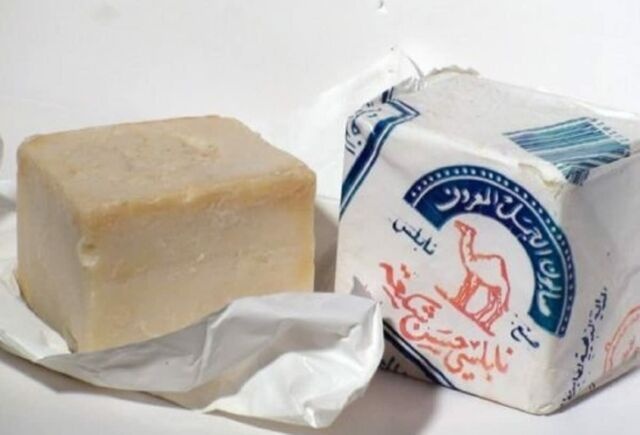
Fig. 1. What up, boys.
Nabulsi soap’s been made the same way for centuries, with the same ingredients– and unlike Aleppo soap, which has laurel berry oil (an ingredient Western soapmakers apparently did not successfully discover as part of their backwards engineering), Nabulsi soap is closer in ingredients and process to what the Western soapmakers were doing than just about anything else I could easily get my hands on.
(In particular, I think Nabulsi soap is still made with soda ash made from barilla, a salt-tolerant Mediterranean plant that was a key reason why these soaps were fucking amazing. Barilla farming and soda ash production was big business until 1792 when Nicolas Leblanc decided to personally ruin my dreams by discovering a way to artificially create sodium carbonate – the primary active ingredient in soda ash – thereby causing the collapse of barilla farming and my current inability to order barilla lye online.)

Fig. 2. That asshole.
Anyway, I figured Nabulsi soap was just as likely to show up as an expensive ingredient in an apothecary shop as any other soda-ash-and-olive-oil soap, and a lot closer to whatever a 1710s household would’ve used than more modern soaps. So, gentle reader, I bought some.
Most of the recipes I found required that the white soap be scraped or grated and then left in the sun for several days. Behold, in progress:
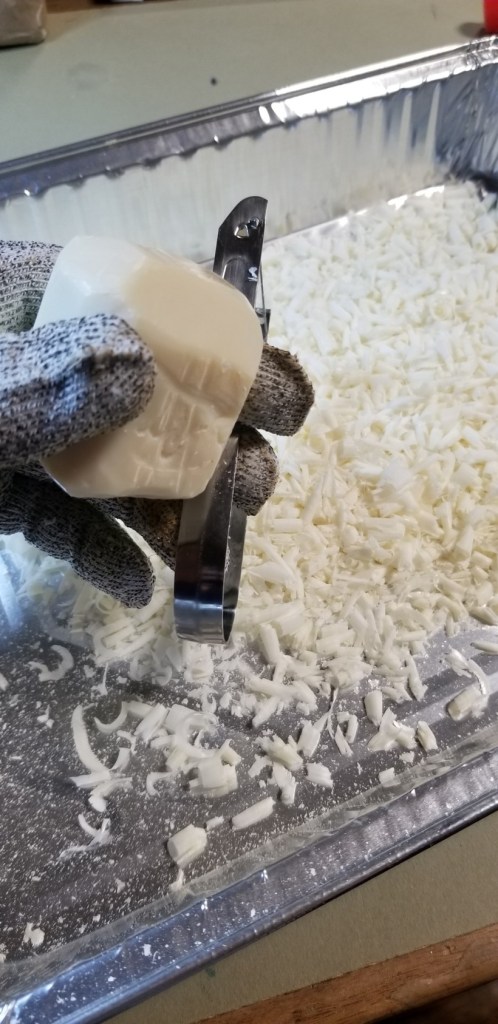
Fig. 3. A partially scraped bar of Nabulsi soap, a potato peeler, a “holy shit don’t cut yourself” safety glove, and thou.
These wee monsters took maybe an hour to scrape down, but I switched off frequently with my younger child, who would’ve apparently been the one Victorian kid who volunteered to spend all day at the factory, so your mileage may vary.
I would say that Nabulsi soap isn’t entirely scentless, but what scent it has is very light and fresh, not at all overpowering or chemical-ly. In future, I’m going to try a cheese grater or, if the gods smile upon me, a microplane.
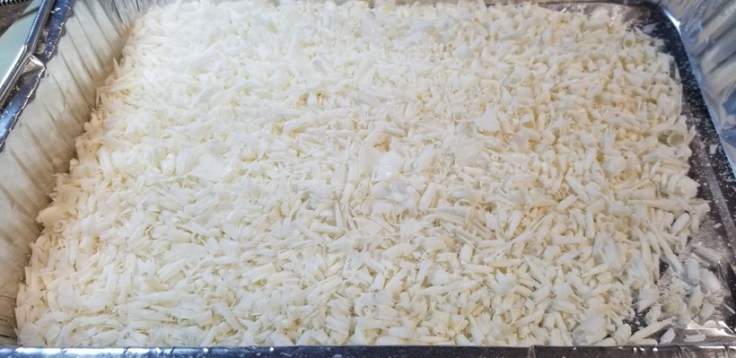
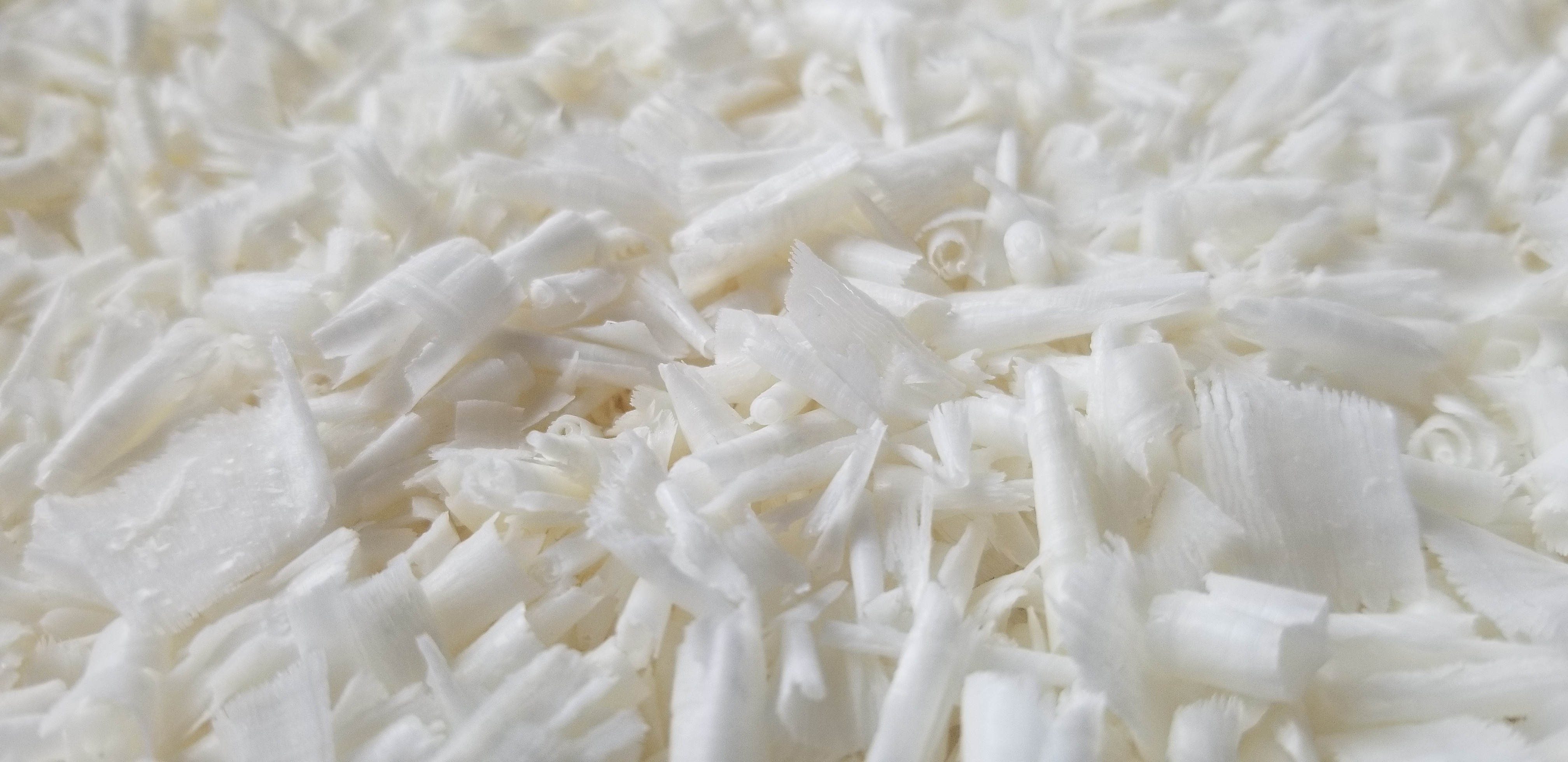
Fig. 4. The entire 7 ounce bar, reduced to smithereens.
This tray was then lightly covered with a see-through lid and in a sunny location in my studio– per Wecker/Culpepper’s 1660 Cosmeticks, I’d leave it to dry like that for the next 6 to 10 days (though I’d planned to stir it every couple of days, to ensure it was equally… whatevered).
While I waited on the soap, though, I knew I should turn my attention to the final riddle: “lavender”… next time.
Soap: Fit the Third
Lavender is a toughie, ingredient-wise– it wasn’t the herbal most frequently added. Powdered orris root (Iris rhizomes), cloves, and storax resins (like bezoin, liquid storax, labdanum, and their various offshoots and adulterated variants) were the usual culprits. A couple of recipes called for lavender flowers, but certainly not the majority, and rosewater was usually what would be added to that dried, grated Venetian Soap when the soapmaker was ready to reform it into wash balls.
In fact, scent-wise… cloves smell spicy/sweet/warm, the various resins all apparently smell warm and vanilla-y, and orris root smells “sweet, soft, powdery, suede-like”– so lavender, which actually has a huge spectrum of possible scents depending on the variety used, might either soften the soap’s entire scent profile or kick it into spicy overdrive. But without the lavender, I did wonder if, somehow, this would be yet another historical cosmetic that somehow smelled like COOKIES.
But! We are attempting to create a specific fictional soap here, so lavender it is– and of a sufficient quantity that it would be specifically identified as the lavender soap.
While the majority of recipes call for the grated soap to be reconstituted with rosewater, both Wecker’s 1660 Cosmeticks and Salmon’s 1685 Polygraphice mention using Oil of Spike in addition to or replacing the rosewater. Oil of Spike was made of spike lavender (Lavandula latifolia), which seems to be one of the spicier lavender boys. I, tragically, did not have spike lavender or store-bought Oil of Spike readily to hand– but I did have some dried French lavender (Lavandula stoechas), several bottles of free olive oil I’d gotten as part of a friend’s pantry cleanout, a recipe from 1623, and too much time on my hands, SO GUESS WHAT:
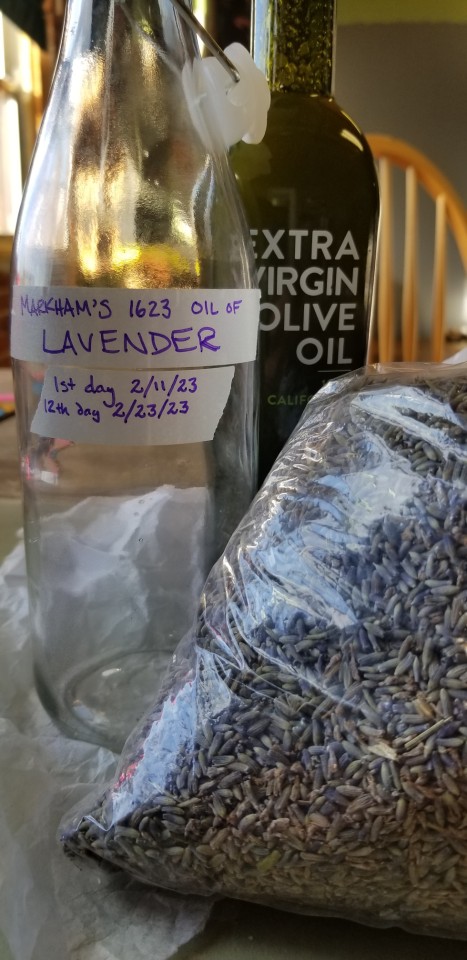
Fig. 1. Local over-invested idiot decides, why the heckity-heck not?
Let’s make some dang Oil of Lavender.
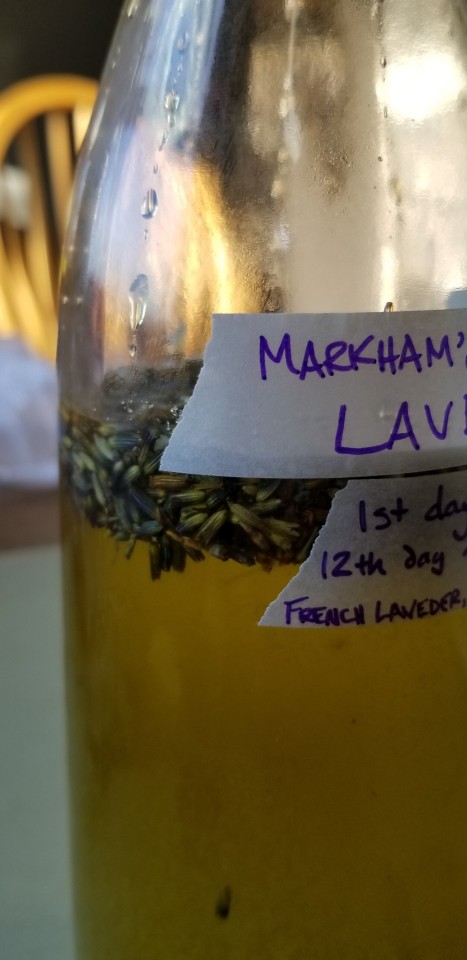
Fig. 2. Local over-invested idiot sees no reason to be concerned
about current life choices, hobbies, use of time and effort.
The recipe is from Markham’s The English Hus-wife, and it’s its own delightful adventure– but once I’d drafted this oil, I was then stuck waiting ten days for the soap to dry and twelve days for the lavender oil to cure.
…and so we leave it here, returning to it again Next Time.
On the Matter of Oyles
When originally writing up the Adventures of the Oil of Lavender above, a question was raised by a friendly reader: “Did soapmakers more often use infused oil such as [the] 1623 recipe, or essential oil (extracted e.g. by steam distillation)?”
To which I answered: GOOD QUESTION.
The fun thing about doing all this historical research is that: I had no clue. But I was genuinely excited to spend the next four hours figuring it out and writing up the results.
So. Our first problem, in the particular, is that soap recipes in Europe weren’t particularly well recorded for a good span of time. This seems to be a combination of the recipes for the Very Nice Stuff being protected by soapmaker guilds, and soap becoming taxed in England starting in 1712 (leading to very closely monitored manufacturing and a lack of later-published works describing how to make it from the bottom up, as it were).
This is why, in my opinion, so much of this research seems to turn up either very old recipes (before the introduction of hard white soap) or recipes that start with “buy the expensive thing first and then just, uh, doctor it up a bit for home use, no selling it, nope, not us.” (Sometimes the recipes say to use very old white soap and I’m just like– is that actually important? Or is it because it implies that any soap you have around would be from before it was taxable? NO IDEA.)
Our second problem, in the more general sense, is that a pile of these recipes, particularly the later ones, assume a base level of knowledge by the practitioner. I have more than once recently found myself referencing the wisdom of our cultural touchstone, Schitt’s Creek:
-Moira: Next step is to fold in the cheese.
-David: What does that mean? What does “fold in the cheese” mean?
“Fold in the cheese” has a meaning we can sort of guess at… but there is a particular meaning to it in cooking that is, to the uninitiated, a secret action that, if one skips, may lead to an imperfect rendition of the desired foodstuff.
Similarly, at least two of these wash ball recipes call for labdanum, a gummy resin thing whose scent is described as “amber, animalic, sweet, fruity, woody, ambergris, dry musk, or leathery”. Nice, right?
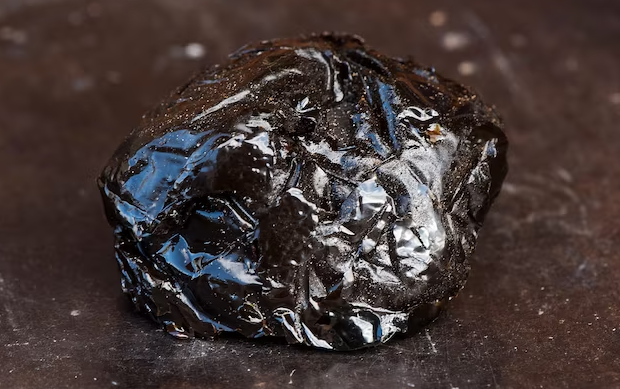
Fig. 1. Sticky goo that had historically been combed from the beards and thighs of goats and sheep
that om nom’d shrubs of the cistus family. So, you know, that’s a thing.
Most of these recipes require the use of a mortar and pestle, and at least one of the recipes say that you need to smack it into powder. So I did a search to see how to do that, what with “sticky” not traditionally being an immediate transitory state to “powder”. And with the incredibly in-depth research I did via, ta da, the first result on Google, I found that modern amateurs like myself pretty much… don’t. Maybe we freeze it first? Or we just skip the “powder” and buy a professionally separated scent thingy from a company, because clearly Machinery and also maybe Chemicals are needed for this process.
Which doesn’t make a lot of sense when you consider that this was apparently bog-standard practice by dorks like me five hundred years ago.
What I’ve since found, though, and why my household journal is starting to look more and more like some kind of glitter-highlighted grimoire, is that there are oodles of books of useful how-to’s like Lémery’s 1686 English edition of A Course of Chymistry and Charas’s 1678 English edition of The Royal Pharmacopœea, which provide breakdowns of a lot of these “known to them but not to us” knowledge gaps– but, additionally, there are sometimes just little “oh, by the way, here’s how you fold cheese, in case you ever need to do that” asides that don’t seem to exist anywhere else hiding in the most unexpected of places (looking at you, Salmon’s 1683 Doron Medicum and its absolutely random table of “common ratios” for just about any/all cosmetics I’ve come across and the order you’re supposed to add them like okay, man, fine).
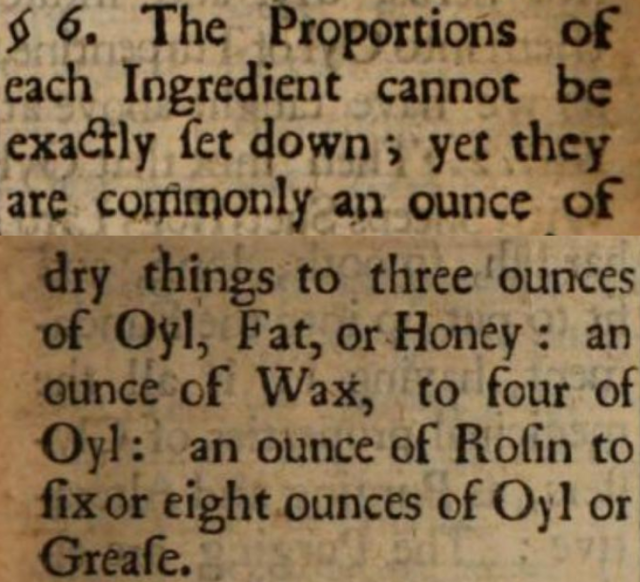
Fig. 2. Here you go. The common ratios. Hanging out on pages 112-113
at the end of a section about how to make emplasters, as so many of us need to do these days.
Oh, and the answer to how to powder labdanum and anything else your little alchemical heart may desire? That’s chapter 14 of The Royal Pharmacopœea, “Of Trituration, or Beating in a Morter”. You’re welcome.
Anyway. Oils.
The short answer is… yes, they sort of had essential oils, but no, they weren’t “essential” or even necessarily the best way to maintain the virtue of a particular ingredient, so it wasn’t valued the same way we value them now.
The longer answer: HUMORISM.
(It’s always humoral theory. It’s humoral theory all the way down)

Fig. 3. Get wrecked, germ theory.
Galenical medicine (e.g., HUMORISM) believed a lot in the idea that everything has an innate sort of value or virtue, and that the best way to get at that virtue was to extract it or distill it or infuse other things with it in the way most likely to maintain that virtue and allow it to be passed on to the patient/customer/family/self.
Anyway, ingredients were considered cold or hot and wet or dry, each to varying degrees, and how you prepared them for use absolutely depended on that information. Lémery says lavender oil can be prepared the same way as aniseed oil is (distilled multiple times in an alembic), and aniseed is, according to Sir Elyot’s 1534 The Castel of Helth, apparently “hotte and drye in the thyrde degree”, so lavender’s virtue wouldn’t suffer in a distilling situation.
So in short, yes, probably we could distill Lavender Oil using the tools available back then to make a very credible essential lavender oil now, but… if you look at the rest of Lémery’s description, what you see is basically the making of a very oil-infused (and possibly fermented?) water. They just… didn’t seem to do essential oils the way we do. This is further backed up by William Salmon again when, earlier in Doron Medicum, he has a section specifically describing how to make or prepare “oyls”:
1. If it be from hot Herbs, dry them, and infuse them twenty, forty, sixty, or a hundred days in good Oyl of Turpentine, or Amber; then strain and press them out, repeating the Infusion if you please, two or three times; lastly, mix this straining with double quantity of Oyl Olive, and keep it for use.
2. But if from cold Herbs, take there expressed Juice, and boyl it in an equal quantity of Oyl Olive, to the Consumption of the Humidity, then strain, and keep it for use.
So, in conclusion: Maybe soapmakers did use essential oils? But probably not. And while I was making the wimpy (possibly even the super-cheap) recipe for Oil of Lavender this time, the next one up the ladder in terms of fanciness involved just boiling lavender flowers in a 50/50 wine and water mix with sesame oil and boiling it down to… what appears to be a liquor rather than an oil. Again. So no version of my lavender soap is going to be as lavender-ish as we would get with a modern– or even pre-modern– essential oil. Getting a really strong lavender scent using traditional recipes is tough.
Unless, of course, I get an alembick.
Which. I’m pretty sure. I should be allowed to get.
Soap: Fit the Fourth
(Also known as “Cursed once again with A TERRIBLE DISCOVERY.”)
Let us return again to the story of the lavender soap, continuing from the previous essay.
The Scraped Soap
Look at this beautiful pile.
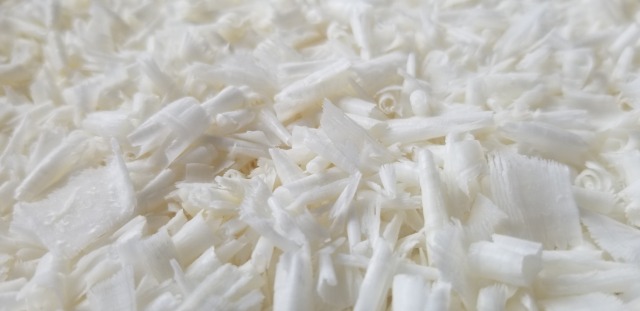
Fig. 1. God’s own pencil shavings.
After drying, lightly covered, in the sun for fourteen days, the scraped soap was indeed pretty dry, even though I definitely forgot to stir ’em up. The smell was light and, I would say, kind of… milky? It was definitely soap, but it was like it was subtly spelling out the word “~gentle~” in my brain every time I gave it a sniff.
Time to Make Up a Recipe
As I may have mentioned before, there are a lot of recipes for wash-balls, and their ingredients range from “regular spice cabinet stuff” to “what in the world is ‘Benjamin’”.
But! Because I was still at the “let’s close our eyes and throw stuff in the pot at random” stage of experimentation, and do not want to spend Lots of Money on something I would subsequently Explode Tremendously, I went through a three-step process to determine my version 1.0 recipe.
- Step 1. What do I already have in supply?
I went through the recipes I’d collected so far for this project (about twelve– not a lot, to be honest, but good enough for now) and made a list of: the ingredients I had around already; what books mentioned them; and if I was very lucky, the amounts of each ingredient those recipes listed.
![Screencap of a portion of a recipe from William Salmon's Polygraphice (published 1685). The cut-off text reads, with modernized spelling for the purposes of this ID: "Cut it [the Venetian Soap] small, to which put some Rose-water, or other perfuming water, boil them a while, then"](https://katherinecrighton.com/wp-content/uploads/2026/10/d63aa3039ab5c799d8eb1f6068815a9852779f07.png)
Fig. 2. C’mon, William Salmon, what am I supposed to do with “some” Rose-water,
how long is “a while,” why are you like this.
- Step 2. Take away the outliers.
From that I subtracted the ingredients that only showed up in one recipe, on the grounds that maybe they were oddballs or actually specific to a particular effect the maker was trying to achieve. So farewell, marjoram and rose-flowers, we hardly knew ye.
I also got rid of at least one ingredient because– well, it showed up in more than one recipe, and it’s something I had around, but… it seemed somewhat random. Surely cornstarch (“Starch-corn”) couldn’t be that important.
…Reader, put a pin in that.
- Step 3. Normalize (or straight-up guess) at amounts.
Because I went with ingredients that appear in multiple recipes, I ended up with a lot of different possible amounts for each ingredient. But using the goal of lavender soap as my guide, I ended up with the following:
Version 1.0
7 oz. dried soap
1 oz. whole cloves, ground fresh
1 handful dried French lavender flowers, ground fresh
rosewater, q.s.
Oh! Welcome to some cool apothecary info: If you see “q.s.” in a recipe, it means “as much as is sufficient.” Thank you, Moyse Charas, you absolute hero, for reaching 345 years into the future to hand me half a clue. I love you.
Time to Guess at a Process
Want another apothecary fact? If you see “s.a.” or “ex Arte” in a recipe, it means “According to Art.”
Or. Hear me out. It sometimes. Sometimes. Means “now do the thing that you were definitely taught by an expert in real life because you definitely won’t be given any hints here. Nerd.”
…I am willing to accept that maybe this is also just an “oh, everyone knows how to fold in the cheese” kind of thing when a “s.a.” shows up. But only because I can’t definitively prove that sometimes these writers were just assholes.
All this to say: you are about to see me get. Very, very wrecked.
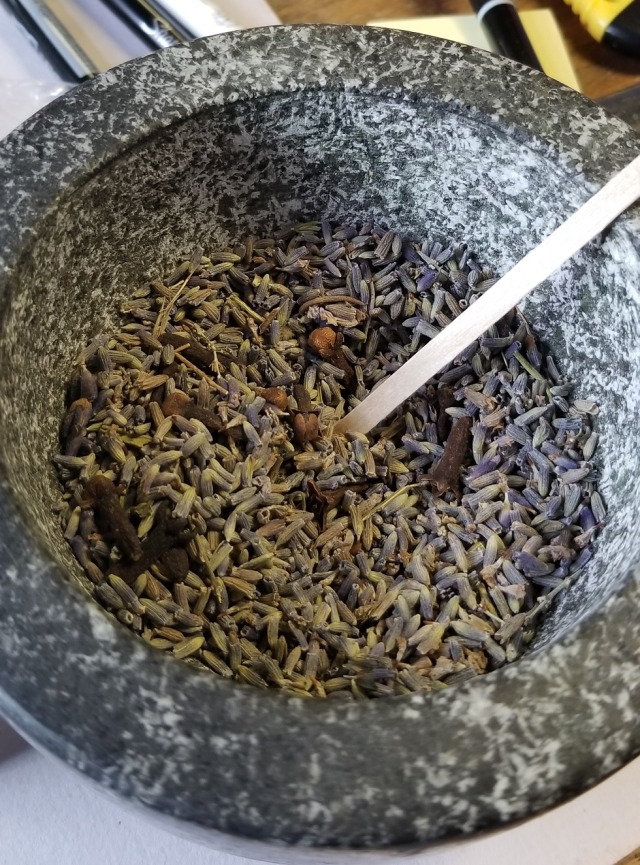
Fig. 3. Cloves and lavender in the mortar.

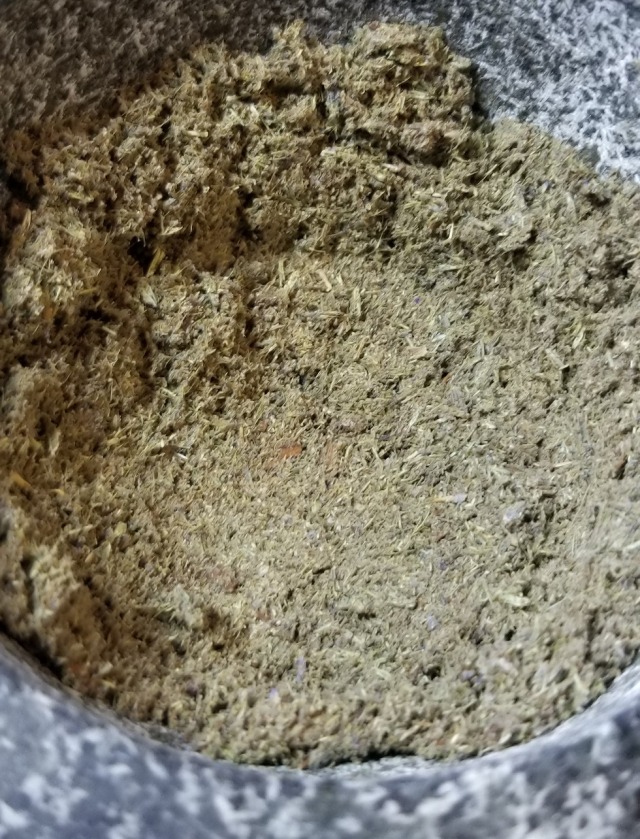
Fig.s 4 and 5. Grindy grindy. As a note, cloves require crunching with the pestle before you can really get a good grind on.
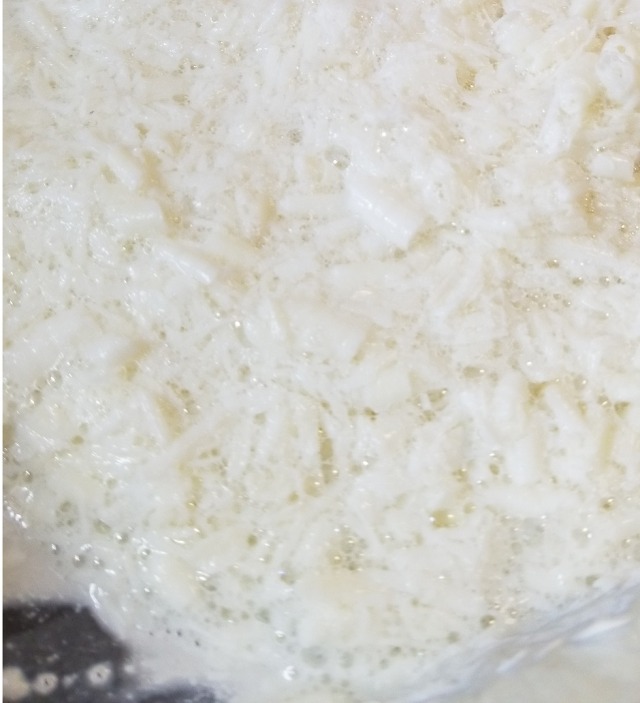

Fig.s 6 and 7. Dampen the dried soap with rosewater… oh god. That… that might be too much rosewater.
Hannah Woolley (1670) was the only writer to mention using your hands at any point while making these balls, but, uh, surely she wouldn’t lead me astray. Surely.
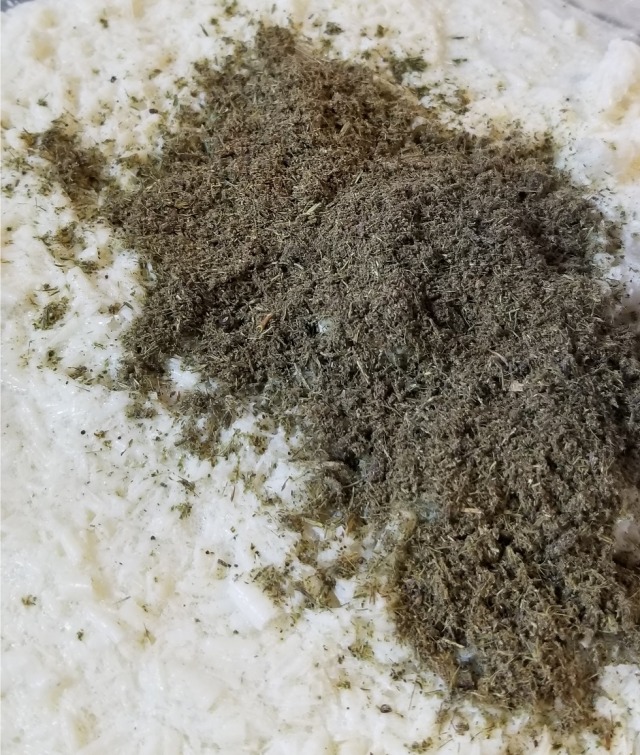
Fig. 8. Maybe adding the powdered lavender and cloves will help soak up the excess!
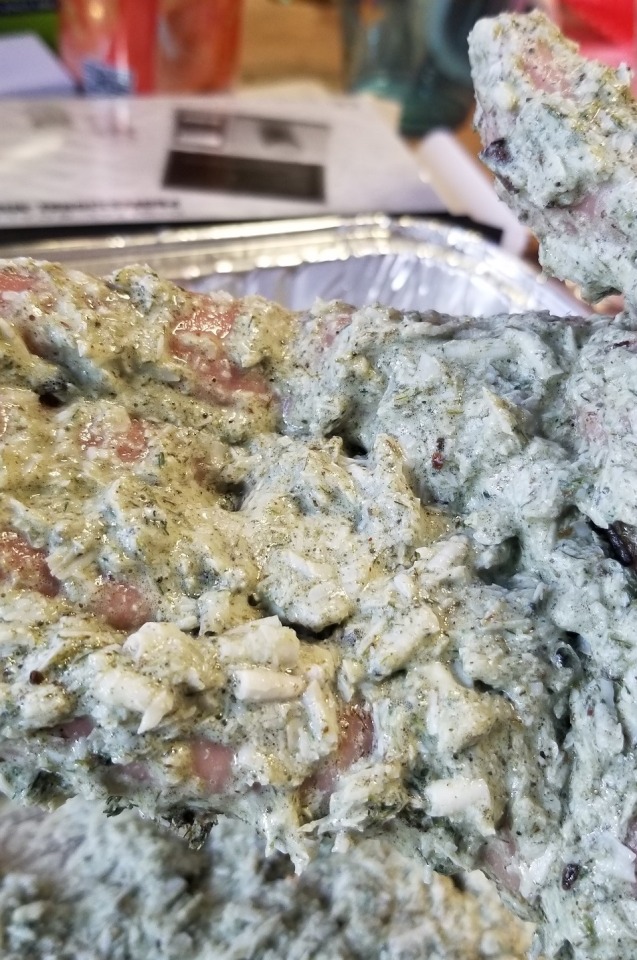
Fig. 9. JESUS CHRIST MY HAND HAS BEEN EATEN BY A GREEN THING.
Hannah Woolley, come outside, I just wanna talk.
Leaving aside my new life as a swamp gremlin, it should be noted that this and subsequent photographs makes it appear as if the mix was, perhaps, a very light green color.
Let me just say: No. I could, at my kindest, call it maybe a heathered green. But it would also not be inaccurate to call it a very, uh, herbal green.
So by this point in the proceedings, the very green mixture was both declining to get particularly dry and was also sticking like hell to my hands.
It was then, like a gift from my already-overburdened memory banks, that I remembered: cornstarch.
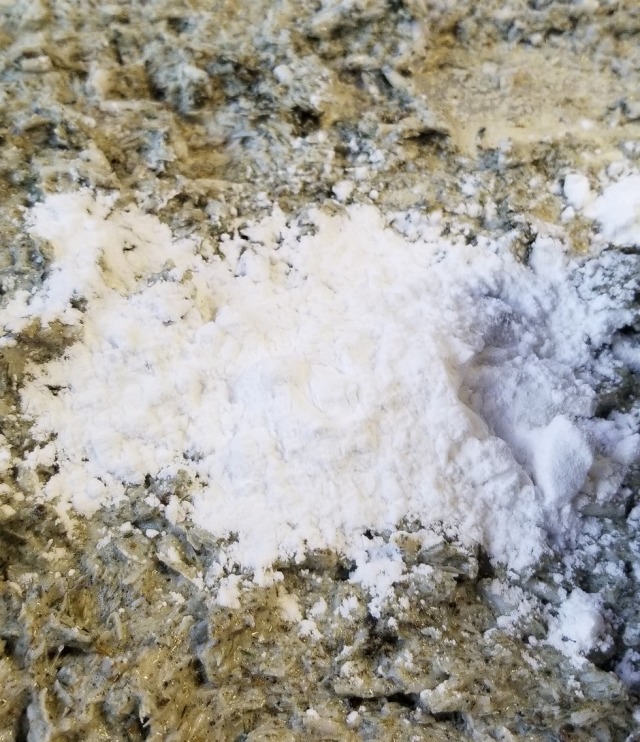
Fig. 10. Okay, not cornstarch. Sorry. It’s arrowroot powder again. IT’S WHAT I HAD NEARBY.
I… may have dumped in the arrowroot at least twice more. No photos, no proof, you’ll never catch me, coppers.
With the arrowroot worked in, though, I finally got enough oomph to start forming balls with the stuff. And, as if my grandmother rose from the grave to try and once again teach me how to make her special Easter cookies, I started rolling the soap in my palms to form the balls… and I suddenly remembered that trick where you flour your hands when you work with dough. To keep it from sticking to your skin.
I was a bit late off the mark, but I did manage to at least partially flour my hands with the arrowroot, and that helped considerably with actually making the ridiculous things. The large volume of cornstarch mentioned, but not explained, in any of my collected recipes was now justified.
(EX ARTE, EAT YOUR HEART OUT.)
Leaving us with:
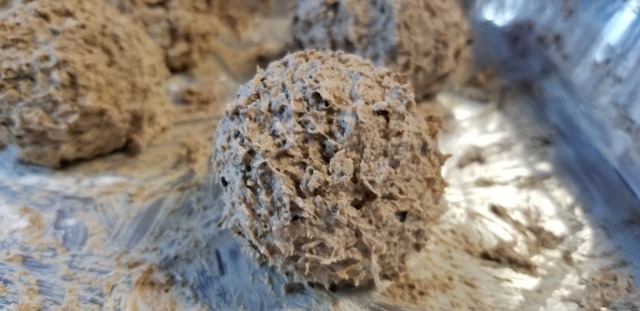
Fig. 11. A goddamn lavender wash-ball.
I ended up making five-and-a-mini little wash-balls, which are technically too small overall, but whatever, this is still Experimentation Time. They are now, per various process notes in various recipes, drying again in a shaded location. For how long? Dunno. We’re gonna find out.
The outside, as you can see, was rough as hell (though, when I was rinsing the mix off my hands afterward, there was a pleasant abrasive quality to it), but some of the recipes suggest that maybe you’re supposed to smooth it out a little after it finishes drying with some rosewater. BUT. I am also considered whether this might be a use for: THE OIL OF LAVENDER. (Aw yiss, full circle.) It was an exciting prospect.
Anyway, I intended on checking on these wee balls in a few days and to see what was up. It would be an adventure.
So the stickiness and the green and the cornstarch thing– those were the “terrible discoveries” you made?
Hm? What?
From the alternate title of the update. The “terrible discovery,” all-caps, that you’re cursed with.
…
Look.
This keeps happening.
The last time I made a historical self-care extravagance, I thought it would smell like oranges. This time, I hoped it would smell like lavender.
And you know what I got instead, both damn times?
COOKIES.
Soap: Fit the Fifth
You have been so brave up till now. We’ve all seen it, and the Editors have made note of it. You have read through each soap update, following along with the experimentation and pinball research, and have been willing to row along with my nonsense cheerfully and without complaint.
Take my hand. You’re going to need some support through this, and I want to be there for you as you experience this new update:
Sometimes Science Gets Ugly
Let me begin by saying there’s going to be a significant glow-up at the end of this article. And that I have learned many lessons during this particular update, thus validating this entire experience as deeply educational. For all of us.
- Lesson 1: Past performance is not necessarily indicative of future results.
I am now in the dubious position of really understanding that the lip balm experiment— which only had two explosions during its making and was almost entirely useable within minutes of completion– was, perhaps, an outlier when it came to the true nature of experimental archaeology.
- Lesson 2: The scientific method exists for a reason.
Much like working on a farm leads to a greater understanding of where one’s food comes from, so too, for me, does going through multiple rounds of Renaissance/Baroque-era European soapmaking lead to an understanding of how exactly the Scientific Revolution came to be.
Because (according to Wikipedia) what I’ve been reading in all these books and treatises and random household manuals from the 16th, 17th, and very very early 18th century is, essentially, the development of systematic experimentation to figure out Stuff. I have, unknowingly, been going along the same journey along with these folks from 300+ years ago, which makes me Feel Some Things, Okay.
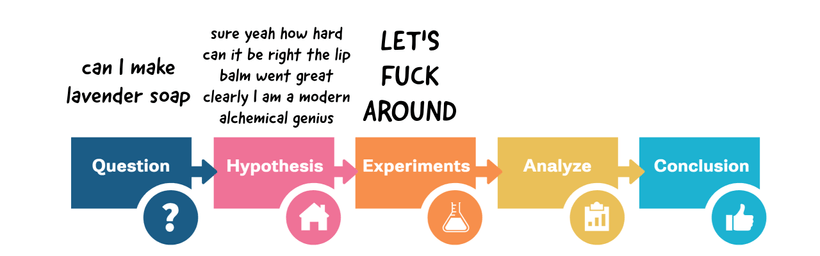
Figure 1. The Editors having a whole scientific revolution of their own, this will go great, no worries.
- Lesson 3: Even a failed experiment can have value.
As I was supposed to have learned in elementary school and am instead realizing in my forties: Fucking up isn’t a bug, it’s a feature.
For instance– just for instance– a failed experiment can still, say, induce such paroxysms of giggles in those who don’t expect its appearance that if we consider the joy that a first round of experimentation can bring to others– never mind what exactly that joy is in honor of— surely we can count said experiment as an unalloyed success.
And with this in mind, let me show you what our green, cookie-scented lavender soap looked like after drying for 8 days:
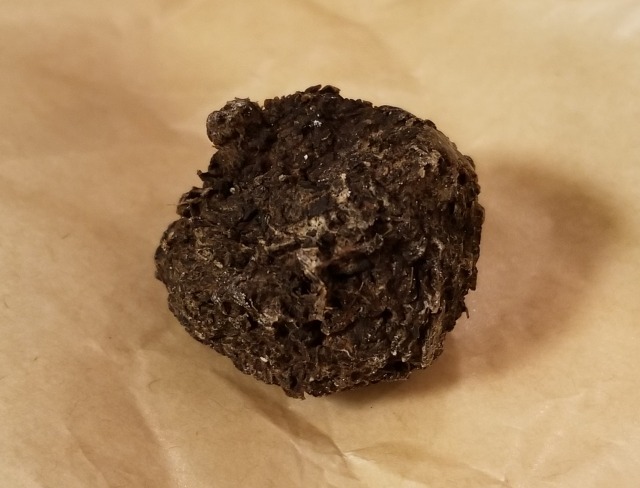
Figure 2. Welp.
(I NEED YOU TO REMEMBER THE GLOW-UP, OKAY, THIS IS NOT THE END.)
(it just… it just looks like it is.)
Anyway. This is the smallest of the wash balls, the one about the size of the end of my thumb. It had the least surface area, so was the driest. Lest you think the others had been spared this transformation–
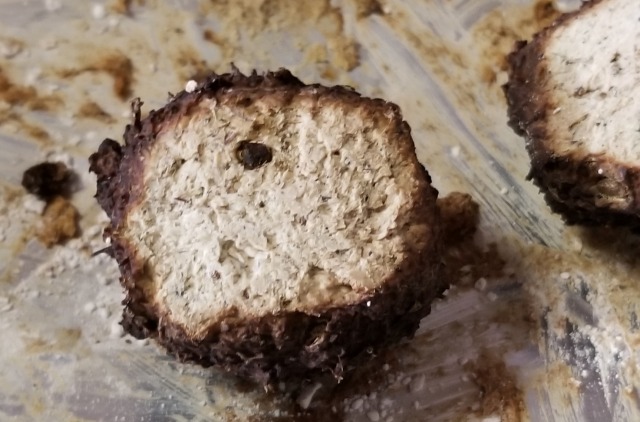
Figure 3. The wash balls turned belly-up.
You can see that where the soap was previously not hitting air, it was still light colored, but dear lord, it had otherwise changed into that rather startling shade of constipated dehydrated brown. They had also, as they dried, collapsed into a much lumpier, less spheroid shape.
This wasn’t entirely unexpected, though I’d certainly hoped for a different outcome. There is, in fact, at least one other company out there making soaps from the same recipe books as me, and their results are… similar to the above.

Figures 4 and 5. I genuinely thought I could do better on my first try than the Venetian Barbers’ Wash Balls (left)
or the Delicate Wash Ball (right), for which I would like to humbly apologize
and beg forgiveness from the gods for my hubris.
My first attempt here, though? Not ideal.
But. Barbe’s The French Perfumer tells us how to gild whatever stamp we press into these kind of soaps. So… surely. Surely. SURELY they wouldn’t add gold to. that.
I of course tried to correct the issue. I took one of them and tried to rub away the knobbly bits before using some of that infused oil of lavender to try and smooth it out further. (You see? I told you it’d come back.)
To say that it didn’t work would be… something of an understatement.
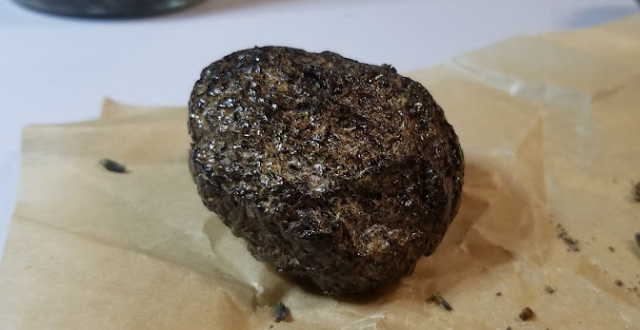
Figure 6. A now shiny lump of shit.
But wait, you say. Have you tried actually washing your hands with it?
Reader. I did.
What’s more, I took a video. And of course I added a soundtrack to it, and yes it is clown music.
In brief:
- It lathers like regular olive oil soap, which is to say, with a very liquid-y, not particularly bubbly lather.
- The lather, however, is brown.
- Yes, this means that it did look like I was washing my hands with a dried piece of shit that melted into a sort of mucus-like–
Look, you get it.
For what it’s worth, it still smelled great and it did leave my hands pretty soft. The soap itself was solid and didn’t crumble. All promising. On the other hand, if I’d used a white or light-colored towel to dry my hands, it would’ve stained it, so, like. There’s that.
In the course of researching what in the world happened here, I found out that vanillin will oxidize and turn brown unless you Do something to prevent or ameliorate it– but there’s no vanillin in any of the ingredients. I also found out that there are soaps out there that produce lathers that aren’t white— but they seem to usually include either charcoal or tar, neither of which are ingredients here.
Though… I also found out that cloves can turn soap and lather brown– or rather, ahem, “a russet lather”, as in this shaving soap. So the cloves may be the culprit. But interestingly, when I flipped the version 1.0 soaps over to try and at least get an even dark brown color, the color change either didn’t happen or slowed considerably… which lead me to the final suspect: the dried lavender flowers. Which, along with most other dried botanical materials, apparently, will brown when mixed into soap, exacerbated by heat and sunlight.
…And the thing is, the recipes had mentioned letting the soaps dry in a cool, dark location, but I, in my infinite wisdom (and concern about how sticky-wet the soaps were), may have. um. put the drying tray. near a western-facing window and opposite a fan-blown wall-mounted gas heater. In winter. At which point the wee bastards went from the previously described herbal green to cat-shit brown in less than 24 hours.
Listen. Mistakes were made.
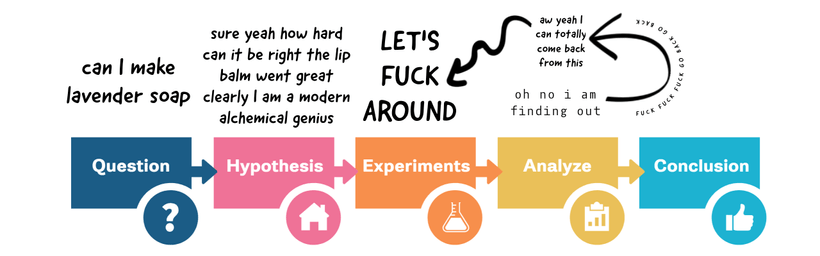
Figure 7. Time to move on back to the earlier “experiment” phase.
Which brings us to:
Version 2.0: Better, stronger, more expensive
I made two big changes from version 1.0:
- Process, My Darlings
Using my hands right from the start was a no-go– too sticky. Adding a bunch of rosewater to soften the soap up first, also a bad idea. Plus using as much arrowroot as I did in order to manage the situation did not, I think, help the slimy quality of the lather later.
Looking again at my collection of recipes, I went from focusing on ingredients and their preparation to the actual physical process of the soapmaking.
Sir Plat’s 1609 Delightes for Ladies said to beat all the ingredients in a mortar, then add in some soap, then dissolve in a little bit of rosewater and “then incorporate all your powders therewith, by labouring of them well in a mortar.”
Woolley’s 1670 The Accomplish’d Lady’s Delight didn’t mention rosewater at all, but rather said to beat all the ingredients in a mortar to a powder, then add the soap and beat them all together “till it be stiff, then work it like Paste, and make round balls thereof.”
Shirley’s 1687 The Accomplished Ladies Rich Closet of Rarities (okay, man) again said to beat all the ingredients into a powder, then add “as much Castle sope as will make it into Balls, when mollified with Rose-water.”
So… it seemed pretty consistent. My new plan was to:
- grind my herbs
- add in the (much more finely grated) dried soap and stir it up some more
- add only as much rosewater as needed– and in small splashes in between stirs– to get the mixture to turn into a paste
But this actually brings me to change number 2–
- Guess who found some fancy ingredients!
As it turns out, my local metaphysical shop happened to have gum benzoin (which is either identical to or pretty close to what my dudes called “Benjamin”) and dried orrisroot. Since both of those– and the orrisroot in particular– are regular ingredients in these soaps, I picked some up, and probably paid an outrageous mark-up to do so.
I also checked their chemical compositions, just in case, like, maybe one of them secretly turns soap white? Because that would be… convenient? Which is how I found out that the orrisroot has, among other things, oil of orris (shocker), which itself contains myristic acid (used for cleansing, emulsifying, perfuming, and as a foam building cleansing agent, hooray!). And gum benzoin has, among other things, cinnamic acid (also found in shea butter, and considered good for both perfuming and skin conditioning), benzyl benzoate (considered good for perfuming and as an antimicrobial) and blasted brown-oxidizing vanillin, drat it.
We will come to see if I regret some of these additions.
Anyway. Let’s go back to process. The new recipe became:
Version 2.0
1 oz. whole cloves
1 handful dried French lavender flowers
1 oz. benjamin
1 oz. orrisroot
7 oz. dried soap
rosewater, q.s.
Let it be said that almost all of these little dudes ground up beautifully, but orrisroot is a brat.
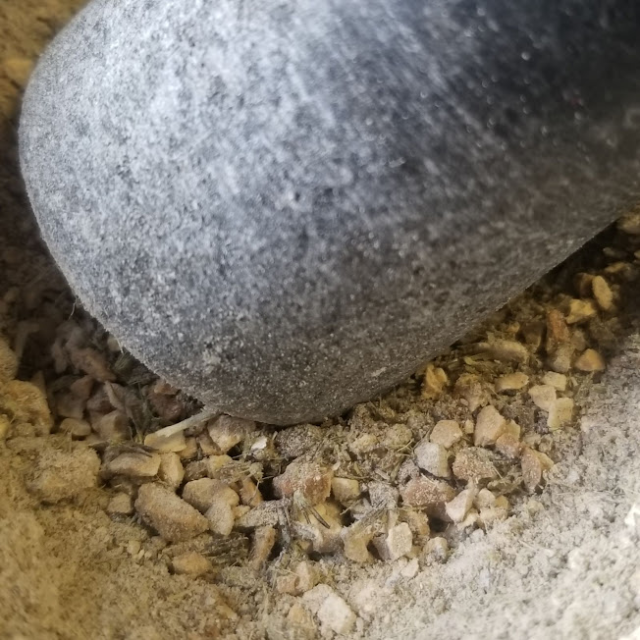
Figure 8. Why are you like this, orrisroot.
After quite a bit of time at the mortar with the orrisroot wanting to stay in hard lumps forever and ever amen, I decided that this now constituted the kind of preparation that probably apothecaries handed over to their small apprentices to keep them busy for a few days, and so I decided to get my own small apprentice.
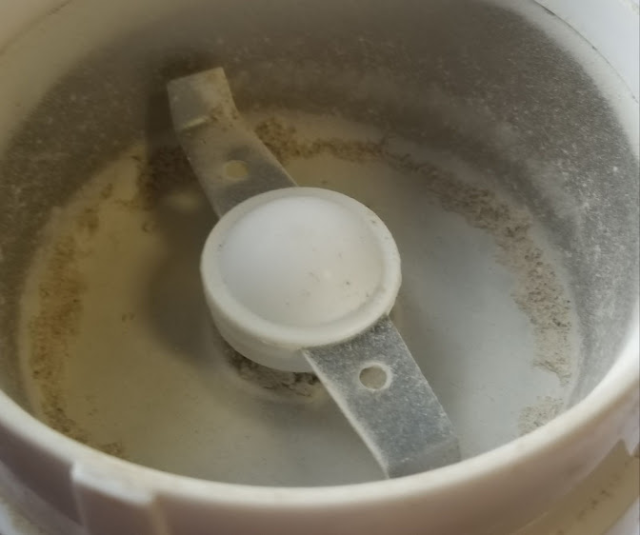
Figure 9. Meet young Thomas, also known as a secondhand coffee grinder I thought might be useful some day
and guess what IT WAS– along with the remnants of the powder mix.
So after Thomas beat the ever-living snot out of everything, I had a pretty fine powder, though I had to let it settle for a second before I took off the lid– the whole dusty thing wanted to float riiiiight up into my face at the slightest provocation. I transferred the powder into a larger, wooden mortar that I’d picked up on sale from an off-price retailer (where the kitchen section had mortars and pestles aplenty just waiting for ridiculous persons such as myself to scoop up), added the dried soap, and got to mixing.
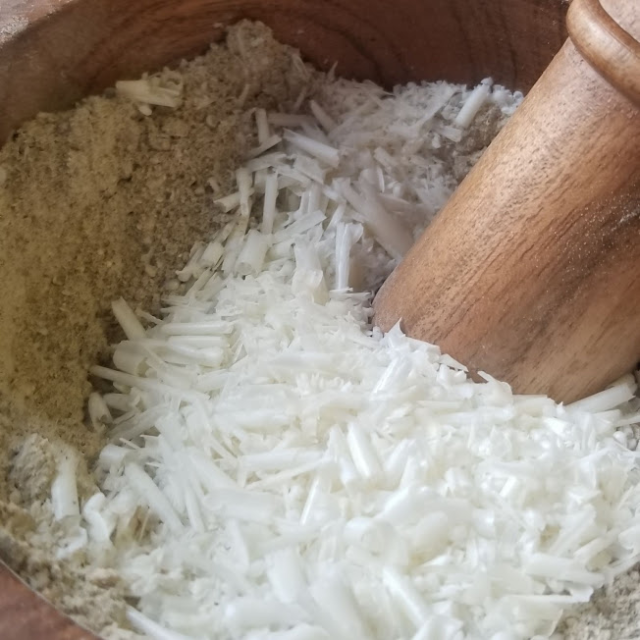
Figure 10. Mixy mixy.
Once the soap was fully incorporated in the powders, I started adding splashes of rosewater to get the thing to start binding together. Pretty quickly it became apparent that I needed a spatula to help scrape the soap off the pestle and down the sides of the mortar, but otherwise it was… actually a pretty tidy process. “Paste” really is the right word– not sticky, not bubbly, and after about 8-10 minutes of work it was, overall, very similar to the consistency of playdough.
The soap paste was green again, but much more even in color and less herbal all the way around– and I found that when the whole thing was incorporated, I could just… take a hunk of it off and roll it easily in my hands, no arrowroot needed (though I did add a few drops of my infused oil of lavender because why the heck not). The balls came out beautifully smooth, with a kind of pebbled granite look. Literally the only downside was that the palms of my hands turned very brown (heh, “russet”). The brown washed away when I used some regular liquid handsoap, though I had to rub a bit– we’ll see if that persists.
But anyway. I promised a glow-up, and by Grabthar’s Hammer, I aim to deliver.
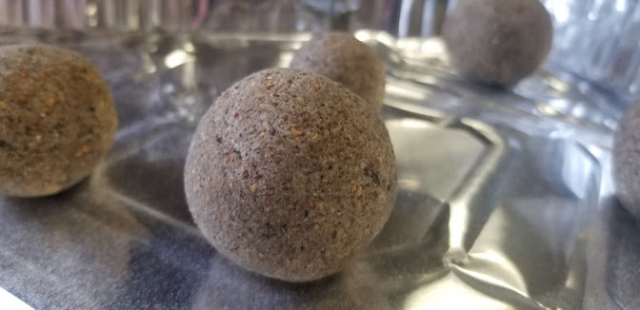
Figure 11. Revenge of the Lavender Wash-Ball.
And for those wondering: yes, I very carefully put the soap to dry in the shade and away from the blower. I aimed to make brand-new mistakes for the next round of experiments.
Soap: Fit the Sixth
Following the glow-up of the lavender soap in Soap: Fit the Fifth, I was filled with some trepidation regarding how they might dry. Would they have undergone a metamorphosisinto something even more delightful?
Or would they have succumbed to t̶͔̤̪͔̊̐̓͜ẖ̷̒̉̓̎̽̊e̸̪͈͎̓̒̚ ̸̬̖̹̥͜͝b̴̨̡͈͂͛͑̽̓͊ŗ̸̬̹̯̳̠́̏̚ò̸̡̼̼̟͎̑͌͑̑͘w̶̘͕̱͇̒͋͝n̶̹̟͊̉̓̄̓̕ ̴̧̮̘̼̖̳͐̃̚͝ḧ̸͇̩̹̣͖́o̶̖̳̭͔̐́̉ŗ̵̲̉͋̾̄͂͌r̵̨̛̳͚͓̮̐̇̆̉̚ô̴̯̟̹͇̾͒͝͝r̸͓̩̳̉̑͒̒̉̒ ?
I was filled with a terrible foreboding, but–

Figures 1 and 2. Look at my precious little weirdos.
Some fast facts, collected at the time:
- They’d been drying for approximately… maybe 49 hours (and they had another 12 or so days to go, or longer if I could be patient enough).
- There was no sinking or losing shape that I could tell, nor significant loss of size (…though next time I’m gonna weigh them first, hoho).
- They’d darkened slightly into the brown range, but it was, crucially, a color completely even all the way around.
- They still had that neat speckled granite look to them… and with this color brown, and how round and nice they are, I could sort of imagine them having gilded stamps on them– it’d probably pop against the brown.
- They were not smooth to the touch– more akin to pumice, really, and I was Not sure how that was going to play when I tried them later.
- The smell wasn’t as sharply spicy as it was previously, which was a bit sad for me, but it was significantly more mellow, as one might expect a gentle soap to be. A fascinating combination with the light abrasiveness.
- They felt pretty solid, but then, I’d been pretty careful with them…
- …I wondered what would happen if I tried to press a pseudo stamp into one of them
- …

Figures 3, 4, and 5. LOOK UPON MY BAD IDEAS AND DESPAIR.
Preliminary results:
- YES, they took stamps like a champ.
- They wanted to be tenderly held rather than set on the table, else their bottoms get squished and it looks like maybe they crack a wee bit.
- I used a tiny flat-headed hammer and some beads, it was great.
- Bead 1 was a small star with rays around it– very successful, easy to pluck back out with pointy tweezers.
- Bead 2 was a kraken octopus pendant, which was a bit too big and unwieldy for nice stamping purposes.
And bonus: Because I was overcome with the rush of experimentation I got out some metallic markers just to See what would happen, and:
- On the one hand: not sure this helps the poop-look situation.
- On the other hand: …I bet I could Improve On This.
I did, however, say in my editorial notes at the top that this was an issue relating to the concept of A Week, and so I must further report that I, naturally, did not wait the full 12 days for the soap to dry before investigating them once again.
In the intervening time they had continued to shrink as they dried, but not significantly (though the stamped designs contracted a bit). The scent continued to mellow from the Spice Cookie of the original to a more complex one overall, but most fascinating of all was that it now had, delightfully, white bubbles.
Granted, they were tiny and there was still a very light brown lotiony-lather that appeared, but! It would seem that the addition of the orrisroot had begat many changes, regardless of what a pain in the ass it was for poor young Thomas to grind it to smithereens.
And did I take a video? OF COURSE I DID.
Of particular interest for me, and what is clear from the linked video, is that the shape of the wash ball very much determined its use. By which I mean, when I typically lather a bar of soap, I revolve it around my palms to build a lather– but with the ball, it didn’t seem to want produce anything if I used it like that.
Instead, I switched partway through to gripping the soap in one hand and using it to rub at my skin to clean– much like you might scrub at a piece of laundry, which is what soap was really used for in this period (prior to the development of The Nice Stuff).
All this made it clear to me that while this wash ball is… not ideal as a hand soap, it might very well be great as an exfoliating soap.
And because I am now clearly a Scientist– I went ahead and tried that.
Starting shortly after the above video, I transferred the lavender wash ball to my shower and have used it a few times now. I can report the following:
- The soap becomes even more bubbly! Not a full-on lather like we may be used to, but hey, I’ll take it.
- In feel, the ball is scratchy almost to the point of being unuseable… but only almost. It makes an astonishingly reviving body exfoliant.
- The scratchy feel (of the god damned orrisroot) is tempered with the incredible silky smoothness of the base Nablus soap– like scratching an itch and soothing it immediately with a balm.
- Shortly after exiting the shower to dry off, an astringent/toning quality seems to activate– which, as it turns out, is probably from the cloves (…neat).
- The scent, though present while using, doesn’t linger on the skin (to my knowledge– no one’s said anything, anyway). And so far as I can tell, my towels have not been stained by any brown-ness remaining in the lather.
The little ball, after a few uses, has become more compact and remained solid. It has also, though, revealed more of its Inner Workings.

Figure 6. Less like soap, more like an emergency homemade energy snack
from an extremely dedicated Girl Scout leader.
This is a wee man who one must learn to love, I think. I have two more levels of experimentation I want to do on this mostly-historically-accurate wash ball, though, which may yet save it:
- the replacement of in-house ground orrisroot with professionally ground orrisroot– and more than just 1 ounce of it– to see if I can increase the suds and lower the scratchiness;
- the use of an entirely separate process that’s sometimes mentioned, which involves reheating the soap and melting it down (so, basically, modern-day rebatching).
And, of course, there are other soap recipes to consider and… a new household good to start upon entirely: the pearl pomatum.
Soap: Fit the Seventh; or Return of the (Soap) King
For those who haven’t been following along, I’ve been having a nice time doing experimental archaeology and recreating cosmetics/household goods from the European Scientific Revolution AKA the 1480s to 1710s AKA very coincidentally the date range of the University of Michigan’s Early English Books Online database.
So far we’ve had successful lip balm, yet-to-be-completed Oil of Lavender, the terrible tragedies that have so far befallen the pearl face cream, and, finally, the unending journey of my own personal white whale: working AND attractive scented soap.
Did this all secretly derive from my researching period-appropriate medical horror? Yes. Am I still going to write about it? Of course come on now I can’t just keep that MEDICINAL CANNIBALISM information to myself—
But TODAY IS NOT THAT DAY.
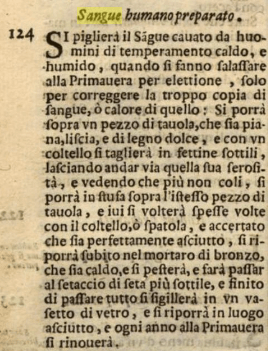
Figure 1. Someday, my beloved. Someday.
Nope, today we’re on the next iteration of the lavender soap, because we’re still at the “fuck around and find out” portion of this experimental process– and so, behold:
Version 3.0
7 oz. dried soap
4 oz. ground orrisroot
1 oz. ground whole cloves
1 oz. ground benjamin
10 drops lavender essential oil
oil of lavender, q.s.
rosewater, q.s.
You may notice that I have, tragically, only added enough of anything lavenderish to allow myself the honesty of still calling this “lavender” soap– as previously discussed, lavender essential oils (as we know them today) were not really a Thing, and the Oil of Lavender (…which is not an essential oil, but rather an infusion of lavender flowers and olive oil) is not quite ready for primetime scent vibes, so I genuinely don’t think these are comparable to actually just grinding up and shoving in the dried flowers.
But for the sake of Science, I needed to find out if removing the flowers would help with the browning issue of previous versions, so– out went the lavender. (For now.) Other changes in this version are:
- store-bought ground orrisroot (…listen, Thomas is but a wee lad, and not yet hearty enough to wreck regular orrisroot as hard as it needs);
- store-bought ground benzoin (because it was cheaper to buy in bulk that the solid resin from the metaphysical shop);
- increased the amount of orrisroot from 1 ounce to 4 ounces, in keeping with some other recipes, to try and bulk up the myristic acid content (i.e., the thing wot makes olive-oil based Nabulsi soap actually produce a bubbly lather)
I should at this point say that typically the scientific process recommends making only one change at a time when conducting Experiments, so that one may know what exactly affected a change in a positive, negative, or neutral manner.
Consider, however, that I have no patience.
So Show Us the Soap
Hold your horses, Readers. To get to the soap, you must first suffer through mortifying ordeal of process photos.
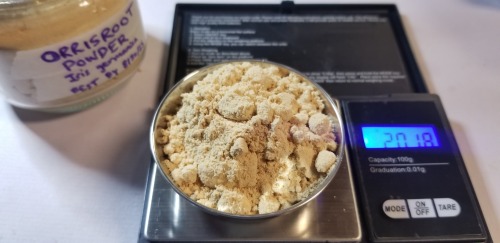
Figure 2. The ground orrisroot on my tiny digital scale (that actually measures grains,
which itself is a holdover from apothecary measurements!)
Wait wait wait actually look at my tiny nonsense scale, I love it, look at its little one-gram calibration weight:
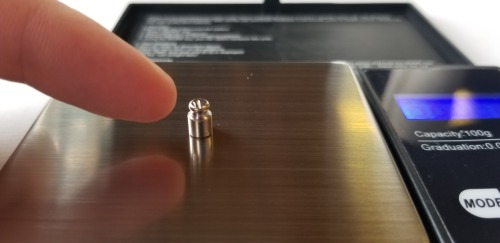
Figure 3. A baby.
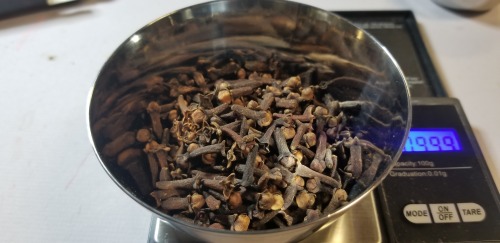
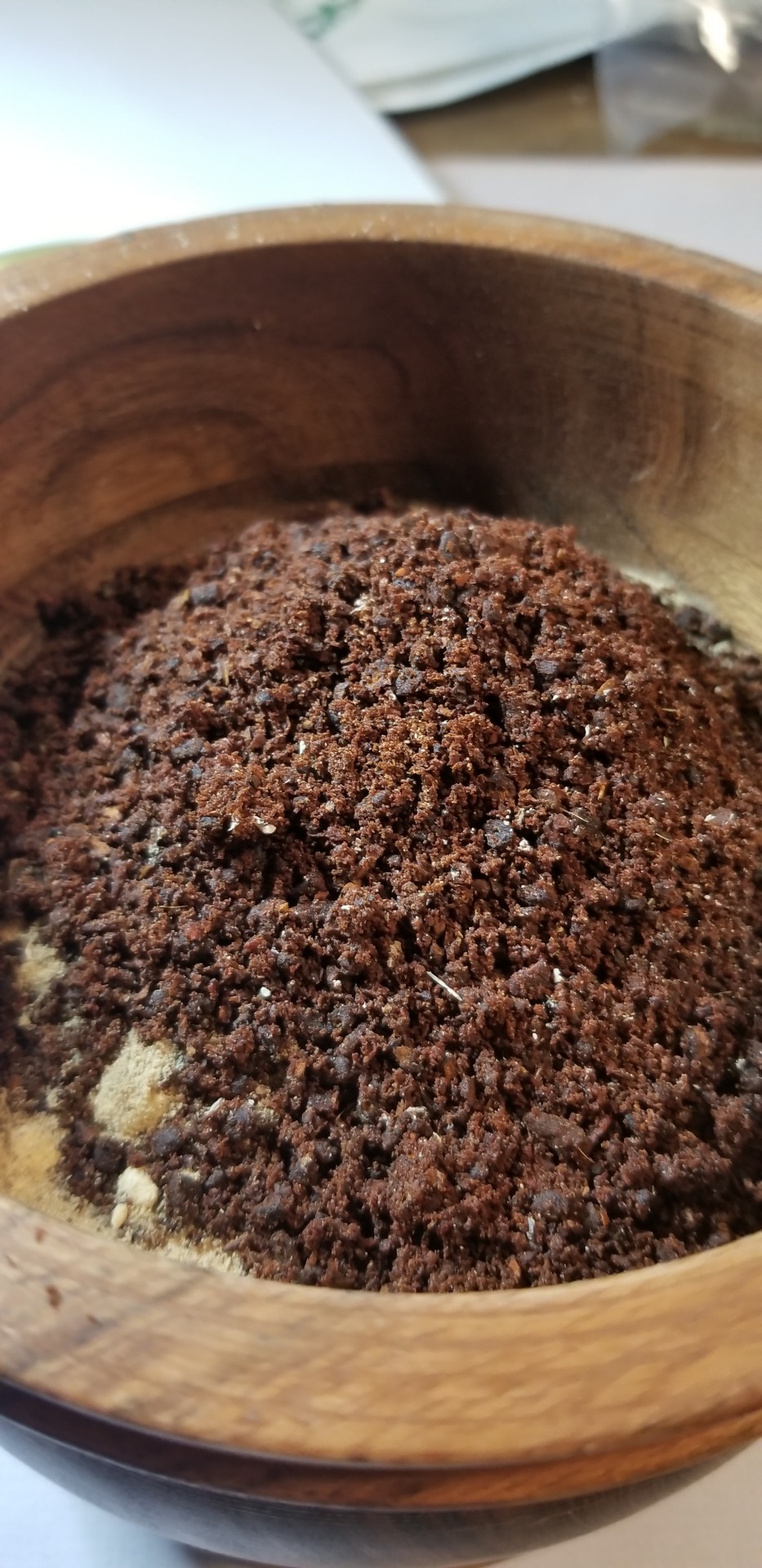
Figures 4 and 5. An ounce of whole cloves (top) and the results of young Thomas’s
efforts thrown on top of the orrisroot and benjamin in the mortar (bottom).
I should note that rather than grinding the cloves in my granite mortar and pestle first, I put them straight into Thomas’s maw– I don’t know if that led to how intensely clove-oily these grounds are, or the fact that the lavender flowers were not present to soak it up. Previously I got a grey-green powder out of grinding the both together, so this rich, wet clove-color did not bode well for my “can I stop this from being brown?” soap plans…
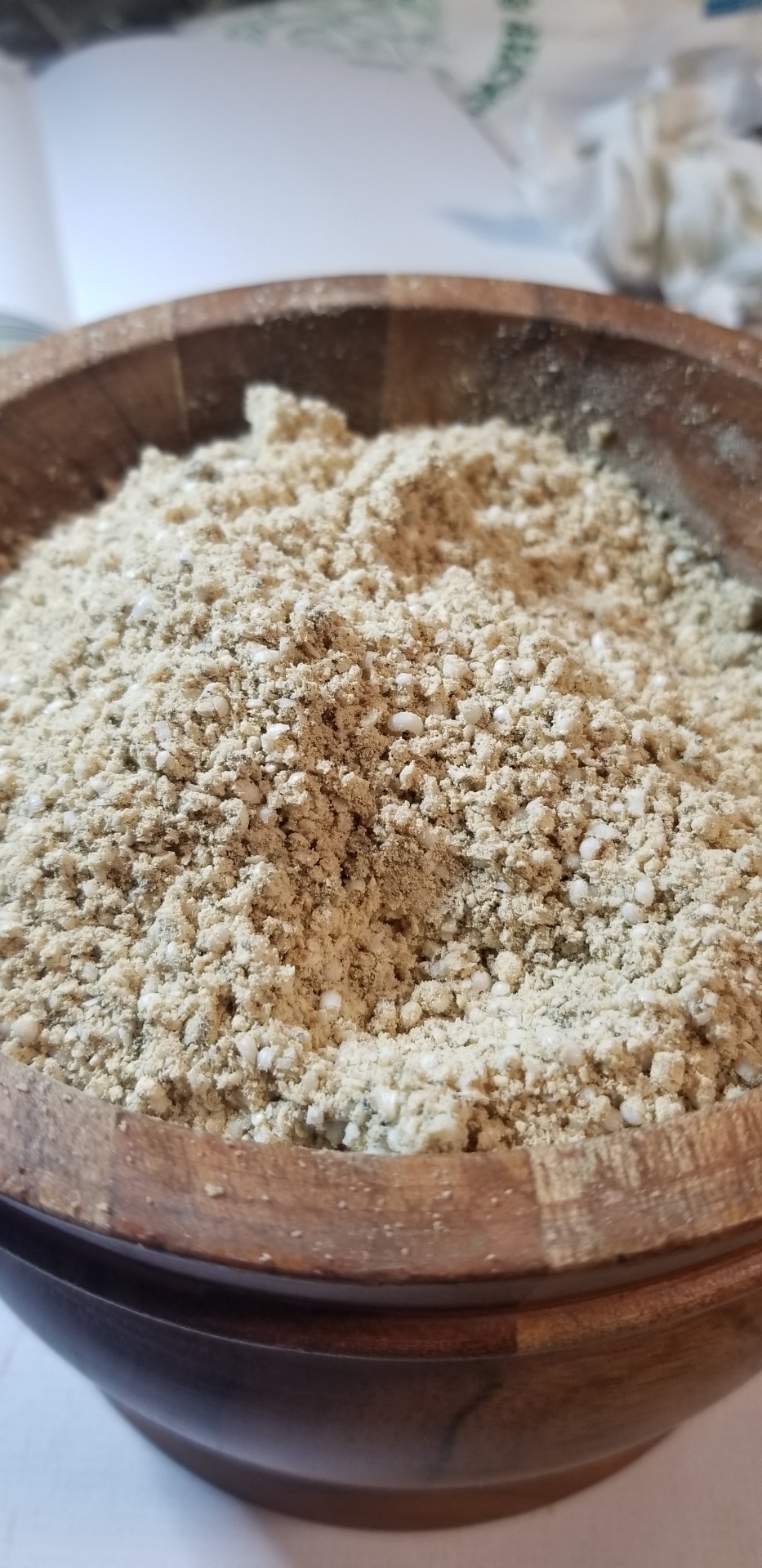
Figure 6. …Or maybe it’ll be fine? I added the dried soap, and now look at them all mixed together!
As a note, I had to actually use a whisk at this point rather than just rely on my pestle to do the work– my mortar is Too Small for these shenanigans, and the four ounces’ worth of orrisroot did not help matters. I won’t say how much of this mix ended up outside the mortar and on my clothes, but it was… it was a non-zero amount.
Whatever, thought I. This is Science. This is me experiencing the divine art of creation across space-time with my alchemical forebears, and also this is why I should not be allowed in other people’s kitchens.
Notably, the upped powder content meant that I had to add a lot more splashes of rosewater to get to a dough-y state where the soap could be hand-rolled, and I had to work significantly longer with the pestle– while version 2.0 was, per my notes, about 8-10 minutes’ worth of work, I would call this a solid 20 minutes at least of beating the ever-loving shit outta this mix until everything was incorporated.
And once it was, well–
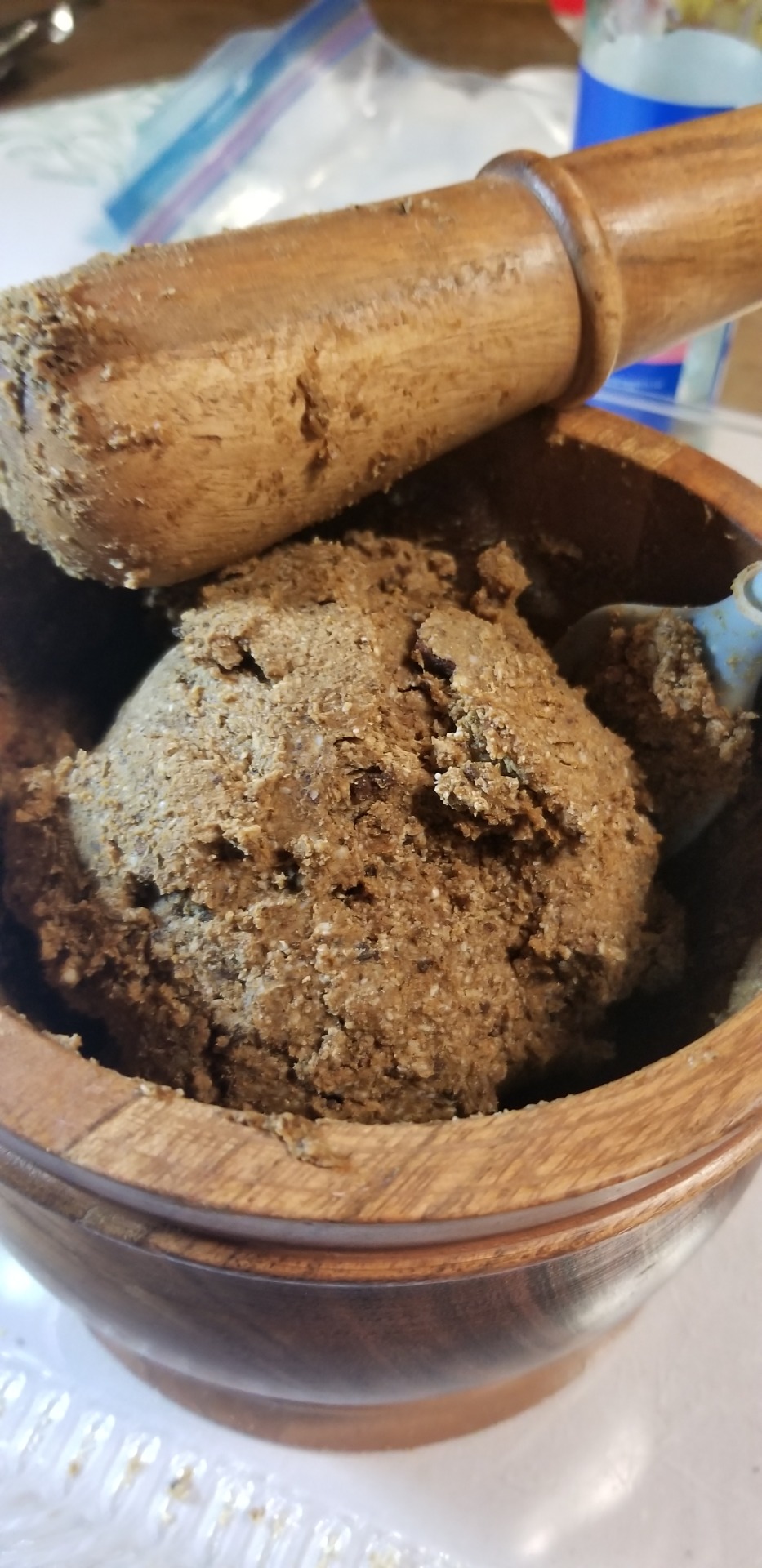
Figure 7. Hello, brown.
As you can see, the soap mix does form up very nicely, though it still requires a spatula to clear the sides of the mortar and pestle.
At this point, remembering that the last time I hand-rolled wash balls my palms came away Very Brown, I donned some latex gloves before I commenced my rolling. However, because (and again, I cannot stress this enough) I lack patience, I threw in another change: rather than leaving them as balls, I squished them slightly between my palms to flatten them into slightly more traditional soap shapes.
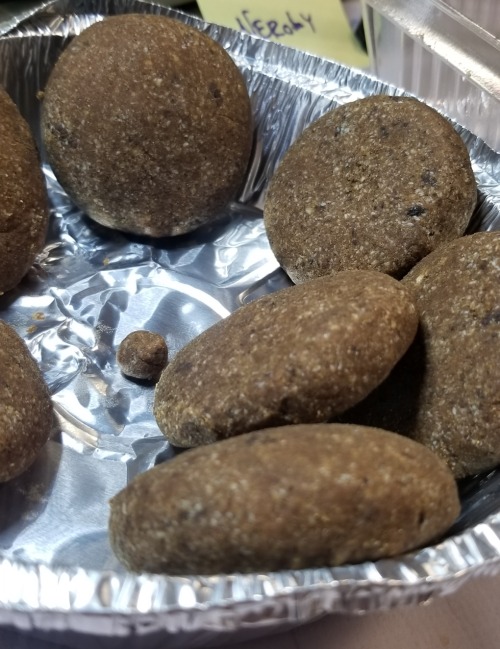
Figure 8. Cookie dough or falafel: you decide.
A note regarding the scent: Whether it’s the relative lack of the lavender, or the big bump to the orrisroot (or some magic alchemical combination of the two), the soaps, while still smelling strongly like spice cookies, now have an oddly-unfamiliar-but-fascinating scent profile, similar to what I found happened when I made the lip pomatum. There’s no good reason why this should make me believe that I’ve come closer to a “real” recipe, but the feeling is there nonetheless– and it’s definitely interesting.
Finally, and because the flat sides of these soaps looked too innocent, too pure, I decided to try that octopus stamp again. For future reference, stamping immediately after making these? Not a great idea. The soap stuck to the stamp like a bramble to an unsuspecting shirttail, and so a lot of detail was lost. But regardless–
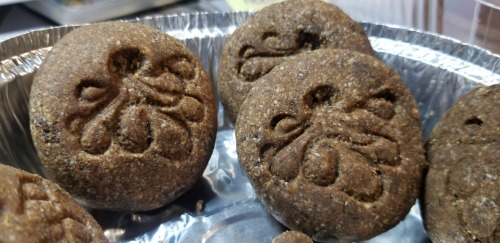
Figure 9. Spice cookie kraken soap cakes, oh my god.
And now, I actually do have to wait a few days before I can try them out, or they’ll fall to absolute pieces. Soon we shall see how they dry (and probably do more unfortunate stamp experiments on them).
Soap: Fit the Eighth (An Evening of Tragedies)
There came an evening, in April of 2023, when I decided that perhaps the Real Problem with my soap experiments was that I wasn’t working from the known to the unknown– that is to say, I wasn’t making a Working version first and then extrapolating from there. (You could THEORETICALLY also say that perhaps I wanted to check and see if I was just rubbish at making soap, BUT YOU’LL NEVER PROVE IT, COPPERS.)
Which led to…
10:46 PM, April 13, 2023
live from the workshop
I am staring down at the contents of my mortar and pestle
and I fear I have made a terrible mistake
10:49 PM
it’s beautiful!
it won’t solidify
10:52 PM
I FOUND SOME SALT
…it’s from the anti-vampire bottle bombs, but whatever, it’s fine
10:56 PM
look at this beautiful bastard
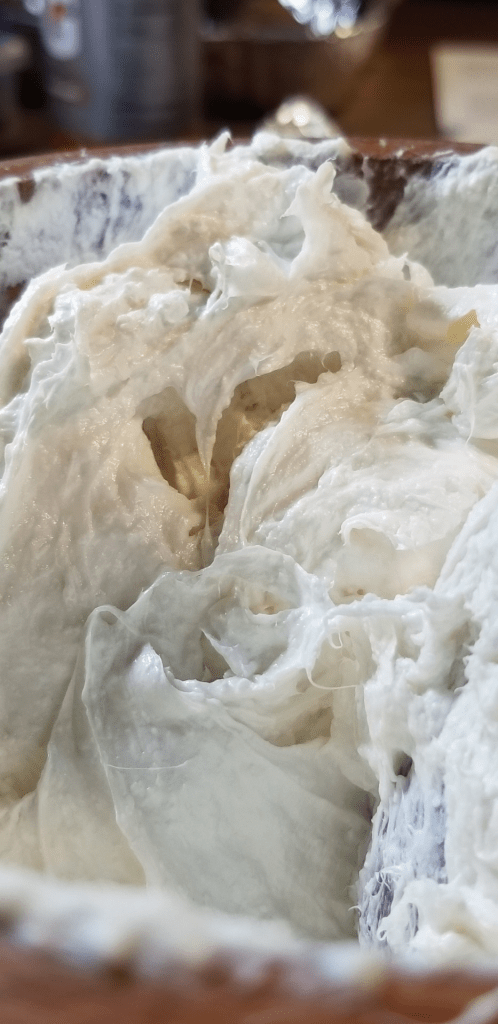
Figure 1. Marshmallowy madness.
11:04 PM
Salt was used to vaguely solidify European soap (the stuff made with potash instead of soda ash). But how much did they use? How solid did that soap actually get?
…I don’t want to add arrowroot, but
*stares at clock*
*stares at mortar*
*stares at depths of soul, considers life, considers choices*
11:15 PM
My god.
The salt I have is coarse sea salt (listen, it’s big and visible and freaks out the undead, we all know this, keep up), which I was putting in whole–
Tut a second ago I decided to maybe grind it up smaller in one of my other mortars (yes I have multiple now, we are doing important nonsense here)–
And when I added the finer salt–
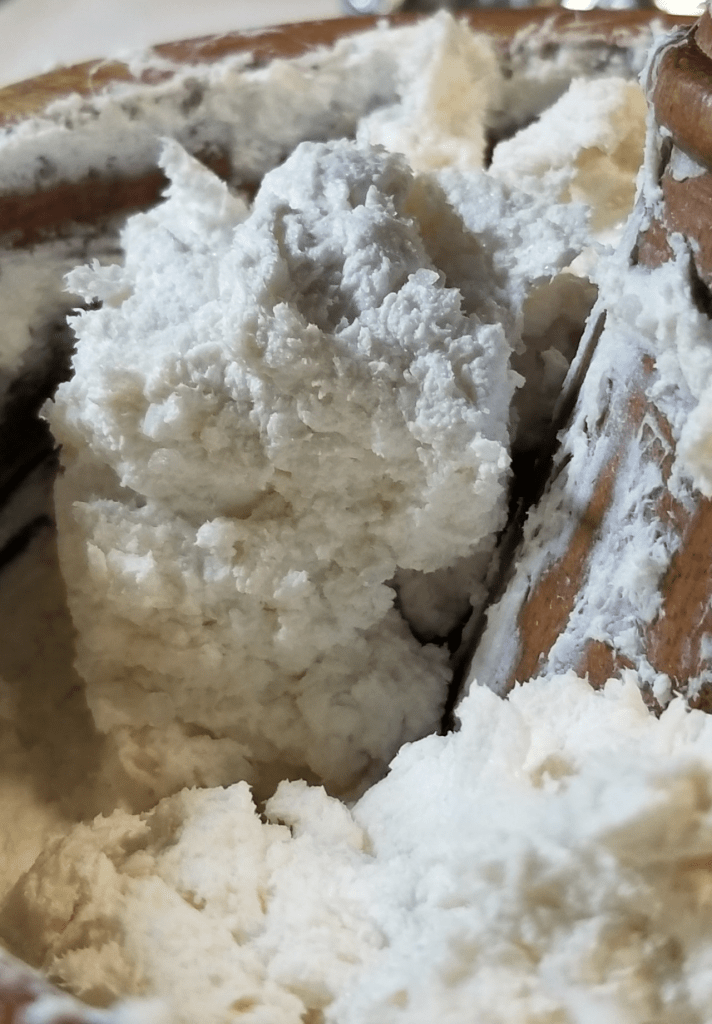
Figure 2. This absolute monster finally started solidifying.
12:02 AM, April 14, 2023
BEHOLD: these fancy as fuck, sweet as hell wash-balls of neroly, from the 1696 English translation of Simon Barbe’s The French Perfumer
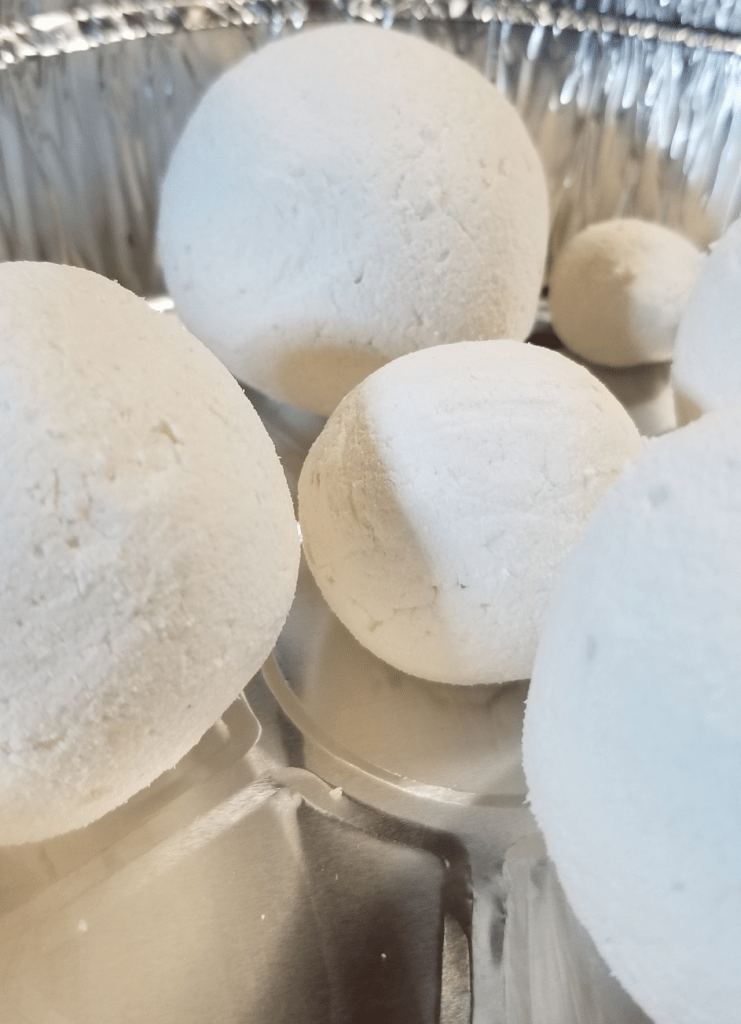
Figure 3. Look at them. Look.
And here’s the thing: The fact that all the previous historical recipes recreated so far have smelled like delicious cookies has made me doubt every “ahahaha oh they were so smelly in the past” bullshit modern narrative.
I thought, finally, this would be the recipe that bucked the trend.
And I was half right, because the Wash-balls of Neroly don’t smell like cookies…
…They smell like a goddamn field of fucking flowers.
Soap: Interregnum
I threatened in my latest issue of The Minor Hours and Small Thoughts Magazine that I would start putting these experimental archaeology write-ups in their own separate posts– and I threatened in my regular blog that I would start using header images like LiveJournal icons. Behold, a two-changes-in-one update to our format! (Signifying two threats realized, aka a Hamlet Surprise.)
But with regard to my soap experiments in particular I’ve lost some momentum, so best to reorient ourselves in the narrative.
Let us briefly recall the heady days of “Soap: Fit the Eighth,” wherein I finally created a beautiful soap:
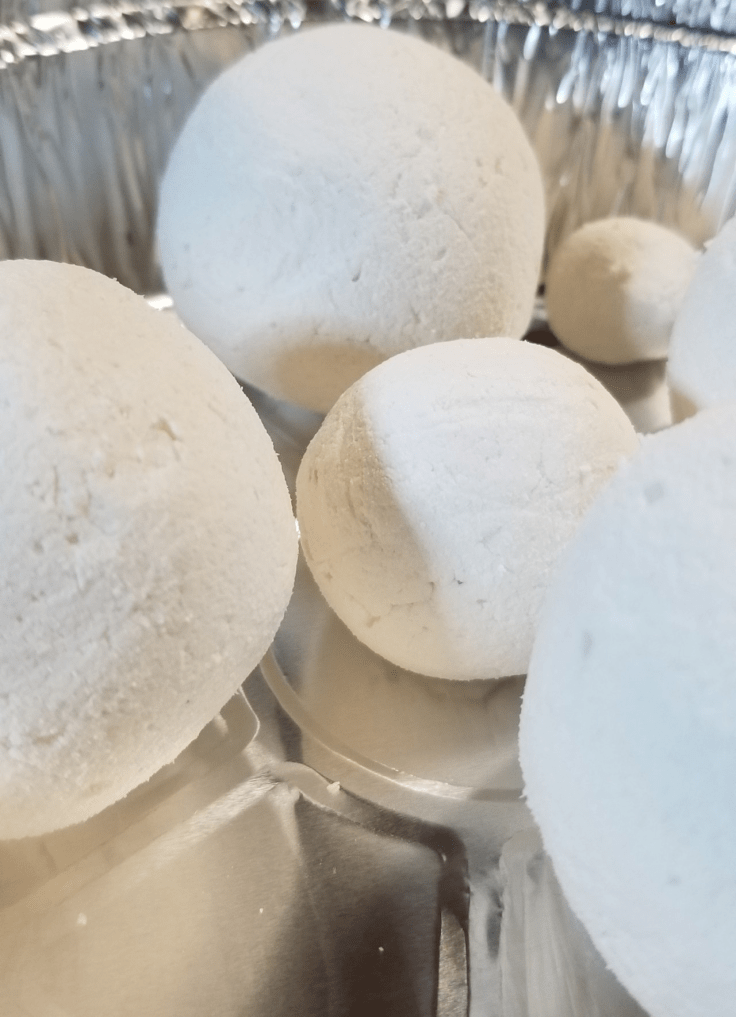
Figure 1. The freshly rolled wash-balls of neroly. Surely I have cracked the code now!
Yes indeed! My long travails: over. My days of soap horrors: no more. The world was beautiful and full of joy, and I would definitely have no cause to change my opinion on the matter whatso-fucking-ever.
Which brings us to… late April 2023. Eleven days after I first made them, ten days since I checked them, and an endless eternity of baseless belief in my ultimate triumph… I entered my workshop and came upon: THEM.
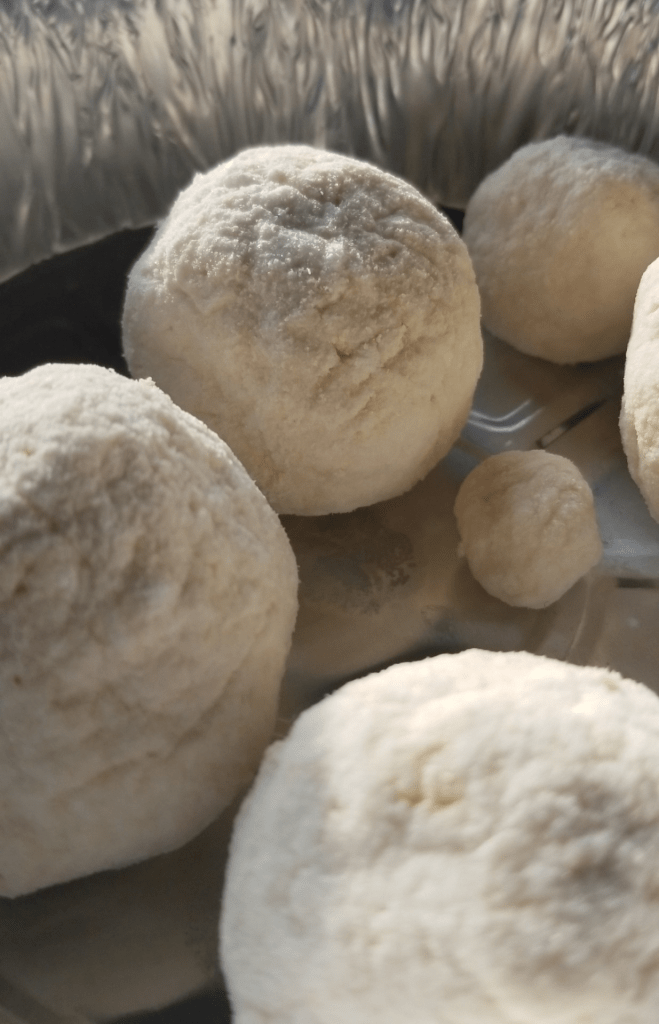
Figure 2. The now-dried Wash-Balls of Neroly. Or for the more discerning:
The Unfortunately-Humorous Wrinkly Salt Balls.
On the upside? They no longer smelled like a field of flowers, and they didn’t taunt me with the scent of a bakery case of cookies.
(Possibly because that would be TOO KIND.)
No no. For whatever reason, on that tragic April afternoon, I discovered that these scratch-meister double entendre wonders fooled the senses and destroyed the mind by smelling like nothing so much as very expensive candy.
…which I am still not supposed to eat, apparently.
Soap: Fit the Ninth (Continuing Developments)
As I sit here with the luxurious scent of soap I bought in London gently wending its way from betwixt the too-weak atoms of the quart-sized freezer bag I’ve unceremoniously shoved them into, I think to myself: Yes, good, this is the atmosphere I need to relay more Soap Adventures.
Before I start, though: I am super aware that I’m playing around from the opposite end of most modern soapmakers– there may be very obvious ways to accomplish the stuff I’m trying, or there may be very known reasons for why the stuff I’m doing is or isn’t coming out right. But since my entire vibe is “”“What If: Shenanigans,”“” I’m trying to suss my way through all this via just the manuals and receipts I can find, and seeing what happens based on that.
If you want to play along, soap-wise, recipes I’ve referenced so far:
- “Balles of fope for barbers of diuerfe fortes and favours” (Balls of soap for barbers of diverse sorts and savors), The secrets of the reverend Maister Alexis of Piemont (1595)
- “A delicate wafhing ball.” (A delicate washing ball), Delightes for Ladies (1609)
- “Of Soaps that Beautifie”, Cosmeticks or, the beautifying part of physick (1660)
- “CHAP. XVIII. Of perfuming Soaps”, Polygraphice (1685)
- “A delicate washing-ball”, The Accomplish’d ladies delight (1686)
- “To make excellent Washballs”, Pharmacopaeia Bateana (1694)
- “Of Wash-balls”, The French Perfumer (1696)
Okay, so! When last we left off, I had two versions in the works. Let’s talk first about:
1. Lavender wash balls
Version 2.0 (AKA the glow-up, AKA the scratchy scratchy snack ball, AKA this cookie-scented monstrosity) continues to live a long and fruitful life in my shower, and I’m actually really very into it now. Like, this guy? My best little bud. Old photo but, for real, it has not changed significantly. Still amazing.

Figure 1. Look at this guy. What a weirdo. I love him.
But I also have Version 3.0, AKA the kraken cake…

Figure 2. …aka the Deceitful Liar For Reasons That Will Become Apparent…
…or rather, I had Version 3.0.
What I have since discovered is that if these soaps don’t dry out, at least on the surface, within a couple of days– and certainly by the 10-day mark– then something has gone horribly awry. By the time my next batch of soaps (the neroly wash balls, which will be discussed below) were done and dried, the kraken cakes were still squishy to the touch– and, even more worryingly, they had begun… to smell.
And that smell was not equivalent to cookies, candy, or, for that matter, anything you’d want on your skin.
As all good experimental alchemy requires, I did try to use them. Just in case. And it was. it was pretty gross. I had to wash my hands a second time just to get the funk off, and even then it still haunted me.
So far as I figured at the time, these little fake-outs didn’t dry as they ought for some weird reason, and because of that they went… rancid? Moldy? Something like that. It was deeply gross, which is maybe what I get for invoking The Kraken when naming them. I gave them a funeral befitting of their service to the experiment, and then I stuffed them in the trash like they were a puppy’s midnight accident.
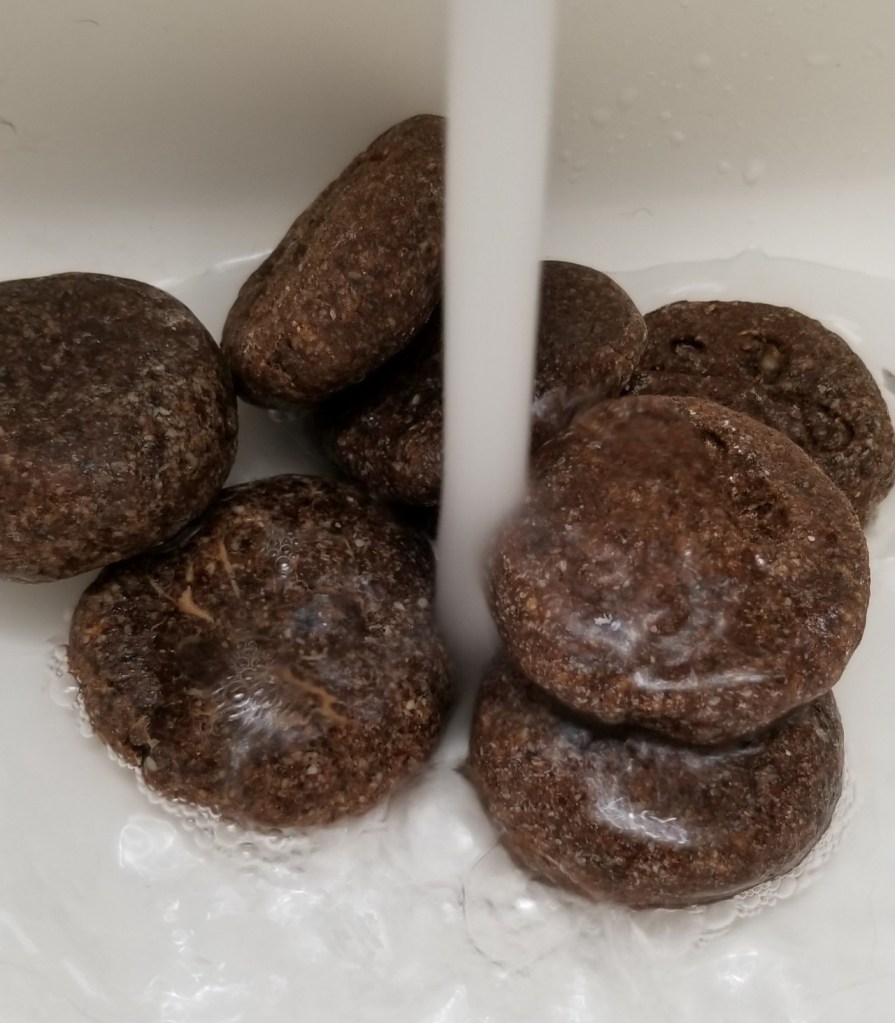

Figures 3 and 4. Burial at sea, shit-bag in garbage.
Okay, so… version 3.0? Not ideal. So for the next round of experiments:
- Lower the amount of orrisroot powder
- Skip the essential oil
- Add the powdered lavender flowers back in
- Either keep them as balls or figure out a better way to dry the falafel shape
- …or accept that my ugly boi version 2.0 is the best we get with this
(Ha, I accept nothing I will FIGHT FOR THESE BALLS.)
2. Wash-balls of neroly
While I was waiting for the kraken cakes to dry (ha), and because I finally got all the ingredients in, I started on a soap recipe that involved large amounts of orange-blossom water and neroli essential oil– basically both the by-products of steam-distilling bitter orange blossoms (oil goes up; water goes down; blossoms presumably go in the trash) all stuffed in one recipe.
Note: In the past, I’ve said that late-1600s/very-early-1700s didn’t really do essential oil as we know it, and this is largely true– but mostly because they didn’t have the industrial portions of raw material and equipment to make it worthwhile for most stuff. (Looking at you, lavender.)
Orange blossoms, on the other hand, had what the sages called shittons of oil in them, and therefore using just common alembics was sufficient to get enough oil for whatever purpose. The bigger issue was just being in an area where bitter orange blossoms actually grew— and if you weren’t from around there, you had to get the stuff imported, and that’s why it was largely for Rich People.
Now, normally I like to plan out my little essays about experimental archaeology and provide process pictures and stuff like that. That was, in fact, what I intended with these neroly wash balls. Like, look! Here’s a pic of the “cover your dried, grated Nabulsi soap in orange blossom water and then wait APPROXIMATELY FOREVER for it to soak up until it’s ‘workable'” step!

Figure 5. Soap et orangey-water.
Per Simon Barbe’s instructions, the next step was to stir it twice a day. Which I definitely did, except I didn’t, I only did it once a day for maybe a week and then I left it for almost five days because whoops. By the time I had the opportunity to check on it again, it had reached what I thought was the “workable” stage, so I started, uh, “working” it–
–which led to that panicked WHAT HAVE I DONE late-night posting where I explained nothing of my previous experiments and mostly just flailed around like a loon as I discovered that this whole mess now had the consistency and approximate stickiness of the devil’s melted marshmallows.

Figure 6. Surprise action shot of my god actively forsaking me.
I was, as per my insane posting, eventually able to actually create balls out of the stuff. And they looked pretty! And for once, something from this time period didn’t smell like cookies.
Anyway– after some drying time– where the salt I used to solidify the soap did not particularly help their appearance, whoops– I came back to discover the scent had matured from “field of flowers” to “jfc is this CANDY”, which, like, why.
And in the intervening time, I have started using the soap regularly. Behold:

Figure 7. A beautiful little wash-ball of neroly, just for me.
And I just… I’ve gotta take a moment here. Because there are two important issues I need to expound upon.
a. The scent of this soap
I feel like I’m not being as accurate as I could be with this stuff. Like, maybe this is just what neroli smells like? Maybe this isn’t how anyone else would perceive it. Maybe it isn’t, in fact, all that special.
But I think the unusual scent combinations just do something to my busy ADHD brains. When I wash my hands and then, like, immediately stuff my face into my palms and inhale, my mind doesn’t flash to actual “scents” but– more like convoluted descriptions? Saying it’s “candy” or “flowers” doesn’t really match up, it’s more like a soundless pinball machine of sense memory and aphasia that spits out results like:
glass… candy? candy glass? like what hot sugar that’s going to be turned into candy shapes looks like it should smell like?
and
really really really really really really fancy hotels, like, not real fancy hotels but like
movie
fancy hotels
And I mean… what do I even do with that? How do I live my life having all these feelings about this soap and these people who lived in a time where this soap was possible–
Gah.
b. The consistency of this soap
Fortunately, though, whenever I get too full up of Feelings about the World and Art and History and the Unbearable Beauty of Humanity, I remember something.
The ‘something’ I remember is that this soap is largely olive-oil based.
Olive-oil soap, when described kindly, is more lotion-like than sudsy. You can, in fact, see a little bit of that on my fingertips in the photo above.
…Again, though, “lotion-like” is a very kind description.
A more accurate one might be… liquidy.
And in the case of this soap… white liquidy.
…And. And let us stop there, and remind ourselves again that the soap smells lik
Soap: Fit the Tenth (The Poor Decisions Are Unending)
So remember that time. When I thought it was a good idea. To try and make a new soap in the later hours of my evening.
Got that in mind? Good. Cool. I MADE POOR DECISIONS AGAIN.
10:49 PM, May 25, 2023
live from the workshop
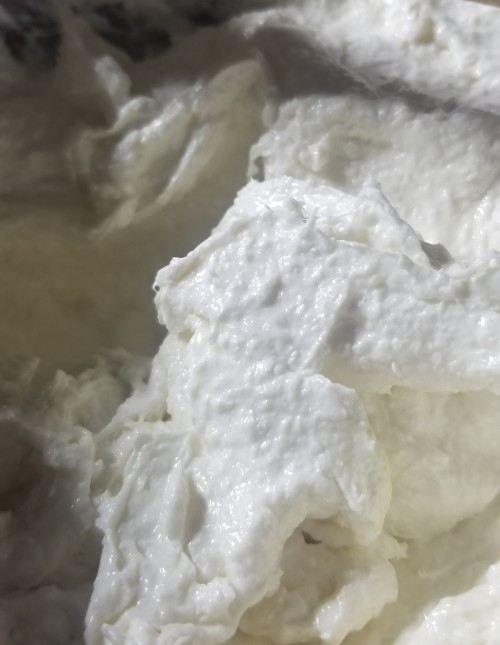
Figure 1. Oh god, oh no.
I’m adding orrisroot this time, to increase the suds and hopefully solidify it without salt, bUT OH GOD.
11:09 PM
…here’s the thing. The labdanum in the recipe is supposed to be “powdered”.
If you ask a bunch of modern people (also known as “the first page of Google”), they say that you can’t powder labdanum. And this is probably true– it’s a resin, and even in its “essential oil” styling, it’s sticky as fuck.
However, I recall somewhere (Charas? Leméry? One of those two, probably) that the way to “powder” some resins was to mix them with broken up almonds, powdering them both down together.
As such, in the future, I wonder whether I should add powdered almonds to this mix… because I’m at 1-¾ teaspoons of orrisroot, and I am CONCERNED.

Figure 2. Thickened, but thick enough??
11:17 PM
Five minutes ago: I wonder if I can roll this soap yet?
Now: FUCK.
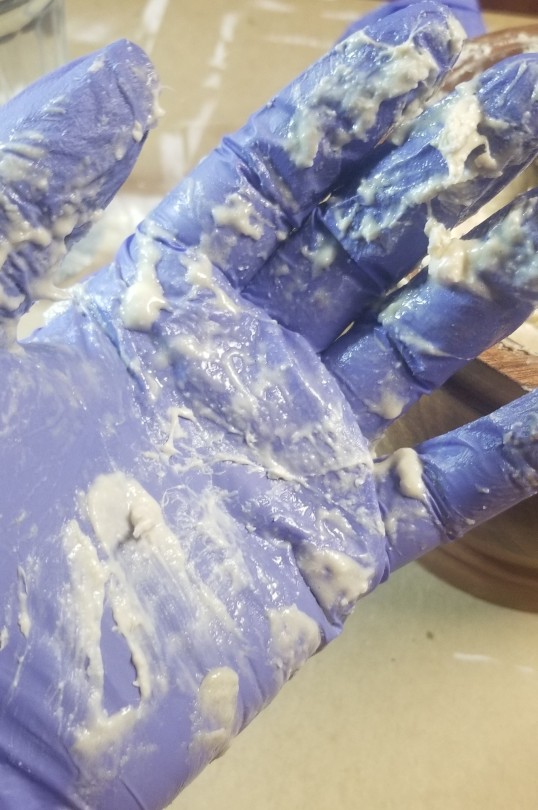
Figure 3. GODDAMNIT.
11:38 PM
I have added salt.
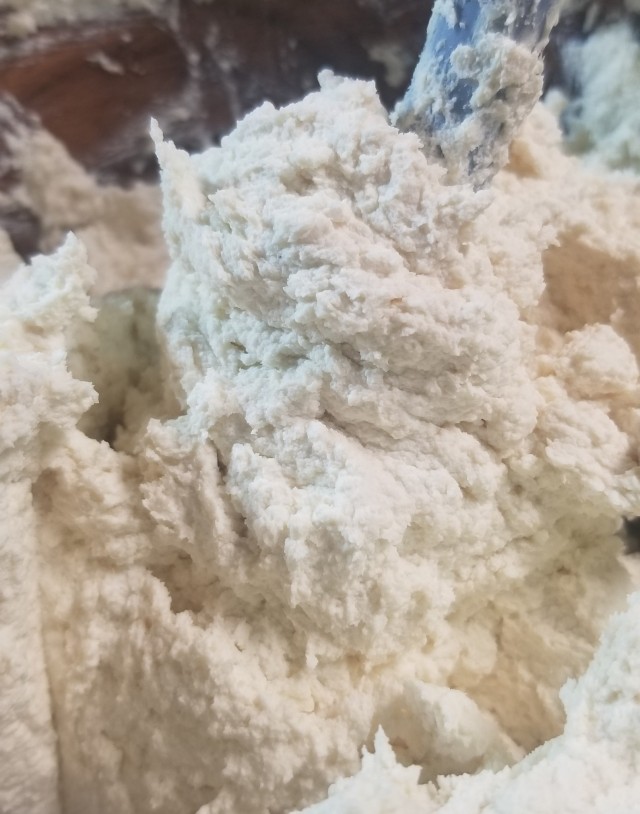
Figure 4. Fuck you, soap.
12:09 AM, May 26, 2023
This time, the wee fuckos have not clung smoothly together, as they did in version 1.0. I dread what this might mean as they dry further. But for tonight, though, I declare these DONE.

Figure 5. Spiky boys.
I left it. I went home and to bed. Days passed.
My hopes weren’t high, but I figured they couldn’t be as wrinkled and salty as the previous late-night batch.

Figure 6. I was incorrect.
They could turn brown too.
…. ಠ_ಠ
Soap: Fit the Eleventh (ex Arte, eat your heart out)
The thing about trying to Frankenstein a lavender soap out of bits and pieces of a bunch of historical recipes–
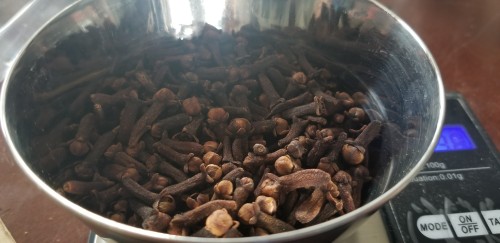
Figure 1. An ounce of whole cloves.
–recipes that were already missing several crucial steps (or iNGREDIENTS)–

Figure 2. Ground cloves, orrisroot, and gum benzoin mixed in the mortar.
–because the authors just assumed you already knew them, so why repeat themselves, everyone already knows ALL THAT–
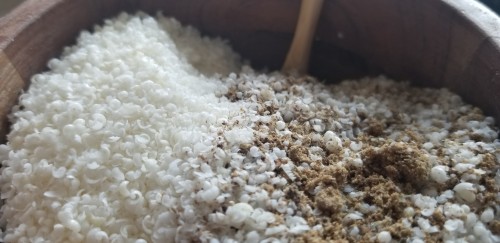
Figure 3. Seven ounces of shaved and dried Nabulsi soap added to the previous powder.
The thing about this whole apothecary gig is… is that I actually am getting comfortable working with these ingredients and these processes and these scents and these tactile sensations under the curved press of my pestle, just like all the books say, the living skills of practice and experimentation and experience cut down to a simple shorthand, just “ex Arte,” just “according to Art”…

Figure 4. An inglorious mixture, doomed to failure.
which means I could SENSE from the
SECOND
GODDAMN
P H O T O G R A P H
THAT THIS TRASH GREMLIN WAS NEVER GOING TO DRY PROPERLY.
Theories! in the Workshop
1. The best iteration so far was 2.0 (the glow-up from the, ahem, “shit soap” 1.0). Every written version of my recipe says to use one ounce of cloves, but when making 2.0 did I accidentally only use one gram?
2. The pre-brought powdered gum benzoin seems… okay, probably. I am, however, highly fuckin suspicious of the powdered orrisroot.
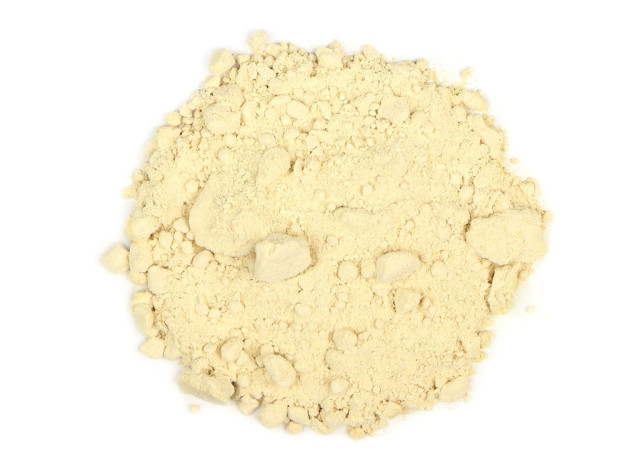
Figure 5. Who are you, powdered orrisroot. What curse have you laid upon me.
A grim order of actions
1. Work the soap and powder mix together in a mortar for a while to see how close you can get to the right consistency before adding the rosewater.
2. Stare into the dark soul of this soap as you twist the pestle.
3. Stare at the bottle of rosewater as it sweats beside you.
4. Stare at the soap again, which will appear to have somehow moved. Closer.
And as we all know, I am a paragon of patience
I sadly did not not get a final photo before I left the workshop, but:
- These lavender wash balls were darker than my best glow-up batch.
- I kept them spheres, lest the falafel shape be a Trap.
- They did roll up very nicely, and made the usual 5 balls. I used only a splash of rosewater to bind the soap mix, so perhaps that would save us from the horrors.
- But the scent, I feared, was Not What It Should Be.
- The only thing I could do now… was wait.
Three days later
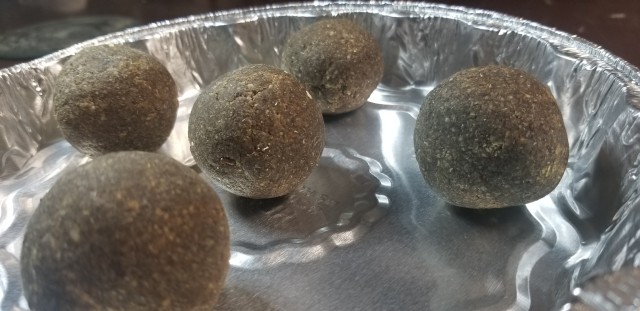
Figure 6. Suspicious wash balls of questionable quality. I DO NOT TRUST YOU.
Nine days after that
I returned again to the workshop to visit this batch and the thing was… the thing was, they didn’t look bad, necessarily.
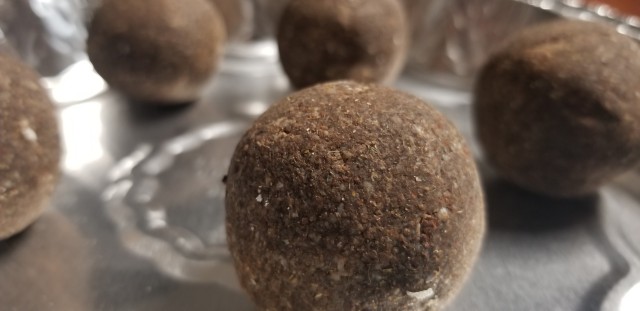
Figure 7. Balls of soap that were, theoretically, lavender in nature.
They’d been drying over a week. They should have been rock solid. But the weather has been garbage. And these fakeys had the very slightest amount of squish.
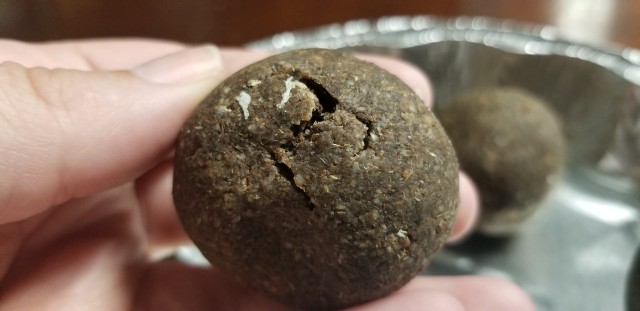
Figure 8. Local apothecary experiment decides to give up on life, love, structural integrity.
But I will also say that the most disappointing thing was that I–
I did not appreciate the smell.
There was a nice slice of clove that hit if you gave it a moment, but overlaying it all was the dampening, dusty, unpleasant scent of what I was fairly certain was that goddamned powdered orrisroot.
AND THIS MAY WELL BE UNREASONABLE but I had grown to expect a certain cookie-scented lifestyle and therefore I was not sure at all that this batch, even if it dried completely, would do.
(…And even with the later, let us say, injudicious application of a low-heat oven, it never did. As I predicted. From the second photograph.)

