Regarding the Pearl Pomatum, here are all of the posts grouped together! Read in one go or skip to:
- 27 March 2023
- A Brief History of Putting Pearls in Things (In Europe)(And Also My Workshop)
- The Incredibly Big Difference Between Essence of Pearl and Seed Pearl in Fine Powder
- Or Is It
- Also No
- Finding Some Real Goddamn Pearls in This Degenerate Age
- Chymistry
- Inciting hordes to riot
- The Pearl Pomatum: A New Ally
- The Pearl Pomatum (at long last)
- The Pearl Pomatum, Cont’d
Originally posted on The Minor Hours and Small Thoughts Magazine (issue 38 and A Minor Thought) and my regular blog.
Or! Head hack to the general Experimental Archaeology collection.
Regarding pearl pomatum
27 March 2023
It should be said directly: None of what I describe in the below should be repeated by any reasonable persons. Do not make my mistakes.
——————————
27 MARCH 2023
On this date, I wrote the following:
“The things I learned about fake pearls tonight cannot be unlearned.”
(Beneath it, I wrote, “It’s been an Evening, boys.”)
A BRIEF HISTORY OF PUTTING PEARLS IN THINGS (IN EUROPE)(AND ALSO MY WORKSHOP)
It was not until April of 2023 that I finally revealed what had occasioned the above comment, but eventually I was ready to reveal all– and herein lies that story.
Some lengthy time prior I had found two related recipes, both of which are nearly identical and so are probably just the same recipe edited across a decade. The first is from the 1696 English translation of Barbe’s The French Perfumer:
Another sort of Pomatum, very fine for the Face.
TAKE two Ounces of Oyl of Sweet-Almonds, half an Ounce of Virgin-Wax[,] four Penny-worth of Sperma-Ceti; melt the whole together in an Earthen Dish, over a Chafing-dish full of burning Ashes; stir gently the Wax with a wooden Spatula, that the whole be well mingled and incorporated: Then take off the Fire your Composition, and pour to it by degrees some fair Water, beating it in the mean while with the Spatula. Continue so doing till your dish is full, and your Pomatum congealed in the Water, for it must swim in the Water: Having so beat it a long while in the first Water, pour the Water out, and put some fresh, still working your Pomatum till ‘tis white, then it will swim upon the Water; take it out with the Spatula, and work it without Water, till it is very white. All the Water being strained out of your Pomatum, mix in it Borax beaten very fine, of the bigness of a small Nut, and some Essence of Pearl beaten very fine; mingle it all together very well, and ’tis done.
The second is from the 1711 English translation of our lip-balm lad Lémery’s Arcana Curiosa:
Another very fine Pomatum for the Face
Take Two Ounces of Oil of Sweet Almonds cool-drawn, half an Ounce of Virgin’s Wax, set ’em over a gentle Fire to melt together, after this fine [?] ’em in Spring-water again and again till the Pomatum comes to a pure Whiteness, then add a little Borax and Seed-pearl in fine Pouder, and beat up again to the Consistence of a Delicate Unguent.
I really loved having these two recipes to compare against one another– Barbe has more detail, but also wanted me to add a little over 8 grams of whale goo to the mix, which I was disinclined to do. Meanwhile, Lémery’s recipe is considerably shorter and in more modern English (hooray for a decade of development!), but it’s a recipe that clearly relies on some shorthand terms– which, fortunately, are described by the earlier Barbe text.
(NOTE: Regarding whale goo, artificial spermaceti exists! It’s called cetyl esters wax, and it’s made from coconuts. But also, apparently the previously-a-mystery-to-me jojoba oil is considered a reasonable replacement– so if you ever want to gross out people, here you go, just start talking about how the jojoba oil in your friend’s homemade whatever is there to replace the skull wax from sperm whales.)

Figures 1-3. Identical objects, apparently.
Since spermaceti left the recipe sometime between 1696 and 1711, I wasn’t particularly concerned with getting any of its replacements. However, I was intrigued by the change to the “pearl” ingredient thrown in at the end.
Was there, I wondered, any difference between “Essence of Pearl” and “Seed pearl in fine powder”?
THE INCREDIBLY BIG DIFFERENCE BETWEEN ESSENCE OF PEARL AND SEED PEARL IN FINE POWDER
There are quite a lot of ways to prepare pearls, if you’re a 1600s apothecary.
“Magistery of Pearls” is pearls dissolved in vinegar.
“Salt of Pearls” is the salt leftover from when Magistery of Pearls is distilled in an alembic.
“Aqua perlata” is pearls dissolved in lemon juice, decanted, more lemon juice added back in, and then an enormous pile of sugar to finish up– essentially lemonade with Super Pearl Power (TM).
There were also Oils, Liquors, Tinctures, Arcanums, Flowers, and Spirits– all of which, if your name is Moyse Charas and you’re feeling salty about unscrupulous Authors, were “drawn forth by the help of corroding Menstruums, which are rather Destructions than Preparations.”

Figure 4. Local calm-looking apothecary with fab hair
nonetheless ready to throat-punch next person who suggests dissolving pearls in vinegar.
Pearls were considered a really special medical ingredient, useful for things like heart palpitations, diseases of the eye, poison resistance, healing from pestilence and malignant fevers, a “great help for those who are sad or timid in every sickness which is caused by melancholia“.
Pearls, though, were really expensive, which to be honest was probably a large part of why they were Special. So there was, let us say, an opportunity for a clever inventor to fill an otherwise empty commercial niche.
Enter M. Jacquin and his process for creating artificial pearls.

Figure 5. A handy illustration of several unnamed women just doing their best and also some guy’s invention I guess.
M. Jacquin made rosaries, and he wanted pearls for them– but he also wanted regular people to be able to afford those rosaries. Around about 1656 he figured out that if one harvested the scales of wee fishies, the natural iridescence of those scales could be extracted and then applied to stuff to make fake, but nice-looking, pearls.
That iridescence is, ta da, Essence of Pearls. Mystery solved.
OR IS IT
Cool, I thought. Well, let’s just see if ground-up fish scales are still around–
Neat! They are! In fact, while the name “essence of pearl” isn’t used so much anymore, this stuff is often referred to by the chemical structure: crystalline guanine.
(You may recognize “guanine” from such fabulous places as our DNA, the related word “guano”, or this list of FDA-approved colorants that are exempt from testing and are also coincidentally used frequently by very fancy cosmetic companies.)
What I discovered, though, after whole minutes of fruitless searching, is that wee little independent weirdos like me can’t get crystalline guanine for love or money– it’s just not available in the consumer market.
Real pearl powder, on the other hand…
ALSO NO
Pearl powder is both expensive and hard as hell to ensure is pure when you’re just a funky little alchemist like myself. I came to the conclusion that, really, it made the MOST sense to just buy a nut grinder and a bag of seed pearls. Goodness, thought I, how has no one else conceived of this notion? I am a genius of truly astonishing proportions.
…let’s fast forward a bit.
Imagine me in my workspace. I have a bag of freshwater pearls. I had boiled them the day before to clean them of ickiness, so there was nothing stopping me from taking out my new grinder apprentice, a strapping lad named Henrik who had a bit more muscle power for pearl pulverizing, and going to town on these little lads. Powdered pearls, and therefore an extremely fancy pomatum, were within my grasp.
I paused to take several very cute process photos. Everything was going great.
…Until I tried to actually grind the bastards. Whereupon my suspicions were raised as to the veracity of their nature when, rather than neatly grinding down into powder (as anything in the 2-to-4 range of the Mohs hardness scale ought), they proceeded to make a hideous cracking sound, smell like burnt hair, and beat the ever-loving shit out of poor Henrik.
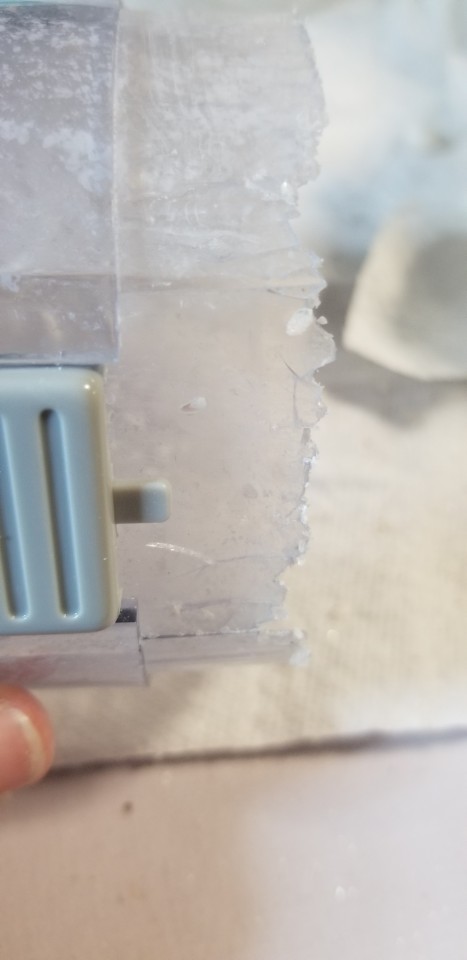
Figure 6. This started the evening as a new and flawless grinder lid.
I do not relish telling young Henrik’s family of what happened to him under my cruel mastery.
Just in case this turned out to be a case of my picking the wrong tools for the job, I also hauled out a metal mortar and pestle and tried whacking the pearls. Notably, this was also a colossal failure.
My hopes and dreams for outwitting the 17th century and having easily sourced pearl powder? Dashed.
FINDING SOME REAL GODDAMN PEARLS IN THIS DEGENERATE AGE
This, as it turns out, was harder than it looked. So here’s my hard-won wisdom, such as it is.
Some tests one can perform in public before purchasing pearls:
- Check that they aren’t all identical. (Machines make identical things. Weird biological processes make weird biological things.)(Note: This is also a fascinating way to determine fakeness in cryptid sightings. If that is. You know. Something you’re doing. Anyway–)
- Check the surface feel. (Pearls are made in layers and have a textured surface. If you rub them against each other or on your teeth, they feel gritty.)
- Weight/touch/temperature. (These are apparently also ways to tell the difference between real pearls and fakes. I have no confidence in my ability to use these methods, and therefore I decline to consider them further.)
- Check the drill holes. (Because of how soft pearls are, beads made from real pearls must often have very tiny holes so as to not destroy the overall structure. Fake pearls have larger holes, and under magnification those holes look kind of funky.)
Using these methods, plus a perhaps naïve assumption that truth in advertising was a law that covered both regular companies and the peddlers of pearls, I had assumed the shiny boys I’d purchased were real. However, there are many fakes out there that are genuinely trying to fool people (such as hapless hobbyists just trying their best–), and these methods won’t work against them.
(Incidentally, I’m not saying there is no purpose in this world for imitation or artificial pearls– which are different from “fakes”, in my mind, because they’re not trying to fool anyone. Some common imitation pearls are bathed pearls, cotton pearls, glass and Majorica pearls, Roman pearls, etc. – provided they’re labeled as such, they’re okay fellas in my book.)
Anyway. Let’s look at some of the things that can be done once you have some pearls and, also, no witnesses to your crimes.
- Fire Test
So for real, probably don’t do this one. But if you do, be advised that:
- The internet says real pearls, held in an open flame, won’t smell. Whether this is true or not, I can say that fake pearls do, and it is not a smell that is easy to dissipate. So, uh, fire tests should be conducted outside. (Except don’t do fire tests.)
- The internet also says that real pearls won’t scorch under an open flame. Or maybe they do, but it wipes off easily. Or maybe they do, and they’re permanently discolored, but they’re not peeling or anything. Or maybe they don’t scorch, but boy howdy they can explode.
All this to say: The internet was singularly unhelpful with regard to actual consistent instructions and results for the fire test, and I am now wondering whether any of my 1600s alchemical guides provide better details on the matter.
- A Big Ol’ Hammer
Remember the Mohs hardness scale? And how delicate real pearls are?
Yeah.
I have, since the tragedy that befell Henrik, gone and bought some more pearls. These, again, passed that first set of “in the store” tests. But it was time for stronger measures.
(No, I will not be discussing what happened with the fire test. Which I definitely didn’t do in March of 2023, nor did I do it indoors, nor do I regret any of the things I definitely didn’t do related to holding the pearl for far too long under the flame and also what it smelled like. You can’t make me, mostly because, as mentioned, it didn’t happen.)
One of the fake pearls, when smashed by the hammer, did not smash. It did make a valiant attempt at destroying my hammer. One of the newer pearls, when put to the hammer, kind of smooshed and revealed a tiny sad pile of powder after just one love tap, thus suggesting that it is, in fact, real.
NOTE: A gem/jewelry person of my acquaintance has, during the course of writing up these adventures, let me know that when grinding, drilling, or filing sea shells, one should wear a face mask because the dust is liable to make one ill (case in point: heavy metal poisoning is No Joke). Whether that is also the case with pearls is an interesting question, but one of the ways to make fake pearls is via shells and mother-of-pearl, so, like– masks are probably a Very Good Idea when doing any of this, or when working with dust of any kind.
- Vinegar Time!
If you take a real pearl, and put it into white vinegar, it’ll do two things:
- Get a fine sheen of small to largeish bubbles across its surface as the calcium carbonate in the pearl and the acetic acid of the vinegar bang into one another and form carbon dioxide bubbles. It’s pretty! It’ll also muck up your pearls, so only do this with test pearls or ones you intend to turn into magic medicine I guess. (No don’t do that, Moyse Charas will come back from the dead to punch you in the throat, we discussed this already.)
- After a few hours (think 24 or so) a very small pearl will dissolve, leaving a kind of gooey shell that you can squish and dissolve too.
You can see a video here demonstrating both the vinegar and the lemon dissolution of pearls, but with regard to my new wee pearl babes in arms, who are– so far as I can tell and without the benefit of actual, like, gem science thingies– actually real, here’s what two of them soaking in vinegar for a few days have been reduced to:

Figures 7 and 8. Two pearls gone swirly in a vinegar bath (left) and the goo left behind (right).
…and if you think you see burned bits of pearl in that vinegar, no you don’t.
Chymistry
It’s wild to me that I am, in my adulthood, in a way, coming to chemical science and formulation.
Meanwhile, I need powdered oyster shells. For Reasons.
Inciting hordes to riot
Or alchemy, same difference.
I’ve slightly mentioned that these are write-ups from earlier/elsewhere that I’m transferring to a more useful/linkable place (i.e., HERE, FRIENDS) until I’m all caught-up and can start telling tales in real time. I’ve got myself on something of a timeline to finish the transfer process because of certain THINGS I hope to have CONFIRMED SOON, so expect more frequent posting.
(And if there is a Narrator waiting in the wings to provide commentary on the likelihood of the above, please do me at least the kindness of waiting until I’ve left the room.)
In that Elsewhere place I was posting I sometimes received queries about my shenanigans, and even sometimes news that others had joined in on the fun. While it seems injudicious to copy over other people’s commentary for a number of reasons, here is a brief summation of a message I received at this point in my historical journey:
- They made the lip balm! But it was a different color than expected, and also very coconut-y.
- They also made the pearl pomatum, even before I had done so myself, based on the recipe I had shared! But it was waxier than expected, and therefore face-application seemed… unwise.
Below, find my more thorough reply.
The Pearl Pomatum: A New Ally
I was deeply interested in what that other Gentle Reader’s pearl pomatum’s consistency ended up being, because my version 1.0 (which I had completed THAT VERY EVENING, so keep an eye out for that write-up) was what I’d call a Ye Olde Cold Cream rather than a more modern facial lotion (which tend to be moisturizing without being heavy, as opposed to this, which is easy to use, deeeeefinitely moisturizing, but, uh, will definitely get that moisturizing goodness on anything it touches, goddamn).
My version came out buttery af, and seems to still be so, but somewhere between removing it from the water and adding the borax (which, note: I did that for Science, but don’t you do it, readers), the mix got itty bitty granules in it– just enough to be annoying. Bah.
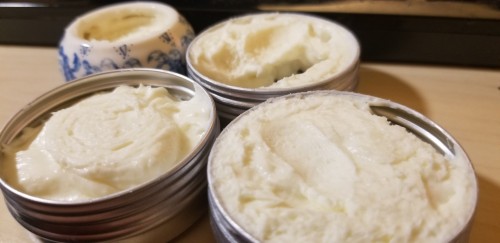
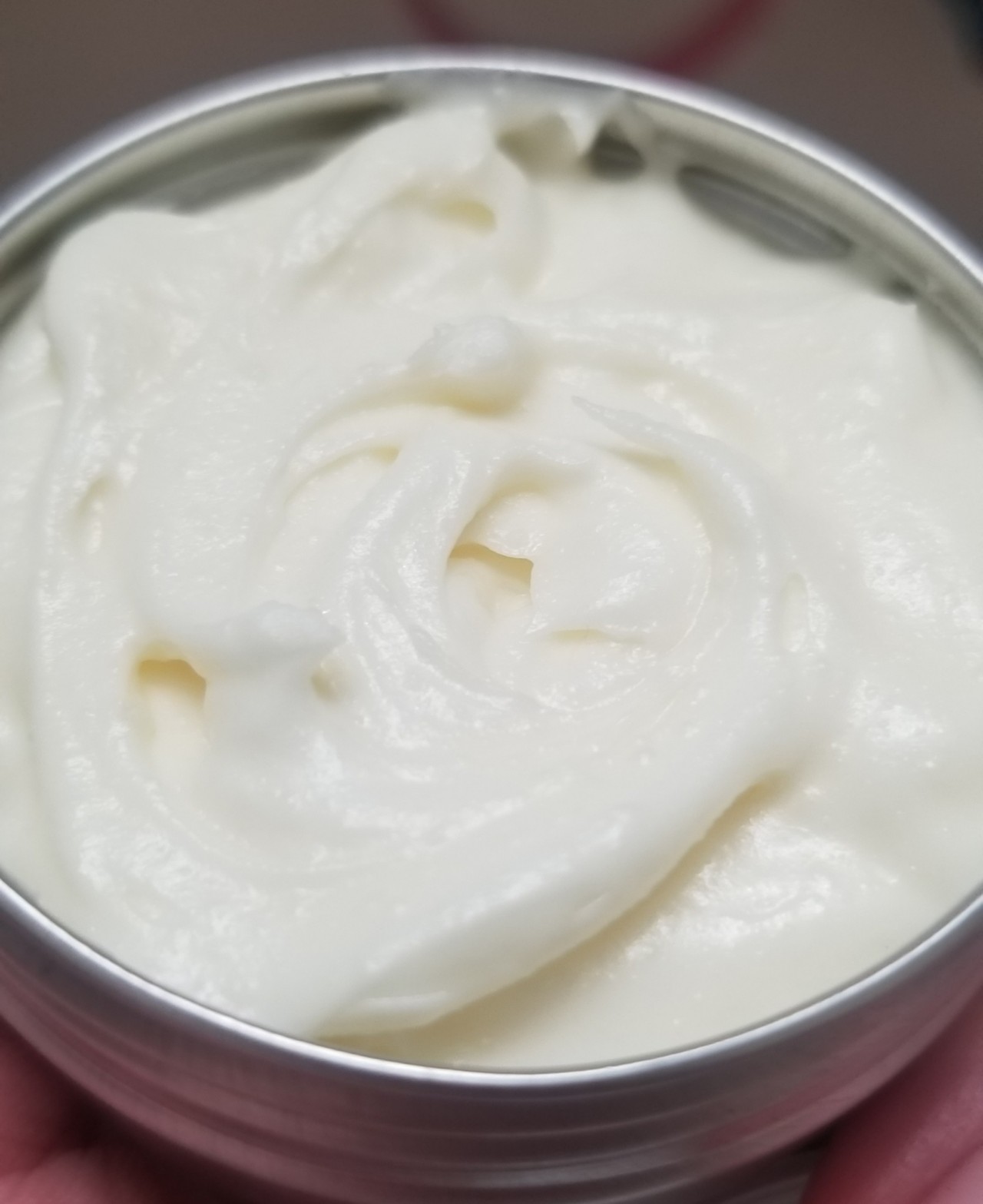
Figure 2. A smooth(ish) operator pomatum; aka, a sneak peek into later apothecary revelations.
That particular night was late May, 2023, and I have none of that original batch left as it was, for the most part, tossed to the trash gods… except one, which I kept for the betterment of society and also to see what would happen.
Much like my lesson with the tablets, I have learned two things:
1. I can now very reliably report that, even when kept out of direct sunlight, that “trick” where you draw on ceramic with a Sharpie and then bake it in the oven to “set” it does not, in fact, stand the test of time. A tragedy for us all.
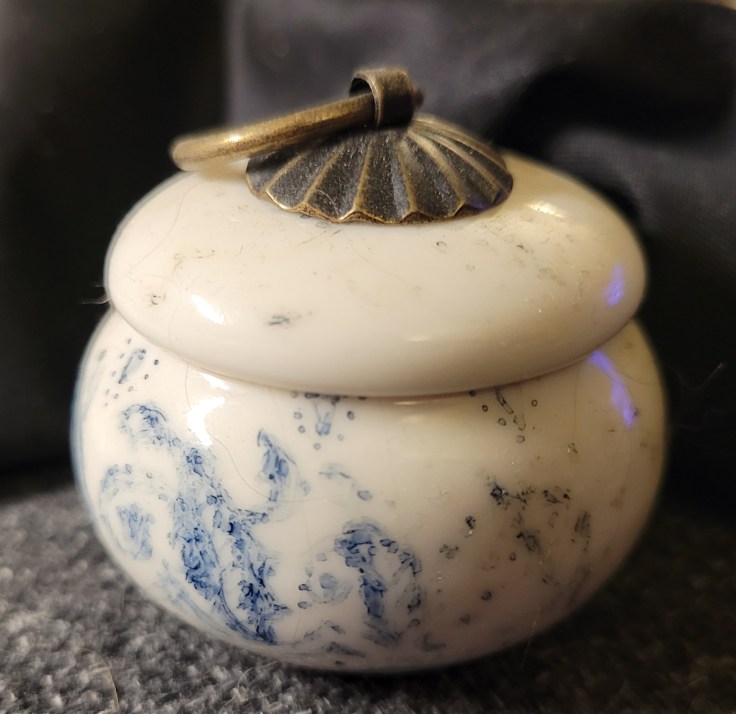
Figure 3. A wee ceramic buddy, but a single inch wide and of questionable glazing.
2. While I have no intention of touching it again, it’s certainly fascinating that, even two years later, this concoction does still sort of look like, well, skin cream. (And it still does not come anywhere close to the horror of the 3.0 falafel soaps in terms of smell.)
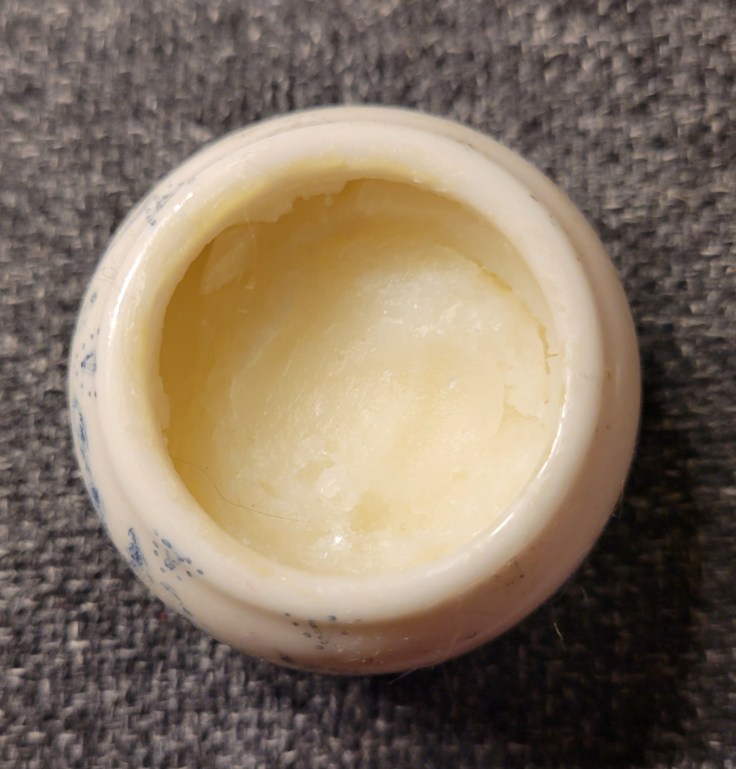
Figure 4. An interior of goo, which is as apt a description of Man as any other.
The Pearl Pomatum (at long last)
The time has come for some actual pomatum and 100% less fun with fire (as the prophecy foretold).
When last we checked in on our intrepid hero (me), I had cruelly destroyed one of my young apprentices, poor Henrik, in the pursuit of making my own pearl powder. When I couldn’t find a replacement lid for him, I went ahead and bought his brother Frederik– who then, promptly, was likewise destroyed in yet another attempt to powder pearls that we don’t need to talk about don’t worry everything’s fine just keep moving everything’s find it’s fINE–
Ahem.
Brave lads, we salute you, but I can only destroy so many coffee grinders before I start to feel like maybe enough’s enough– so I finally succumbed and bought some actual cosmetic-grade micronized pearl powder as suggested by a helpful Reader.
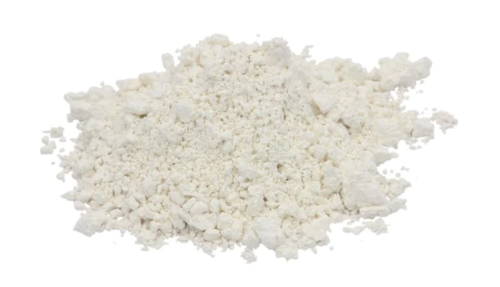
Figure 1. Totally normal, not suspicious-looking micronized pearl powder,
where “micronized” means “not cocaine, regardless of certain choices made in
product advertising photography.”
Ingredients-wise, this means I could get to work making the pearl pomatum with the following ingredients:
- 2 ounces of sweet almond oil
- ½ ounce of beeswax
spermacetiahahahaha no, we’ve discussed this, no whale skull wax goo thx- a Bunch of rosewater (just keep a bottle ready, tbh)
- a heaping quarter teaspoon of pearl powder (because I like to be Fancy)
a teaspoon of boraxNOPE replace with maybe four teaspoons of baking soda
Actually, on that note, I’ve talked about spermaceti briefly before, but now it’s time to talk about a new historical ingredient– [Borax: The Troublesome Lad]
The Pearl Pomatum, Cont’d
Take my hand. Look into my eyes. Feel me when I say:
Making this pomatum is basically magic.
To start with, if you look at the ingredients, it’s a bunch of yellow stuff and clear stuff, no in-between.
By the time we’re done with this recipe, though? That whole mix is gonna be WHITE and it’s gonna be SMOOTH AS HELL.

Figure 3. Sweet almond oil and broken up chunks of beeswax just starting to melt
in their wee silicone tub (in the less wee but still fairly wee pot of boiling water).
(Side note: For those who are curious, that silicone pot is actually for melting chocolate, and they’re super cheap and easy to use.)
The second bit of magic, though, is revealed in the directions from one of the recipes. Simon Barbe, who is delightfully thorough in his descriptions, wrote:
Then take off the Fire your Composition, and pour to it by degrees some fair Water, beating it in the mean while with the Spatula. Continue so doing till your dish is full, and your Pomatum congealed in the Water, for it must swim in the Water: Having so beat it a long while in the first Water, pour the Water out, and put some fresh, still working your Pomatum till ‘tis white, then it will swim upon the Water.
See what I bolded there? “Swim in the water.” “Swim upon the water.” Sounds fanciful as all get out. Nicolas Lémery, whose directions are considerably shorter and more off the cuff, doesn’t mention anything about “swimming” – and in looking at later, related recipes, that little detail also tends to get omitted.
I wasn’t sure what the hell it was supposed to mean, so I figured I’d just follow Barbe’s directions to see what happened. As soon as the beeswax and almond oil had completely melted together, I took the pot out of its bath and starting pouring in “by degrees” the rosewater (presumably so I would not, again, explode my workspace):

Figure 4. Glug glug, lil guy.
You’ll notice, from the photo, that the mix turned pretty quickly into something (still) yellow that went from a thick liquid to something the consistency of, say, creamed honey. Not swimming, not white. BUT I PERSEVERED.
Little by little, the wax and oil mix took up the rosewater (via the wonder of emulsification)– but the directions said I had to slowly keep adding water until it reached the top of the container. Plus whatever that swimming thing was. So then I kept going, adding more rosewater to make up for what was soaked up, mixing mixing mixing, and seeing… a change come on.
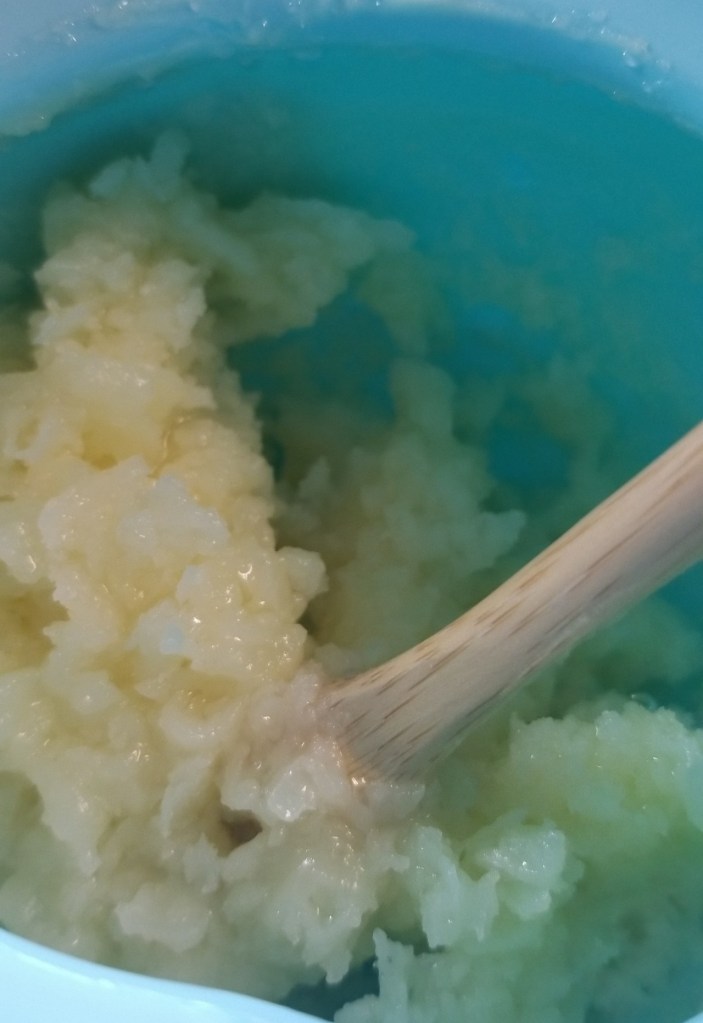
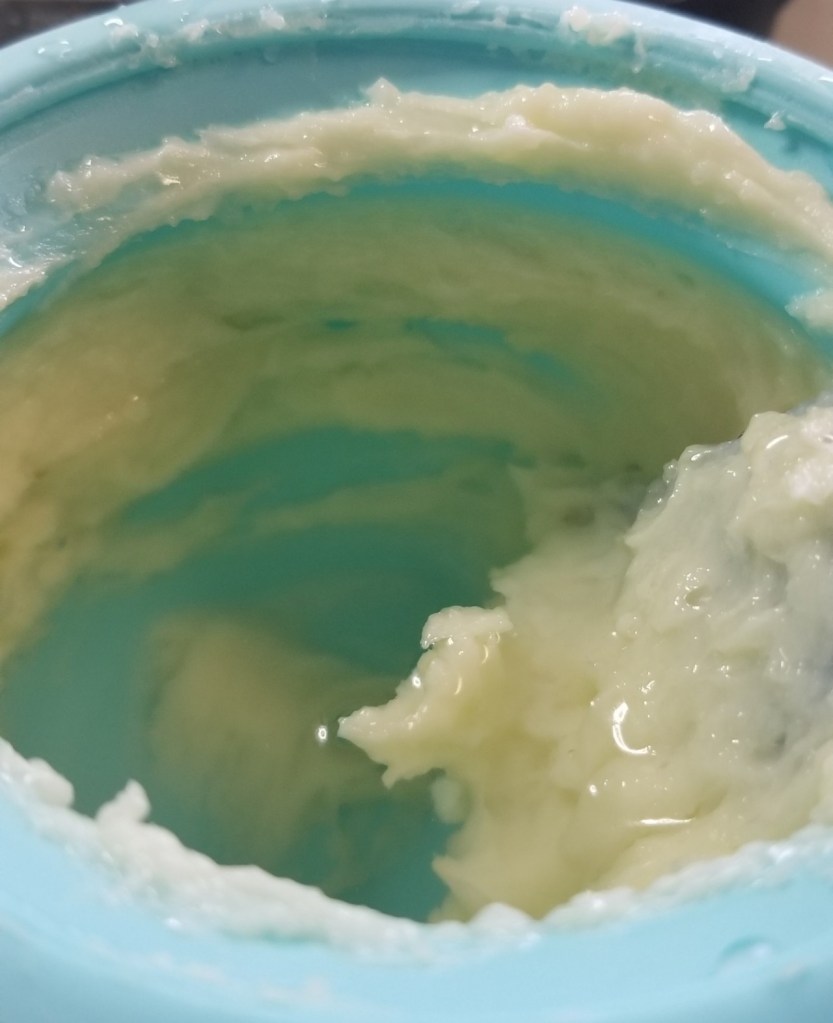
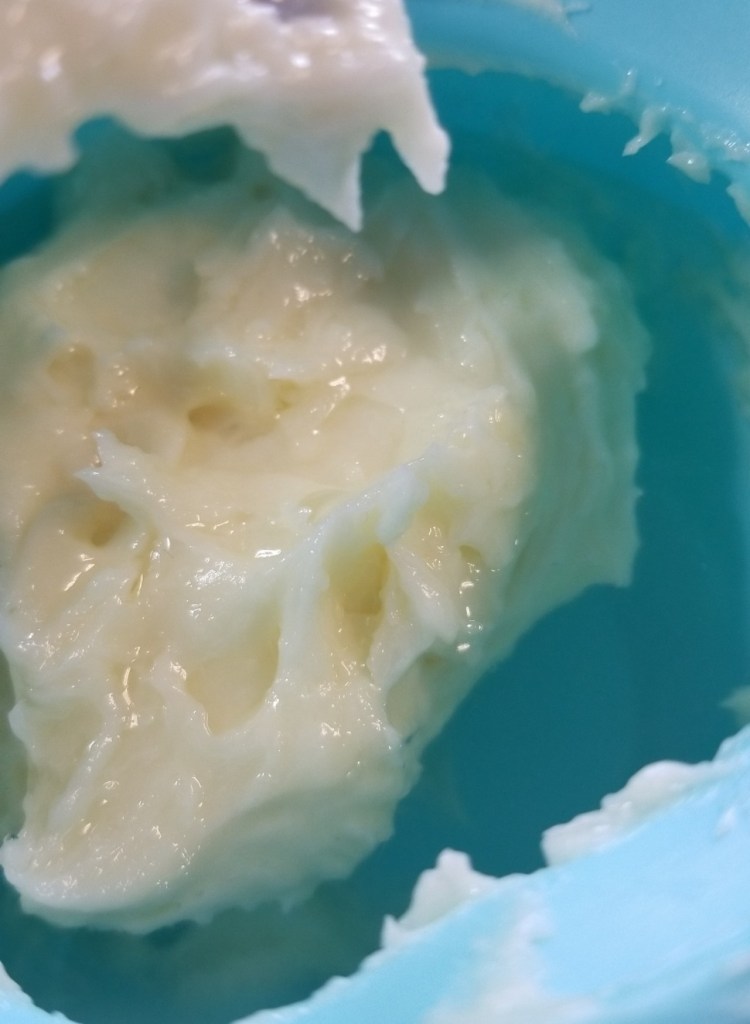
Figures 5, 6, and 7. Clumping together, and then… whaaaat
“OH,” said I. “SWIM. He meant it’s gonna fucking float.”
With a spatula, a bone-deep curiosity, and a podcast playing, I kept at it until, yup, I got all the way to the top of the container with rosewater– the mixture was now white– and by golly, the thing swam upon the waters.
I’ve since found that I don’t need to do a second-round of rosewater if I keep working the mix until it flat refuses to take up more water– instead, I can go to the next step, which is
take it out with the Spatula, and work it without Water, till it is very white. All the Water being strained out of your Pomatum[…]
So I was supposed to pull the pomatum out of its bath and squish it a bunch to remove the leftover, unemulsified rosewater. Which I did, pouring the excess water into the pot I’d been boiling things in.
HEY DO YOU WANT TO SEE WHAT ALL THIS LOOKS LIKE BECAUSE GUESS WHAT
Video 1. The pomatum after it has reached full on “swimming upon the waters” state,
such that I can jiggle the watery little fucker, followed by “working” the pomatum
on a room temperature pan to remove the excess rosewater.
Briefly, regarding the “room temperature” thing: I think the crystallization I got in my version 1 test (with the borax) was because the mixture moved from its warmish bath to a colder-than-it pan, and made it seize– therefore I think it may actually be worthwhile to have a slightly warmer than room temperature pan, though I’m not sure how to achieve that in a reasonable way. Put it in a warming oven? Do any of us have warming ovens?
Either way: Avoid having a cold pan.
Onwards. As soon as I stopped being able to squish rosewater out of the pomatum, I added the baking soda a little at a time and beat the snot out of it some more. It didn’t significantly change the consistency at this point, but it did help with the thickening once I finally stopped whacking it, going from a thick lotion to a more creamy balm.
Finally: the pearl powder. Apparently good for the skin in a variety of interesting ways, but mostly just adds the very faintest of sparkle to the overall pomatum.
Mixy mixy, scoopy scoopy, shut the lids and done. It makes about five .75 ounce tins, with an extra one for testing purposes. You will never, ever, ever get this pomatum completely off whatever tools you end up using, so just, like, hit up a thrift store and pick your eternal warriors.
So how does the pomatum look when it’s done? BABES, LEMME SHOW YOU.
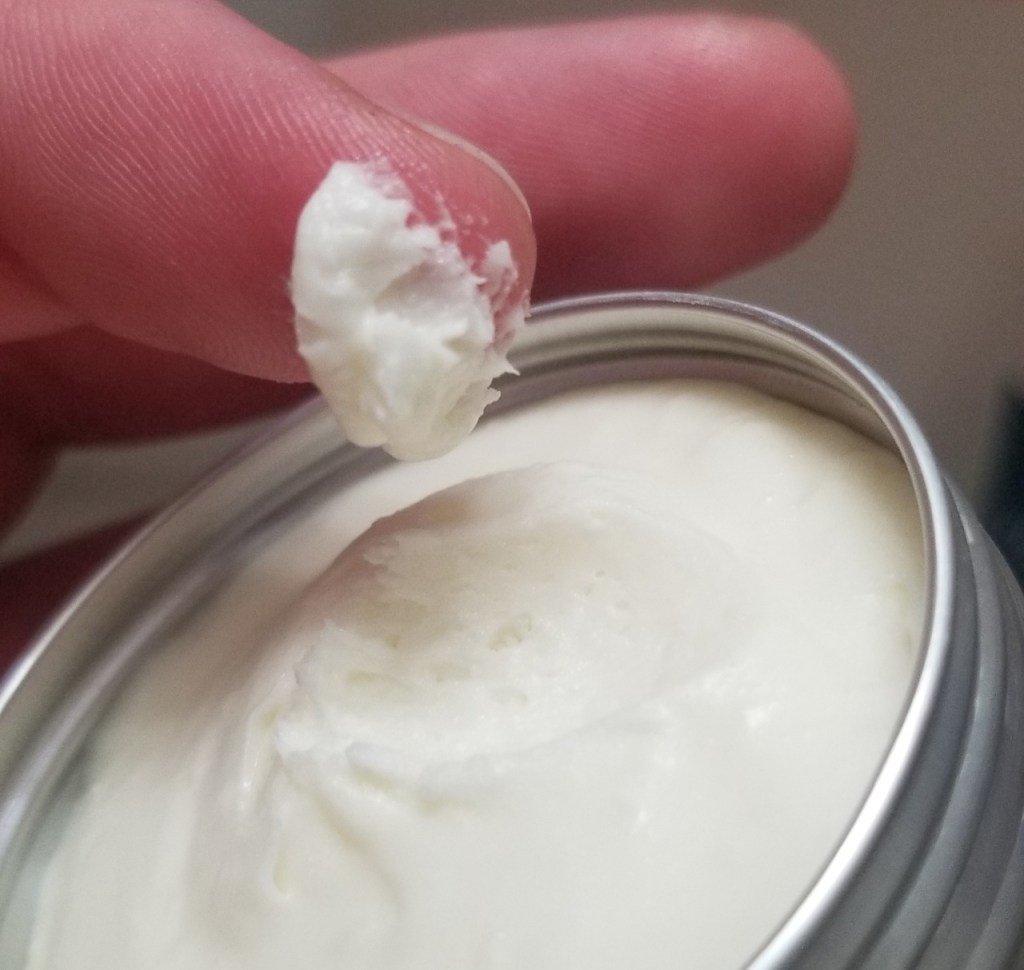

Figures 8 and 9. SO FUCKING PRETTY.
It smells like roses and needs truly miniscule amounts to moisturize places like my elbows (like, we’re talking the size you see on my fingertip there or smaller).
But it’s not just a moisturizer– the baking soda (or, previously, the borax) is basic enough to slightly saponify the beeswax… which means I have, once again, made SOAP.
(THIS IS MY LOT IN LIFE, I AM COMING TO ACCEPT IT.)
Really, though, this pomatum is actually what we call cold cream, which works as a moisturizer, a facial cleanser, a makeup remover, and a visual gag in a lot of early comedies. (Female-presenting person with a towel wrapped around their head and a face covered in white goo? That’s cold cream.)
To be completely thorough, I did “wash” my face with it– by which I mean, I took a two-fingered scoop of the stuff and massaged it into my face, leaving it there for a couple of minutes because hey, felt nice. It smelled nice, too, which was delightful. Then I took some cotton rounds, wetted them with cold water, and wiped it off.
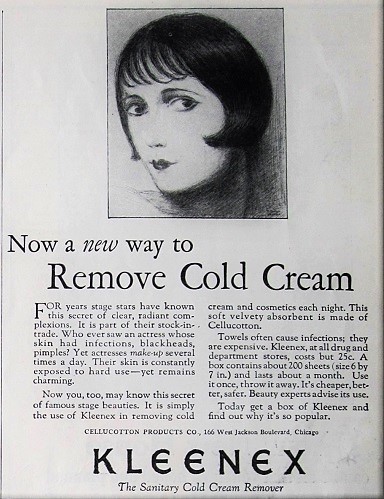
Figure 10. Side note: did you know that Kleenex was originally invented
as a disposable towel for removing cold cream, and only later marketed for blowing noses?
I think the pomatum worked, because it definitely seemed to dirty the rounds, but I don’t wear makeup so I didn’t get any proof of that aspect of it. However, I can say that my face? Has never felt so soft in my goddamn life.
And finally, for anyone keeping track:
To make one 2-oz tin and two ¾-oz tins of pearl pomatum takes approximately two-and-a-bit Wellington Paranormals.
…Pretty sure I am accurately nailing apothecary timekeeping, and no I will not accept anything more accurate.

