
As I sit here with the luxurious scent of soap I bought in London gently wending its way from betwixt the too-weak atoms of the quart-sized freezer bag I’ve unceremoniously shoved them into, I think to myself: Yes, good, this is the atmosphere I need to relay more Soap Adventures.
Before I start, though: I am super aware that I’m playing around from the opposite end of most modern soapmakers– there may be very obvious ways to accomplish the stuff I’m trying, or there may be very known reasons for why the stuff I’m doing is or isn’t coming out right. But since my entire vibe is “”“What If: Shenanigans,”“” I’m trying to suss my way through all this via just the manuals and receipts I can find, and seeing what happens based on that.
If you want to play along, soap-wise, recipes I’ve referenced so far:
- “Balles of fope for barbers of diuerfe fortes and favours” (Balls of soap for barbers of diverse sorts and savors), The secrets of the reverend Maister Alexis of Piemont (1595)
- “A delicate wafhing ball.” (A delicate washing ball), Delightes for Ladies (1609)
- “Of Soaps that Beautifie”, Cosmeticks or, the beautifying part of physick (1660)
- “CHAP. XVIII. Of perfuming Soaps”, Polygraphice (1685)
- “A delicate washing-ball”, The Accomplish’d ladies delight (1686)
- “To make excellent Washballs”, Pharmacopaeia Bateana (1694)
- “Of Wash-balls”, The French Perfumer (1696)
Okay, so! When last we left off, I had two versions in the works. Let’s talk first about:
1. Lavender wash balls
Version 2.0 (AKA the glow-up, AKA the scratchy scratchy snack ball, AKA this cookie-scented monstrosity) continues to live a long and fruitful life in my shower, and I’m actually really very into it now. Like, this guy? My best little bud. Old photo but, for real, it has not changed significantly. Still amazing.

Figure 1. Look at this guy. What a weirdo. I love him.
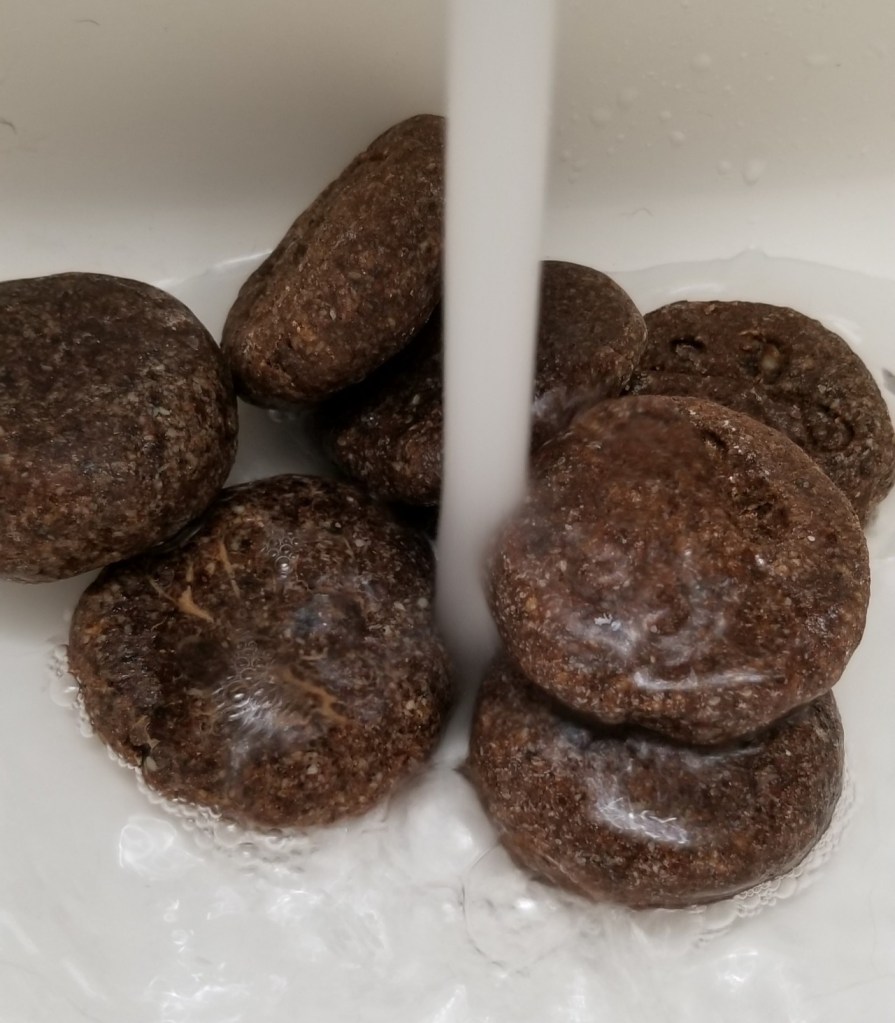
But I also have Version 3.0, AKA the kraken cake…

Figure 2. …aka the Deceitful Liar For Reasons That Will Become Apparent…
…or rather, I had Version 3.0.
What I have since discovered is that if these soaps don’t dry out, at least on the surface, within a couple of days– and certainly by the 10-day mark– then something has gone horribly awry. By the time my next batch of soaps (the neroly wash balls, which will be discussed below) were done and dried, the kraken cakes were still squishy to the touch– and, even more worryingly, they had begun… to smell.
And that smell was not equivalent to cookies, candy, or, for that matter, anything you’d want on your skin.
As all good experimental alchemy requires, I did try to use them. Just in case. And it was. it was pretty gross. I had to wash my hands a second time just to get the funk off, and even then it still haunted me.
So far as I figured at the time, these little fake-outs didn’t dry as they ought for some weird reason, and because of that they went… rancid? Moldy? Something like that. It was deeply gross, which is maybe what I get for invoking The Kraken when naming them. I gave them a funeral befitting of their service to the experiment, and then I stuffed them in the trash like they were a puppy’s midnight accident.

Figures 3 and 4. Burial at sea, shit-bag in garbage.
Okay, so… version 3.0? Not ideal. So for the next round of experiments:
- Lower the amount of orrisroot powder
- Skip the essential oil
- Add the powdered lavender flowers back in
- Either keep them as balls or figure out a better way to dry the falafel shape
- …or accept that my ugly boi version 2.0 is the best we get with this
(Ha, I accept nothing I will FIGHT FOR THESE BALLS.)
2. Wash-balls of neroly
While I was waiting for the kraken cakes to dry (ha), and because I finally got all the ingredients in, I started on a soap recipe that involved large amounts of orange-blossom water and neroli essential oil– basically both the by-products of steam-distilling bitter orange blossoms (oil goes up; water goes down; blossoms presumably go in the trash) all stuffed in one recipe.
Note: In the past, I’ve said that late-1600s/very-early-1700s didn’t really do essential oil as we know it, and this is largely true– but mostly because they didn’t have the industrial portions of raw material and equipment to make it worthwhile for most stuff. (Looking at you, lavender.)
Orange blossoms, on the other hand, had what the sages called shittons of oil in them, and therefore using just common alembics was sufficient to get enough oil for whatever purpose. The bigger issue was just being in an area where bitter orange blossoms actually grew— and if you weren’t from around there, you had to get the stuff imported, and that’s why it was largely for Rich People.
Now, normally I like to plan out my little essays about experimental archaeology and provide process pictures and stuff like that. That was, in fact, what I intended with these neroly wash balls. Like, look! Here’s a pic of the “cover your dried, grated Nabulsi soap in orange blossom water and then wait APPROXIMATELY FOREVER for it to soak up until it’s ‘workable'” step!

Figure 5. Soap et orangey-water.
Per Simon Barbe’s instructions, the next step was to stir it twice a day. Which I definitely did, except I didn’t, I only did it once a day for maybe a week and then I left it for almost five days because whoops. By the time I had the opportunity to check on it again, it had reached what I thought was the “workable” stage, so I started, uh, “working” it–
–which led to that panicked WHAT HAVE I DONE late-night posting where I explained nothing of my previous experiments and mostly just flailed around like a loon as I discovered that this whole mess now had the consistency and approximate stickiness of the devil’s melted marshmallows.

Figure 6. Surprise action shot of my god actively forsaking me.
I was, as per my insane posting, eventually able to actually create balls out of the stuff. And they looked pretty! And for once, something from this time period didn’t smell like cookies.
Anyway– after some drying time– where the salt I used to solidify the soap did not particularly help their appearance, whoops– I came back to discover the scent had matured from “field of flowers” to “jfc is this CANDY”, which, like, why.
And in the intervening time, I have started using the soap regularly. Behold:

Figure 7. A beautiful little wash-ball of neroly, just for me.
And I just… I’ve gotta take a moment here. Because there are two important issues I need to expound upon.
a. The scent of this soap
I feel like I’m not being as accurate as I could be with this stuff. Like, maybe this is just what neroli smells like? Maybe this isn’t how anyone else would perceive it. Maybe it isn’t, in fact, all that special.
But I think the unusual scent combinations just do something to my busy ADHD brains. When I wash my hands and then, like, immediately stuff my face into my palms and inhale, my mind doesn’t flash to actual “scents” but– more like convoluted descriptions? Saying it’s “candy” or “flowers” doesn’t really match up, it’s more like a soundless pinball machine of sense memory and aphasia that spits out results like:
glass… candy? candy glass? like what hot sugar that’s going to be turned into candy shapes looks like it should smell like?
and
really really really really really really fancy hotels, like, not real fancy hotels but like
movie
fancy hotels
And I mean… what do I even do with that? How do I live my life having all these feelings about this soap and these people who lived in a time where this soap was possible–
Gah.
b. The consistency of this soap
Fortunately, though, whenever I get too full up of Feelings about the World and Art and History and the Unbearable Beauty of Humanity, I remember something.
The ‘something’ I remember is that this soap is largely olive-oil based.
Olive-oil soap, when described kindly, is more lotion-like than sudsy. You can, in fact, see a little bit of that on my fingertips in the photo above.
…Again, though, “lotion-like” is a very kind description.
A more accurate one might be… liquidy.
And in the case of this soap… white liquidy.
…And. And let us stop there, and remind ourselves again that the soap smells like candy, and we will continue on with all our lives and say no more about it.
Discover more from Katherine Crighton
Subscribe to get the latest posts sent to your email.

