——————————
SOME EDITORIAL NOTES
I was wondering aloud today whether there might be value in a Sunday Edition of these pages, with puzzles (and perhaps cartoons?) to wile away the hours– particularly as we are entering a period of time where perhaps a distraction such as that might be a welcome one at present.
We shall see today whether such a thing will come to pass.
——————————
LAVENDER OYL, UPON REVIEW
As discussed in the previous issue, I tried at one point to recreate an Oil of Lavender, as it seemed like a Good Idea at the Time. To complete the story: At the nine-day mark, I checked in on the Oil of Lavender, which due to Tragic Circumstances I was unable to mess around with earlier– and it was. Very olive oily.
I spent some time considering the following:
- Whether to filter out the soaked lavender and refreshing with new (possibly more gigantic) handfuls of lavender flowers, letting it soak for even longer.
- Should I look into weird cheaper olive oil? Or– more expensive olive oil? (More expensive than… free?)
- Deciding that this was definitely what 1638 intended Oil of Lavender to be. Just… just magically imbued with. Uh. Lavender powers. Like transubstantiation but. Olive oil. Into lavender oil.
- No, boo, I hated that. Also, bad science. I needed to explode this at LEAST twice before I could consider the Law of Contagion a viable historical answer here. And even then… this was supposed to be oil to help make a really lavender soap. I had to find some Super Lavender vibes to lavender that soap up, and this was the best way I’d found so far. I had to continue.
- If worse came to worst, maybe I’d try a different recipe. There was one I found from 1562 that has more than two ingredients, so maybe that would be. A better route.
At the fourteen-day mark (two days after it was supposed to be ready for use), I checked the oil again… and:
- it turned out that the Oil was definitely not ready yet; and
- its use could actually be put off a bit for reasons that will become soon apparent.
I should, however, come clean at this point– while I did stuff more lavender into the bottle in high hopes that something might occur, I have not opened the bottle since perhaps a few days after the thoughts above.
I should probably check on it and see what time hath wrought.
——————————
SOAP: FIT THE FOURTH
(Also known as “Cursed once again with A TERRIBLE DISCOVERY.”)
Let us return again to the story of the lavender soap, continuing from the previous issue.
The Scraped Soap
Look at this beautiful pile.

Fig. 1. God’s own pencil shavings.
After drying, lightly covered, in the sun for fourteen days, the scraped soap was indeed pretty dry, even though I definitely forgot to stir ’em up. The smell was light and, I would say, kind of… milky? It was definitely soap, but it was like it was subtly spelling out the word “~gentle~” in my brain every time I gave it a sniff.
Time to Make Up a Recipe
As I may have mentioned before, there are a lot of recipes for wash-balls, and their ingredients range from “regular spice cabinet stuff” to “what in the world is ‘Benjamin’”.
But! Because I was still at the “let’s close our eyes and throw stuff in the pot at random” stage of experimentation, and do not want to spend Lots of Money on something I would subsequently Explode Tremendously, I went through a three-step process to determine my version 1.0 recipe.
- Step 1. What do I already have in supply?
I went through the recipes I’d collected so far for this project (about twelve– not a lot, to be honest, but good enough for now) and made a list of: the ingredients I had around already; what books mentioned them; and if I was very lucky, the amounts of each ingredient those recipes listed.
![Screencap of a portion of a recipe from William Salmon's Polygraphice (published 1685). The cut-off text reads, with modernized spelling for the purposes of this ID: "Cut it [the Venetian Soap] small, to which put some Rose-water, or other perfuming water, boil them a while, then"](https://64.media.tumblr.com/8cf996b109d211e59cea0b11b35bb06e/0d1837eebf353237-f7/s640x960/d63aa3039ab5c799d8eb1f6068815a9852779f07.png)
Fig. 2. C’mon, William Salmon, what am I supposed to do with “some” Rose-water,
how long is “a while,” why are you like this.
- Step 2. Take away the outliers.
From that I subtracted the ingredients that only showed up in one recipe, on the grounds that maybe they were oddballs or actually specific to a particular effect the maker was trying to achieve. So farewell, marjoram and rose-flowers, we hardly knew ye.
I also got rid of at least one ingredient because– well, it showed up in more than one recipe, and it’s something I had around, but… it seemed somewhat random. Surely cornstarch (“Starch-corn”) couldn’t be that important.
…Reader, put a pin in that.
- Step 3. Normalize (or straight-up guess) at amounts.
Because I went with ingredients that appear in multiple recipes, I ended up with a lot of different possible amounts for each ingredient. But using the goal of lavender soap as my guide, I ended up with the following:
Version 1.0
7 oz. dried soap
1 oz. whole cloves, ground fresh
1 handful dried French lavender flowers, ground fresh
rosewater, q.s.
Oh! Welcome to some cool apothecary info: If you see “q.s.” in a recipe, it means “as much as is sufficient.” Thank you, Moyse Charas, you absolute hero, for reaching 345 years into the future to hand me half a clue. I love you.
Time to Guess at a Process
Want another apothecary fact? If you see “s.a.” or “ex Arte” in a recipe, it means “According to Art.”
Or. Hear me out. It sometimes. Sometimes. Means “now do the thing that you were definitely taught by an expert in real life because you definitely won’t be given any hints here. Nerd.”
…I am willing to accept that maybe this is also just an “oh, everyone knows how to fold in the cheese” kind of thing when a “s.a.” shows up. But only because I can’t definitively prove that sometimes these writers were just assholes.
All this to say: you are about to see me get. Very, very wrecked.

Fig. 3. Cloves and lavender in the mortar.

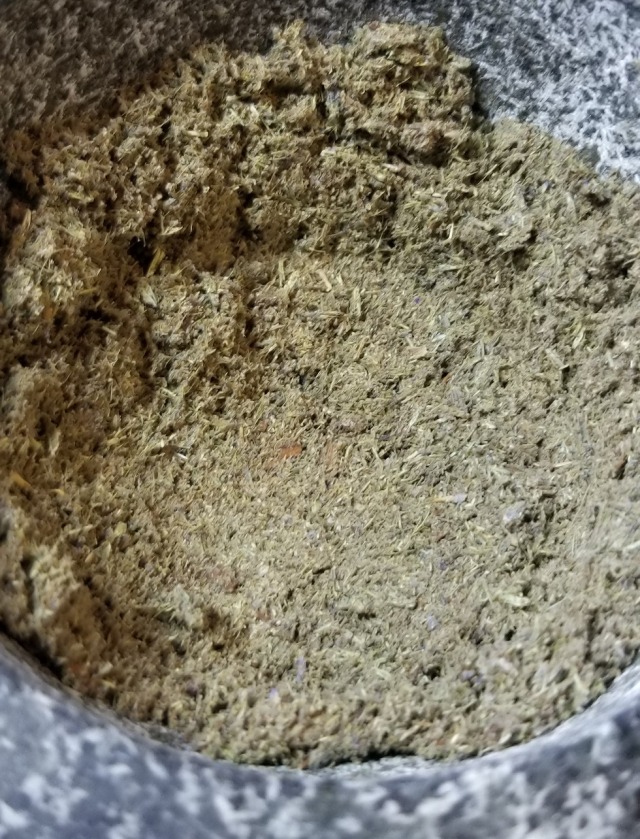
Fig.s 4 and 5. Grindy grindy. As a note, cloves require crunching with the pestle before you can really get a good grind on.
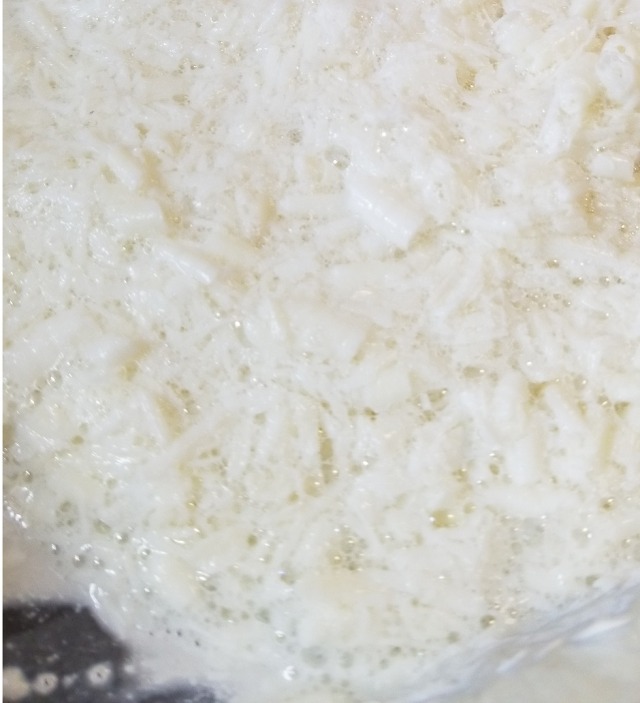

Fig.s 6 and 7. Dampen the dried soap with rosewater… oh god. That… that might be too much rosewater.
Hannah Woolley (1670) was the only writer to mention using your hands at any point while making these balls, but, uh, surely she wouldn’t lead me astray. Surely.

Fig. 8. Maybe adding the powdered lavender and cloves will help soak up the excess!

Fig. 9. JESUS CHRIST MY HAND HAS BEEN EATEN BY A GREEN THING.
Hannah Woolley, come outside, I just wanna talk.
Leaving aside my new life as a swamp gremlin, it should be noted that this and subsequent photographs makes it appear as if the mix was, perhaps, a very light green color.
Let me just say: No. I could, at my kindest, call it maybe a heathered green. But it would also not be inaccurate to call it a very, uh, herbal green.
So by this point in the proceedings, the very green mixture was both declining to get particularly dry and was also sticking like hell to my hands.
It was then, like a gift from my already-overburdened memory banks, that I remembered: cornstarch.

Fig. 10. Okay, not cornstarch. Sorry. It’s arrowroot powder again. IT’S WHAT I HAD NEARBY.
I… may have dumped in the arrowroot at least twice more. No photos, no proof, you’ll never catch me, coppers.
With the arrowroot worked in, though, I finally got enough oomph to start forming balls with the stuff. And, as if my grandmother rose from the grave to try and once again teach me how to make her special Easter cookies, I started rolling the soap in my palms to form the balls… and I suddenly remembered that trick where you flour your hands when you work with dough. To keep it from sticking to your skin.
I was a bit late off the mark, but I did manage to at least partially flour my hands with the arrowroot, and that helped considerably with actually making the ridiculous things. The large volume of cornstarch mentioned, but not explained, in any of my collected recipes was now justified.
(EX ARTE, EAT YOUR HEART OUT.)
Leaving us with:

Fig. 11. A goddamn lavender wash-ball.
I ended up making five-and-a-mini little wash-balls, which are technically too small overall, but whatever, this is still Experimentation Time. They are now, per various process notes in various recipes, drying again in a shaded location. For how long? Dunno. We’re gonna find out.
The outside, as you can see, was rough as hell (though, when I was rinsing the mix off my hands afterward, there was a pleasant abrasive quality to it), but some of the recipes suggest that maybe you’re supposed to smooth it out a little after it finishes drying with some rosewater. BUT. I am also considered whether this might be a use for: THE OIL OF LAVENDER. (Aw yiss, full circle.) It was an exciting prospect.
Anyway, I intended on checking on these wee balls in a few days and to see what was up. It would be an adventure.
So the stickiness and the green and the cornstarch thing– those were the “terrible discoveries” you made?
Hm? What?
From the alternate title of the update. The “terrible discovery,” all-caps, that you’re cursed with.
…
Look.
This keeps happening.
The last time I made a historical self-care extravagance, I thought it would smell like oranges. This time, I hoped it would smell like lavender.
And you know what I got instead, both damn times?
COOKIES.
——————————
LETTERS
From V, to the Editors, “having Strong Feelings”:
Some Future Scholar is going to find your household journal in an archive and clutch it to their chest (metaphorically, so as not to damage it) with profound love for That Weird Lady Back in the Bad Old Days
ALSO: look, I cannot for the life of me remember where I read it, so take me with an entire Lot’s wife of salt, BUT: I read a Whole Thing (very convincing) about how one of the main blind spots in modern medicine is the reluctance of epidemiologists/doctors everywhere to assign aerosol transmission to diseases, despite the cries of aerosol engineers, who have been screaming at doctors about it for many decades (see, e.g., the engineering paper that came out about the early Covid outbreak in the SKor restaurant with entirely clear figures showing obvious aerosol transmission in 2020, thanks for nothing WHO). Now, yes, on the part of the money guys, they want to make sure everything’s “droplet” and not “aerosol” because if transmission is “droplet” then, well, individual folks are responsible for our own droplets, aren’t we, so outbreaks are Our Fault, aren’t we all terrible, whereas if it’s IN THE AIR, it’s a structural issue that no individual can help, and the gubmint has to get involved, and some company somewhere might have to PAY A MONEY FOR SAFETY o no. (such as, e.g., the $1100 UV virus filter I have in my got dang house that could be everywhere IF ONLY). However, part of the resistance to the Very Idea of Aerosol is not just $$$ but also the stick doctors have up their asses about the Galenic humors and the idea that they might be GASP people who don’t actually know everything about a thing. It can’t be in the AIR, that would make it a MIASMA, and they are SCIENTISTS, they don’t hold with that old-fashioned hogwash!!!!
******
From the Editors, to V, “An Answer”:
Regarding miasma–
While we don’t know which article you might have read on the topic of certain pandemics and the establishment’s hesitance to label it as airborne, we found this site to contain a succinct summary of one– containing also the very useful phrase “belief perseverance”, which…
One of the biggest hangups we Editors have had to overcome in our pursuit of interesting historical recreations is the notion that the peoples of the past were somehow stupid, or silly, or intentionally ignorant or cruel. It’s easy to think such things if individual “cures” are looked at in isolation– the prevalence of medicinal cannibalism and the truly surprising number of enema recipes recorded for household use being only some of the examples we could list– but it is another thing entirely when one views these beliefs in the whole, as part of a greater theory of medicine based on syllogistic, deductive reasoning. There were, of course, charlatans– but there are charlatans in our current age as well. The majority, however, seem to have been trying their utmost to do what was right by their patients, using the tools and techniques at their disposal.
It took over a hundred years of diligent scientific effort to shift the needle from Galenic humoralism to empirical research, and pockets of it existed (and exist) far longer than even that. But modern people’s fear of being backwards, or “unscientific”, or (ha) “medieval” is one that leads to throwing out everything accomplished by those early scientists– even those things that, if not for the taint of humoral theory, might be reasonable to investigate further.
All this to say: While it is often the English majors who throw up their hands and decry the lack of Humanities in scientific education, the historians could make the same argument, and with gusto.
Regarding household journals–
One must wonder what they will make of the glitter-imbued highlighter.

Fig. 12. Experiment notes on a certain skin cream whose story has not yet been shared.
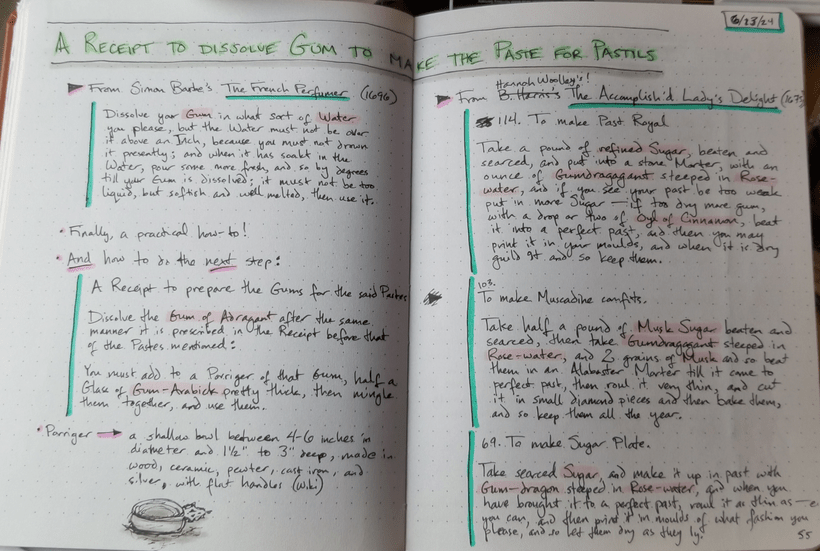
Fig. 13. Research into the process by which gum tragacanth can be turned into a mucilage,
and from a mucilage into something either reasonable to put in one’s mouth or wear about one’s person.

Fig. 14. General research into the meanings and equivalencies of unfamiliar terminology.
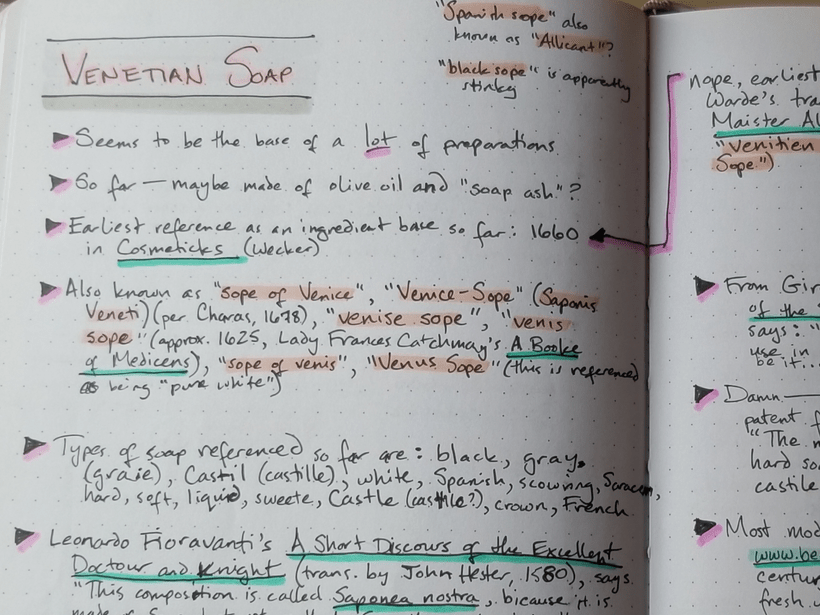
Fig. 15. Particular research into the particular ingredient popularly referred to as “Venetian Soap”.
——————————
COMMONPLACES
From George Thompson’s Galeno-pale, or, A Chymical Trial of the Galenists, that Their Dross in Physick May Be Discovered with the Grand Abuses and Disrepute They Have Brought Upon the Whole Art of Physick and Chirurgery (1665):
In the Botanicks, or knowledge of Plants, [Galen] hath instructed the World no more then Dioscorides his predecessour, whom he hath plainly transcribed in many places word for word, concealing the Author, sticking in the mire of the four Elements, their Mixture, Qualities, and Temperaments, neglecting the Virtus Cherionia, Crafts, and specifick properties of Simples. His followers have, and do even obstinately to this day, to the destruction of millions, cry up his method; a tedious way to cure Diseases, but a short one to get money.
******
The Great Preparations of Chymistry have this last Age so vainly and extravagantly prevailed on the minds of some men, and they have been so strangely enamoured, what with the Charming Curiosities of it, and what with the kind acceptation of Chymical Medicines to the difficult Palats of divers Patients, that they have wholly addicted themselves to the Preparations of this Art, and have beyond all reason undervalued all the good Preparations of Nature, or the Old Physicians, as if they were most Impure, Improper, and Ineffectual in themselves. It is very Natural to men in general, to value themselves more than is needful on the Particular Acquisitions of their own Industry, and what does likewise carry some Mystery along with it, that is not understood by every body. What is commonly known, is as commonly despised, let it deserve of us never so well.
******
From Moyse Charas’s The Royal Pharmacopœea, Galenical and Chymical According to the Practice of the Most Eminent and Learned Physitians of France (1678):
As to the extent of the matter of Medicament, it is easie to judge that the number of Preparations cannot but be very great. And so much the more, in regard the Chymical Pharmacy has very much augmented those, which the Galenists have for so long time together practis’d. Now in regard it is the design of this Work to comprehend both the one and the other Pharmacy, and that they have both need of the mutual assistance of each other, I thought it very much to the purpose to rank them both together, seeing they both aim at the same end, which is the Health of Mankind.
——————————
ANNOUNCEMENTS
You know, I think I will come up with some sort of Sunday Edition of a fashion.
I suspect it will contain Word Searches of some kind.
******
To the Gentle Readers supporting The Minor Hours: Erste, Sekund, Terzo, and Quartus, thank you for your continuing support!
******
If you would like to write a letter to be produced/answered in the magazine, please email me at minor.hours.magazine@gmail.com with the subject line:
Letter to the Magazine: [subject of letter as you would like to see it printed]
If you wish the letter to be anonymous or under a nom de plume, please state so in the body of the email; similarly, if you’d rather not be printed at all, please also state so in the body of the email. It will otherwise be assumed that mail sent to that address is intended for print.
Alternately, commenting on the Patreon post will get you a similar result, with much less fuss.
******
-Until next time, be safe.
Discover more from Katherine Crighton
Subscribe to get the latest posts sent to your email.
 Katherine Crighton