
This is going to be very quick, because I can’t tell it slowly.
Your Hand in Mine, We’ll Be All Right
So this is an old reading (previously talked about here) of “Your Hand in Mine, We’ll Be All Right,” originally done for Flash Fiction Online‘s 10-year anniversary, that I noticed was down for the count. I figured why waste a perfectly good reading, though, so I reuploaded it, added captions, etc. etc.
When I’d gotten the opportunity to do the reading, I’d had a choice– do it sitting at my desk, best writerly setup in the background (big bookcase of hefty genre tomes, my own contributions suspiciously in eyeline, all that vlogger chicanery), and an emphatic, but still narrator-ish, tone… or I could do what I did, and actually perform it.
I didn’t have a lot of time, and you can see that I was basically using whatever setup I had on hand, but I think it holds up. It’s a body-horror story written in first-person, so it’s ripe for creepy theatrics , unsettling eye contact, and tension-filled pauses– which also, uh, conveniently cover me scrolling down on my laptop screen to get to the next page of text, because there are many reasons I didn’t go into acting, and “memory lol” is definitely high on that list.
I think giving a performance gave it a little extra oomph, though, so for others who want to follow in my footsteps (or want to improve on it), here are some quick tips and resources:
Poor-Man’s Teleprompter
I used my laptop and opened it up to a Word doc of my story. The doc didn’t match my original story, because fiction is largely a visual medium– by which I mean, part of what I think about when I write is how the words, punctuation, and white space looks on the page. Since this was a video performance, though, I instead broke up the text by pauses and emphasis rather than by layout and written grammar. (Insert here rather a lot of talk about the history of punctuation, the invention of silent reading, and the past lives of the paragraph.)
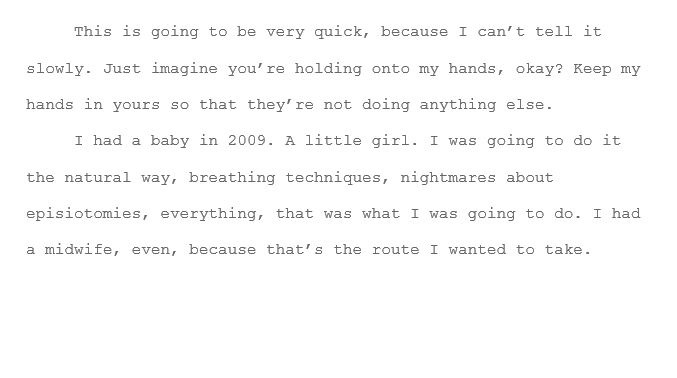
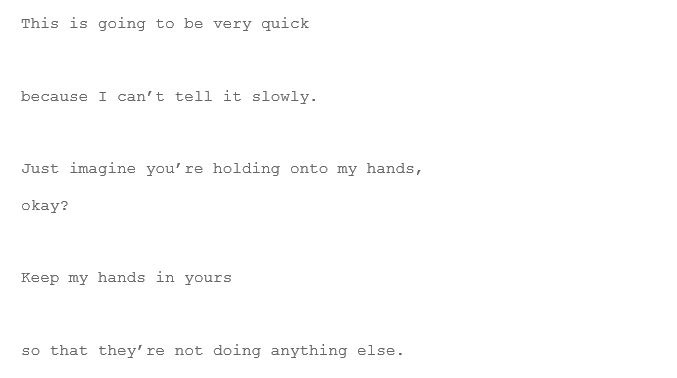
Then I propped that open and used the down arrow to scroll, though I imagine using the “Page Down” button would’ve been more useful (or even fancier devices, none of which I had immediate access to, oh well).
Location
The story eventually reveals that it’s being told in the kitchen of the main character as they’re preparing lunch. To provide some extra verisimilitude for myself and the audience, I filmed myself in my own kitchen– which provides what’s called in game design theory ludonarrative consonance, which is when players can “actually feel the themes of the game being expressed through mechanics” (i.e., the mechanics of the game match the narrative of a game, leveraging the two to provide greater meaning/immersion/etc. for the player). It’s actually a child-term of the original ludonarrative dissonance, defined in 2007 by Clint Hocking to describe the mismatch between the themes/narrative of the game BioShock, but both are terms that I think need to be talked about more often in fiction writing.
So: If I recorded myself in front of my very very writerly bookcase, there’s a dissonance there for the audience– they spend the majority of the story assuming I’m in a living room, but when I say I’m making lunch (and then reveal a knife), there’s the slightest opening for the audience to lose their concentration on the tension of the story as their brain quickly tries to reconcile their previous assumption with their new knowledge. It’s in that pause that the audience might lose their suspension of disbelief, and it’s the last thing I want.
On the other hand, though, when I say I’m making lunch, some of the room behind me starts to make sense– the camera is under the overhang of cabinets, there’s a smoke alarm on the ceiling, some of my spice rack is even visible on occasion. When I say I can see my kid playing in the backyard, there’s a window behind me that I turn to glance out of. It makes sense, and the audience can have their understanding of what they’re listening to (a story told in a kitchen) and what they’re watching (a person standing in a kitchen) confirmed, validated, and strengthened.
Is this possible all the time? Maybe not. Surprisingly few of us have starships on hand, for instance. (Though Chris Hadfield saw an opportunity and ran with it.) But you could consider artificial backgrounds, or even just recording yourself in a darkened space like a cleared-out closet draped with black curtains, thereby creating the same “behind the eyes” darkness that allows us to imagine a narrative in the first place. Sometimes the best you can do is neutral. The key, though, is to avoid that outright dissonance.
Lighting, Setup, and Sound
This I will freely admit is my weakest point. But fortunately, there are a lot of people who give good info on this; the vloggers and YouTubers are busily teaching one another from the ground up, so you could do worse than looking around to see what how-tos are available.
In particular, when late-night hosts started filming from home during lockdown, mathematician and comedian Matt Parker put together a set of fast tips to instantly improve a home-vlogging setup, and I think it’s a fantastically useful guide.
Performing for an Audience
I will not be any means say I’m actually good at this. But you know who’s great at it? SFF author and previous President of the Science Fiction & Fantasy Writers Association, Mary Robinette Kowal, who has a fabulous essay and thorough essay on the topic on SFWA’s site: “Reading Aloud.” Absolutely read that– it’s fantastic.
What few things I’ve learned over the years, though, amount to the following:
- One page of prose equals about one minute when I’m just giving a professional reading at a conference or similar. If it’s a dialogue-heavy page, it’ll go faster, but it’s a pretty good way to estimate my time commitment for an entire piece. Either way, though, I always have to talk more slowly than feels natural.
- That time estimate goes out the window when I’m performing because the words aren’t the only way I’m communicating. Body language, pauses, eye contact, hand movement, prop-work– that all takes time, and I always have to remember to give myself permission to take that time.
- When I flub (and if I can edit, rather than recording all in one take), I try and remember to leave a big pause and then restart the line from the beginning, rather than trying to start at the exact word I messed up. It makes editing considerably easier.
- I always try to add ludonarrative consonance, and one of my tools is to use a hefty dose of method acting. So I didn’t just imply a kitchen in my background– I literally recorded in my kitchen and stood where I would be making lunch. I hunched forward and close to the camera when I was telling something shameful; I leaned back and opened my stance when I was pretending everything was fine; I pressed my hand up against the muscle of my cheek when I described the memory of pressing into flesh; I held a knife in my hands as I told the audience that they were the ones responsible for keeping me from doing anything with it. Adding these small touches gave me some bonus points and hopefully helped make up for the poor camera quality, verbal flubs, and, let’s be honest, very dissonant element of my idiot cat occasionally meowing for my attention in the background.
- …unless of course you’ve seen Ghostwatch, in which case, congratulations, you get to have unintended narrative parallels! Hooray!
Another Writing Tool in Your Toolbox
Even if you never intend to read for an audience or put up a video performance, recording yourself reading (or, as I’ve heard folks at Viable Paradise recommend, going forth and yelling your story at the ocean) is a powerful way to take yourself out of your own head and hear your story like your audience will.
As you read, check to see where you trip up. What combinations of words or phrases twist your tongue too much. How big a breath it takes to read through a long sentence, and whether you run out of air partway through (and if that’s intentional… are you gasping between two words that justify, and benefit from, that extra, drawn-in breath?). Mark these moments on your pages, and go back to them later when you’re working on your revisions.
If nothing else, it’s remarkable how much stronger your work will be once you’ve listened to it as the Audience, rather than reading it as the Author.
Discover more from Katherine Crighton
Subscribe to get the latest posts sent to your email.
 Katherine Crighton