——————————
SOME EDITORIAL NOTES
It’s an odd time of year, gentle readers, and an odd mood I find myself in. While the calendar in no way suggests it, the air seems set for turning from one year to the next– a book closing, another opening. I feel like I’m reviewing the reference list of last year, paging through the index to see what, after all, warranted a listing.
It is August, and I am approaching a door whose lintel bears the words laborem et dolorem. Or, no, that’s mixing metaphors– it’s a book that I’m approaching, waiting on the shelf for me to switch it out with the one I’ve been diligently reading for the last year. On the cover is a door whose lintel bears the words dum vita est, spes est. The door is an open one, and on the other side: an indistinct and distant figure, holding up a lamp.
It’s sad to let go of the last year. There’s a kind of love that comes from surviving everything that came my way — love of self, love for that which is lost, love for that which might never be (but was, nevertheless, envisioned). Letting go of the year — putting down this book — feels like losing that odd love too.
It doesn’t much matter that I know I’ll love again. It won’t be this year’s love. I can see it now, understand the feeling, but I’ve only really encompassed it in these moments leading to its loss. Like, I suppose, it’s meant to be– but it’s still strange to have it now, in August, and it’s strange to feel it so acutely, and I don’t know how much of these notes I’ll keep come morning, but for the moment:
Here is one foot on the side of this turning year, and here is one foot on the other, and here is me, caught centered between the two, under a lintel that bears the words aut inveniam viam aut faciam. I suppose the following articles will reflect the same.
——————————
ELEMENTS OF A STILL-ROOM
In the last few months I have, astonishingly, fallen to the siren call of bullet journalling.
For those unaware, a bullet journal is essentially a dot-grid journal, like so:
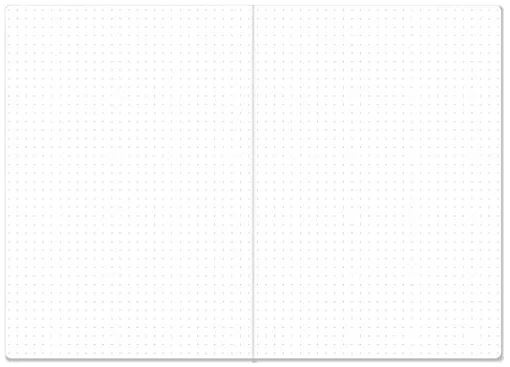
Fig. 1. An open, blank journal printed entirely with a grid composed of dots.
It is a formless void of possibility and potential horror.
Bullet journalling, the method of personal organization intended to be developed outside the bounds of pre-printed organizers and to the benefit and use of the individual, is notably different from bullet journalling, the social media-driven artistic style and justification for stationery porn ostensibly for the use of organizing one’s personal journal.
Like any stationery nerd who desperately needs to become better organized but fails when confronted with what “normal” persons seem to think is the best method to organize one’s thoughts, I was very intrigued by bullet journalling when I saw it running through the socials, but attempting the artistic style was entirely too overwhelming — my attempt at the method was stymied by the need for perfection I assumed was a necessary part of the process.
It was only this year that I returned to it again, partially because I was seeking out advice to help my oldest child incorporate doodling into their note-taking and partially because I found myself with Rather a Lot of Thoughts to Organize, and in doing research I came across a video by youtube user studyquill, called “what I learned from 5 years of bullet journaling (and why i’m quitting)“. Her discussion was enormously helpful, and led me to actually start my first journal.
As it turns out, provided I don’t worry overmuch about any performative nonsense, it is intensely useful for me to be able to collect my research about various things in locations outside my own head. I have so far accumulated about five or so different journals on different topics, including home ownership, art and art projects, household recipes and methodology, financial management, and so on. My primary tools are Sharpie pens on inexpensive journals found on sale from big-box craft stores — but I also have a small ridiculous pen case filled with highlighters and such, because there is performative for others, and then there’s performative for myself, and I am perfectly happy to indulge in one while decrying the other.
As can be expected, there’s a huge overlap in topics and interests, and sometimes the same sort of item can come up across multiple journals. At the moment, the household recipes journal (which we shall call “Queenie” for the duration) is possessed of several series’ of notes regarding Regency-era style still-rooms. Keen readers may recall my previous experiments in housewitchery — I have only gotten more outrageous with them, and they are the sorts of things that are best suited to creating in a dedicated space that is no longer quite common but is nonetheless something I deeply wish to possess.
Then there’s my home ownership journal (which we will call “Reginald,” because I think that’s funny) — it exists to catalogue the large amount of information and research and preferences and thoughts related to finding, buying, and making a home in our modern era. While Queenie may have the research, Reginald has the wishlist: fixtures, equipment, supplies, storage needs, glassware, safety measures, &c. It is easier, I find, to daydream if I do so with some amount of accuracy.
While Queenie and Reginald are quite tied together in this matter, the art and art projects journal is a bit more obscure in its relationship. It actually possesses a name already: “Historically Inaccurate,” which is also the name of my Vast Publishing and Artistic Shenanigan Empire. Historically Inaccurate has within it any number of projects, most of which are small tangible bits and bobs for the purposes of art sales and whatnot. It is, in many ways, a useful outlet for the parts of me that aren’t easily assuaged by the pen and keyboard, not to mention the parts of me that still long to run an esoteric shop slash performance art piece. (Cf. daydreams, gentle reader.)
At any rate: Most recently, Historically Inaccurate has been delicately inundated with project ideas for, ahem, historically accurate cosmetics, floral waters, balms, salves, and other items of self-care easily achievable within a modern kitchen provided one doesn’t mind carefully researching replacements for all the poisonous ingredients.
It is, I think, the next step to my overall bogwitch evolution — but it highlights what things I want to do, what things I could achieve, if I had not only the inclination but the real wherewithal as well.
It is a pleasant thing to dream about (and in my dreams, I plan.)
——————————
COMMONPLACES (REGARDING GRIEF)
From Mary Ruefle’s “Twenty-Two Short Lectures” in Bat City Review:
Short Lecture on Translation
I asked my friend the translator, What was the first known act of translation in the history of mankind? His answer was, Probably something into or out of Egyptian. I thought about this for a while and ventured a certainty: No, I said, it was when a mother heard her baby babble or cry, and had to decide in an instant what it meant.
******
From Sadeq Rahimi’s The Hauntology of Everyday Life:
What haunts is not that which is gone, it is that which was expected to come but whose condition of arrival has been foreclosed, and the ghost is an advocate of the promised future that was unrightfully canceled when the past was destroyed.
******
From Gregory Orr’s Orpheus & Eurydice: A Lyric Sequence:
To guide someone
through the hall of hell
is not the same as love.
——————————
LOCAL WANDERINGS
In the past week I took my youngest child to the White Mountain area of New Hampshire, visiting penny-candy shops, introducing her to the sacred Wolfman experience, and casually getting stranded in a receptionless area as my car’s alternator decided that life was too short to remain a functioning part of my daily conveyance.
But in and around that excitement, there was certainly beauty.

Fig. 2. Through the White Mountains, where the clouds are near and waiting.
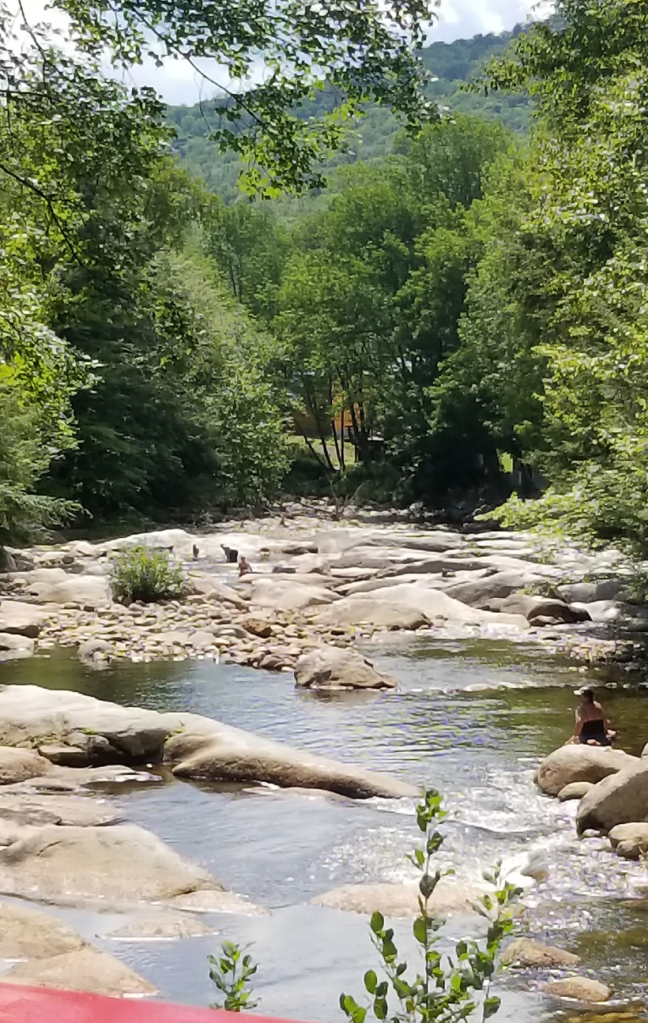
Fig. 3. A portion of the Pemigewasset, stones smooth and waiting like a child’s fantasy
of what playing in a river should be.
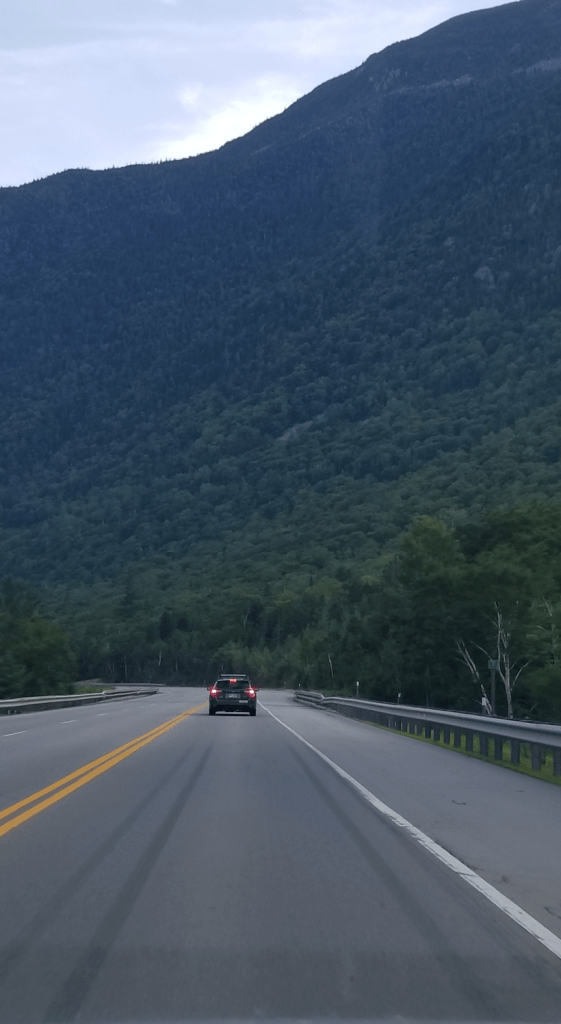
Fig. 4. Self-portrait.
——————————
COMMONPLACES (REGARDING LOVE)
From Louise Glück’s “Sunrise“:
And if you missed a day, there was always the next,
and if you missed a year, it didn’t matter,
the hills weren’t going anywhere,
the thyme and rosemary kept coming back,
the sun kept rising, the bushes kept bearing fruit–
******
From coffeepeople:
How wild is it that every version of you probably exists still, somewhere, in someone’s memory? The messy you, crying on the floor exists still in your mind. The happy, sun-soaked you, exists in your best friend’s memory. No part of you has died, all parts of us exist always, simultaneously and hidden.
******
From viridianmasquerade:
I make my ramen the way a friend taught me in eleventh grade. Every fall, I listen to a playlist made for me by a boy I drove across a border to hook up with. I eat sushi because a girl who won’t talk to me anymore made me try it, and Indian food because my best friend’s parents ordered for me before I knew what I liked. There are movies I love because someone I loved loved them first. I am a mosaic of everyone I’ve ever loved, even for a heartbeat.
——————————
A DIALOGUE
The Editors: …Milton’s description sounds just like New Hampshire: “O’er many a frozen, many a fiery alp / Rocks, caves, lakes, fens, bogs, dens”– oh, and monsters, obviously.
Daughter: Fairies; moose; Mt. Washington.
——————————
LETTERS
From “A Correspondent,” to the Magazine, “Postcards from the Edge of Beyond”:
Concerning the Postcard to Mrs. Mary Belden [Issue 3, “Small Ways” – Eds.], as I’m sure you’ve long-since recognized, the line in the address immediately following “Sharon,” is the old pre-ZIP abbreviation for Connecticut, viz. “Conn” (rendered in cursive with a rather more florid capital-C than Palmer Method usually employs).
******
From the Magazine, to the Correspondent, “A response”:
The Editors had not yet, in fact, recognized the abbreviation “Conn”, and were still in the throws of believing the line to be an ill-rendered number or word.
It’s easy to realize, after the fact, that time has changed that which is easily recognizable to that which is not. There are always a select few who either remember things as they were, or choose to keep the information alive in hope of some distant use– though that seems, sometimes, as if these people are depending their future fortunes on a world that will still contain enough recognizable edges that the crowbar of Knowledge might be applied until the cask opens and Comprehension is revealed.
We worry, sometimes, that this will not be the case. The golden records sent out on Voyager 1 and 2 come to mind.
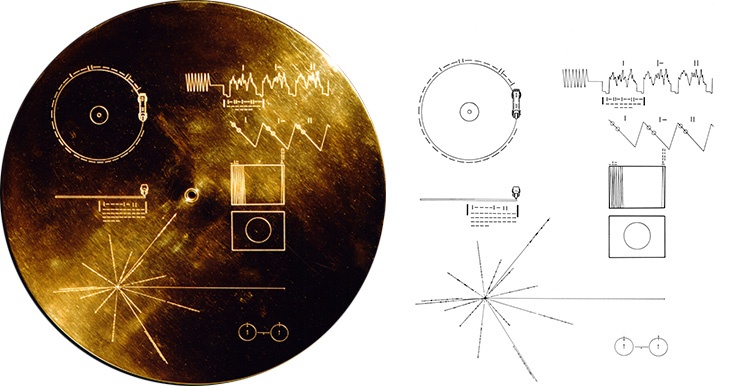
Fig. 5. “The Golden Record cover shown with its extraterrestrial instructions.
Credit: NASA/JPL”; or: a message, known and unknown. Waiting.
We say this, knowing fully well that it speaks poorly as to our education and general cleverness, but: For all that the record has dozens of clues and instructions intended to provide assistance to whoever might find it, whenever that might be, in whatever form they might take and whatever level of technology they might have…
It is beautiful — but incomprehensible — to the Editors.
With the explanation provided by NASA, the levels of information and the sheer hope and love put into the project are clear– but in some distant place, some future time, what will survive of it? What makes this record the easiest way to communicate a people and a time, that makes it different from the Voynich manuscript or Linear A?
Maybe the makers explain their thinking somewhere; we have not checked, much the way someone cracking open one of the Voyagers and finding these rendered objects can’t/couldn’t/won’t/willn’t. We can only assume, then, that for all its cleverness, for all the information packed within it to allow some peoples the ability to open door after door into who we once were, and why we wanted so strongly to share who we were and who we might be outside the confines of our small world–
They are just postcards. Messages to someone else, with depths of meaning that may never be known (though some with specialized knowledge might, perhaps, glean glimpses here and there). But they were important enough to send out. And as with Mrs. Barnum to Mrs. Belden, for those who find these records perhaps the most important message will be: “These were people, once. And there was feeling, there.”
——————————
COMMONPLACES (REGARDING HOPE)
From fiovske:
a ship loves an anchor the same way a hearth loves a fire
with enough passion to make it a home
******
From lyricwritesprose, paraphrasing Fred Clark’s post “L.B.: The Rise of the Anti-Huck“:
I used to read a blogger who insisted that “All right, I’ll go to Hell,” from Huckleberry Finn is the most pure and perfect prayer in the canon of American literature. Meaning, as I understand it, that the decision to do the right thing in the face of eternal damnation is the most holy decision one can make, and if God Himself is not proud of the poor mixed-up kid, then God Himself is not worth much more than a “Get thee behind me,” and the rest of us should be lining up to go to Hell too.
******
From swampmaiden:
you see a tiny sign planted in the ground. bending down to read, you just make out, in impossibly tiny script “a mundane clump of dirt; much beloved by god, like any other”
——————————
ANNOUNCEMENTS
What will the new year (that is not a new year, that exists for no one but myself and the season turning) bring? I don’t know. The living room is dark, and the lamplight insufficient. A character on a television show once said
“What is grief, but love persevering?”
An actor on a chat show said that
grief is unexpressed love.
One of the first pieces of poetry I ever found on my own, and loved in an instant, said
An angel with no face embraced me
and whispered through my whole body:
“Don’t be ashamed of being human, be proud!
Inside you vault opens behind vault endlessly.
You will never be complete, that’s how it’s meant to be.”
But I’m realizing: What it means to be halfway through the door to tomorrow is that I can no longer see what the lintel reads. And maybe that’s for the best; Latin was never my subject anyway.
******
If you would like to write a letter to be produced/answered in the magazine, please email me at minor.hours.magazine@gmail.com with the subject line:
Letter to the Magazine: [subject of letter as you would like to see it printed]
If you wish the letter to be anonymous or under a nom de plume, please state so in the body of the email; similarly, if you’d rather not be printed at all, please also state so in the body of the email. It will otherwise be assumed that mail sent to that address is intended for print.
Alternately, commenting on this post will get you a similar result, with much less fuss.
******
-Until next week, be safe.
Discover more from Katherine Crighton
Subscribe to get the latest posts sent to your email.

