
——————————
SOME EDITORIAL NOTES
I am returned from my vacation — slightly refreshed, but with the curious weight of reentering the normal world (for various definitions of “normal”).
For the first time, this is proving a little hard to write. I’m not sure why. The break in routine? Perhaps. Or perhaps I’m just caught up in my own tangles again.
Probably my best avenue is to just continue as I have previously: write what I want to write, don’t write what I don’t, and generally enjoy myself as much as possible.
——————————
LOCAL WANDERINGS
My vacation took me to Cape Ann, and the small, touristy town of Essex. It hasn’t reached that strange sort of commercialized bucolicness that some New England towns strive for, though it is assuredly trying its damnedest to cater to outsiders.
I stayed in the Shea’s Riverside Inn and Motel, beside the Essex River. The road to my left had antique store after antique store, some of them the fun sort that invite you to dive in and get lost, the majority of them the very fancy, overpriced kind that feel like a funeral home for furniture. The road to my right had, within a fifteen minute walk, a creamery, a brewery, several seafood restaurants, and a small shipbuilding museum. And, this being Massachusetts, right across the street there was, of course, a Dunkin’ Donuts.
Had I walked further, and the world been a different place, I could have taken a half-hour long boat ride on the Essex. Boating in general seems to be a popular past-time there — farther up the river, I could see boat after boat moored on slips, and even Shea’s had a small, branching pier with several small boats tied to it. The town used to be part of the shipbuilding trade, and to some degree you can see the marks of that in both the boating culture and the old Cape Cod houses that dot the busy road. Those houses are lovely to walk past, but they seem built oddly close to the modern road — in sharp contrast to newer imitations that make sure to be set well back, so as to avoid noise and invite passersby to admire wide and useless front lawns.
Of particular interest to me is that the Essex is a tidal river, something that I had never seen before. The ocean tide is an amazing thing, but with a tidal river, I could see both sides at once — it made for dramatic and lovely changes through the day. When the tide was in, the salt marshes on the opposite shore appeared to be a short grass carpet, something that would perhaps reach the ankle if you walked along it. When the tide was out, the truth was revealed: the marsh grasses were several feet tall, and the tide revealed a wide, damp beach that went on for more than a body’s length before it hit water. A rock that I had clocked as a nice spot to read when I arrived at the motel was later completely submerged and invisible. And boats that had seemed to float easily when the tide was in were landlocked when the tide went out.
I spent my too-few days there sitting in my room, the chair pushed up to the window, listening to soft music and reading romance novels. The air smelled very faintly of the sea, cooking seafood, and, later, rain. It was an ideal place to sit and do nothing very much, and I would very much like to go again.
——————————
A DIALOGUE (OVERHEARD)
First lady: So I said, you can’t dock here. And he sails off. But then I come down ten minutes later and there his boat is, docked.
Second lady: No.
FL: So I call Dan, and I tell him that somebody who doesn’t belong here is docked, and what’s he gonna do about it. And he tells me that he can’t do anything.
SL: What.
FL: So I said, well, would you have to do something if there was a boat in the middle of the river? Yeah, he says. Great, I said, because in ten minutes there’s gonna be.
——————————
TWO VIEWS
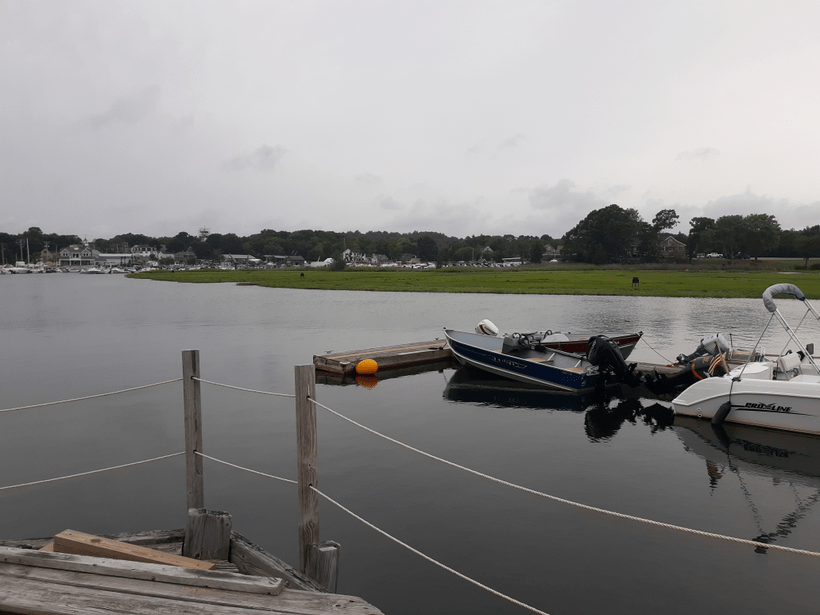
The high tide, on a stormy day. Note the salt marshes across the river.

And here is low tide, at sunset. A sudden beach on either side, and tall grasses.
——————————
ARTS AND CULTURE
I don’t consider myself someone who enjoys modern classical compositions. However, I came across the work of Italian composer Ludovico Einaudi a year or two ago in someone’s playlist, and, as my Spotify account would testify, I am now a full-fledged fan.
Einaudi primarily does piano compositions, though strings are a frequent guest. I find that they are both calming and possess the particular arrangements that pluck at my subconscious, telling small, intense stories that may or not resolve happily, but are always… right. Before my vacation, I would turn on his music if I wanted to set a typing pace for myself, but didn’t want to be distracted by lyrics or, conversely, have something so boring as to be little more than background buzz. I can write to Einaudi’s music, and in turn it’s present enough to affect me if I’m at a lull, uncertain where to go next. I listen to a measure, and it somehow reminds me of the feelings I forgot I wanted to set to paper.
During my vacation, however, I found myself wanting to have the comfort of music without the… pressure? Of a driving, pulsing beat, of intricate lyrics, of stories that begin and end with hard starts and stops. I wanted something like the river — easing in and out, a story that doesn’t stop, that could carry me softly from one moment to the next. I remember playing Einaudi’s music, laying on the wide white bed, the air conditioner on high, the sunset coming through the blinds, and my eyes heavy. I slept, and I woke, one moment breathing into the next, and it was restful, and it felt like peace.
My entry point was the piece “Primavera” — it’s the story of a spring storm, my favorite kind. If you want to know what rain feel like for me, try this. And if you want to know what my vacation felt like, you could try the rest of his music too.
——————————
MEDITATIONS BY A RIVER SIDE
On one of my walks, I stopped and sat by the river. I didn’t pull out my phone. I didn’t open a book. I didn’t put in my headphones. I didn’t perform athletic feats of yoga positioning. I sat, and I watched the river. I don’t know for how long — my internal clock suggested about fifteen minutes, but I didn’t check.
I don’t have very much practice in the art of meditation, but I know enough to sometimes reach that very quiet moment of equilibrium. Where there is no internal voice, and the anxiety that comes from silence is, briefly, lifted. I sat by the river, and I watched it, and I stayed until the moment came when I left again. For those few minutes, I let myself be still.
——————————
LETTERS
From the Spotify, to the Magazine, “We Have More Than Just One Station”:
We here are Spotify thank you for your subscription. In the course of regular auditing, we had cause to notice that you pay several whole dollars a month for a service that, so far as we can tell, you only use to listen to the same six or so songs. We don’t typically encourage people to just go out and buy CDs, but maybe this is something you wanna invest in? Otherwise, please consider listening to literally anything else whatsoever, since it’s getting boring over here and we like our algorithms to have something to work with.
******
From the Magazine, to Spotify, “Your Criticisms Are Noted”:
The Editors are in receipt of your letter, and will give your suggestion all the consideration it warrants. In the meantime, kindly fuck off to the moon.
******
From the Magazine, to the Town of Essex, “Clams”:
Why does anyone like eating bivalves? This was a mystery before we went to your town, and it continues to be one. We await a response.
——————————
COMMONPLACES
From Edward Gorey’s L’heure Bleue:
I thought it was going to be different;
It turned out to be (,) just the same.
******
From Dylan Moran’s Yeah, Yeah:
This is from my granny. She was a beautiful, spiritual person. She always used to say, “Doesn’t matter how big the fucker is. They all have a neck.” Another thing she used to say was, “Never get involved with more than 11 people sexually at one time. You cannot keep everybody happy. Work on the farm deteriorates almost immediately. Don’t do that.”
——————————
ANNOUNCEMENTS
Well, having reached the end, I can say that it was not, after all, as hard as I imagined. And, once again, I’m reminded that concentrating on what is good, rather than on Everything Else, is actually a pretty nice way to spend an hour or so.
******
If you would like to write a letter to be produced/answered in the magazine, please email me at minor.hours.magazine@gmail.com with the subject line:
Letter to the Magazine: [subject of letter as you would like to see it printed]
If you wish the letter to be anonymous or under a nom de plume, please state so in the body of the email; similarly, if you’d rather not be printed at all, please also state so in the body of the email. It will otherwise be assumed that mail sent to that address is intended for print.
******
-Until next week, be safe.
Discover more from Katherine Crighton
Subscribe to get the latest posts sent to your email.
 Katherine Crighton
Leave a Reply