——————————
SOME EDITORIAL NOTES
It’s difficult for me to find focus when I’m in my own home — I’m used to going out and locking myself into various locations until I’ve completed the work that needs doing. I wouldn’t say that my writing is suffering, precisely, but it’s more difficult than I’d like to get to a moment of mental equilibrium that allows the inner voice to whisper words.
As such, I’m a little surprised by how easy this magazine is for me to write. This is the first issue of August, but I’m writing it in July, weeks ahead of time. The words are just there. I don’t know exactly why, but I think it’s because I’m devoting my work in this one spot to just whatever I feel like writing — not subject to the whims of gatekeepers, or to the widening maw of Real Issues, or even to you, Gentle Readers.
I write what makes me happy to write. I concentrate on that. And somehow, it’s working.
——————————
A USEFUL RECIPE
One of the hobbies I wish to cultivate is recreating historical recipes. It’s been on my list of things to do for ages, ever since I was a teenager. In high school one of the English teacher’s ran a school-wide variant on a Renaissance faire — and because no one was particularly paying attention to my antics, I decided to go as a witch, wearing my mother’s old SCA surcote and stashing hand-calligraphed recipes up my sleeves to hand to people who asked for my help. (I was under-appreciated in my time.)
While most of the “recipes” I wrote down were essentially herbal folklore I found on pagan websites, I did find one real recipe — for mead. Which I thought was incredibly funny to hand out to those who I didn’t think would narc on me, though I do not recall who exactly that ended up being. The actual citation is lost to the annals of time and my childhood bedroom, but the vague urge to actual follow these ancient instructions someday stayed with me, only heightened by my subsequent discoveries over the years of St. Hildegard von Bingen’s “Happiness Cookies”, the website of Medieval Cookery, and Samuel and Sarah Adams’s 1825 work The Complete Servant.
I am by no means alone in this urge to recreate historical recipes. I am a rampant retweeter of various bread adventurers who use ancient (probably cross-contaminated) yeast to do test bakes, and yesterday, while attempting to find a video to explain how one slices an avocado, I found Max Millers’s YouTube series Tasting History. Specifically, I found his recreation of Hannah Glasse’s everlasting syllabub, from her 1747 cookbook The Art of Cookery Made Plain and Easy, and the idea of this hobby was again reignited.
To make everlasting syllabubs.
[Note: In the following, the “long s” has been transposed throughout with a more modern “single s” for the sake of readability, and the second half of the recipe, pertaining to calf’s foot jelly, has been transposed with a calming lake for the sake of baby cows.]
TAKE five half pints of thick cream, half a pint of Rhenish, half a pint of sack and the juice of two large Seville oranges; grate in just the yellow rhind of three lemons, and a pound of double-reined sugar well beat and sifted; mix all together with a spoonful of orange-flower water; beat it well together with a wisk half an hour, then with a spoon fill your glasses. These will keep above a week, and is better made the day before. The best way to whip syllabub is, have a fine chocolate mill, which you must keep on purpose, and a large deep bowl to mill them in. It is both quicker done, and the froth stronger. For the thin that is left at the bottom, have ready some–

——————————
HISTORICAL EPHEMERA
While I don’t speak of my more professional writing here, I should say that one of my stranger goals is to write a semi-nonfiction book called THE COMPLETELY USELESS COOKBOOK.
I am not a particular reader of cookbooks, and I am not a particularly talented cook, but I have an extreme fondness for reading through very old cookbooks that have been rendered almost incomprehensible to modern persons whose sole understanding of cookery comes from overly long blog posts, mid-afternoon HGTV, and hazy childhood memories of double boilers.
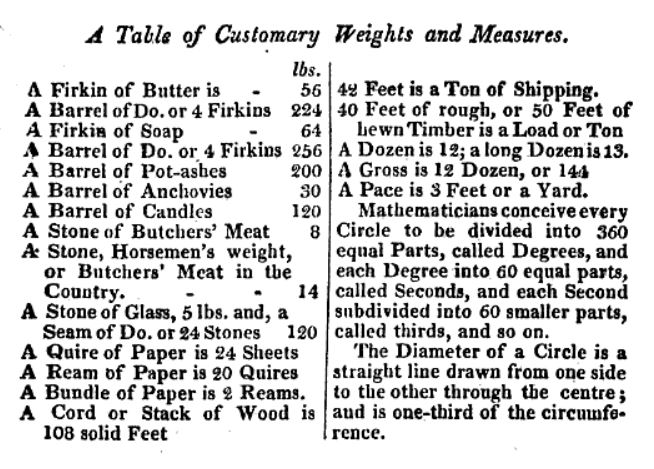
Should I ever actually write it, my book will be a tangle of real information, things that sound real but aren’t, and things that sound neither real nor particularly safe. An example of such very real things can be found in The Complete Servant, which teaches very important customary weights and measure, such as firkins and quires and the three very different things that can be measured in stones:
——————————
FURTHER EPHEMERA
As I was looking up links to Hannah Glasse’s cookbook this evening, I ran across Fredrick Accum’s A Treatise on Adulteration of Food and Culinary Poisons, an 1820 book whose title goes on for considerably longer than I have quoted here. It has what I now consider to be the gold-standard cover art for all publications related to food safety:

——————————
LETTERS
From the Magazine, to the Federal Department of Agriculture, “A Humble Request”:
Print “there is death in the pot” above a poisonous spider and snake motif on all your pamphlets, you cowards.
******
From the Magazine, to Itself, “Language”:
We agree, it is very fun and linguistically satisfying to come up with “neither/nor” sentence constructions. Nevertheless, the Editors must ask that we keep it to a maximum of one use per issue, else we may see our puddings removed until we learn better.
******
From the Magazine, to the Neighbors, “Unnecessary”:
The number of reasons to knock at the Editors’ door, in the middle of the day, unexpectedly, is not zero, but functionally may be considered as such.
——————————
COMMONPLACES
From Jonah Lehrer’s “Magic and the Brain: Teller Reveals the Neuroscience of Illusion“:
“This is what makes magic so difficult: The magician must sell people a lie even as they know they’re being lied to. Unless the illusion feels more real than the truth, there is no magic.”
******
From Machiavelli’s The Prince:
“God is not willing to do everything, and thus take away our free will and that share of glory which belongs to us.”
——————————
ANNOUNCEMENTS
I intend to go on vacation next week, which won’t mean much for you Gentle Readers yet, but I suspect that the next issue will be curiously themed around rivers, relaxation, and the curious liminality of hotel rooms. I don’t intend for there to be themes to these, but I’m not particularly inclined to fight it, either.
******
If you would like to write a letter to be produced/answered in the magazine, please email me at minor.hours.magazine@gmail.com with the subject line:
Letter to the Magazine: [subject of letter as you would like to see it printed]
If you wish the letter to be anonymous or under a nom de plume, please state so in the body of the email; similarly, if you’d rather not be printed at all, please also state so in the body of the email. It will otherwise be assumed that mail sent to that address is intended for print.
******
-Until next week, be safe.
Discover more from Katherine Crighton
Subscribe to get the latest posts sent to your email.
 Katherine Crighton